
Supporting Claims with Evidence: 5 Strategies to Help Students Choose Strong Evidence
Sometimes, the problem with student writing isn’t what we think.
Take the year we asked students to write a paragraph about the theme of Disney Pixar’s Up. Nearly every student used some version of “Adventure is out there” as their claim, supporting evidence, commentary, and yes, even their concluding sentence.
We assumed the problem was commentary. After all, the theme was plausible, and the movie’s refrain technically counts as evidence. So we worked on analysis (including an overhaul of what became our 5C paragraph structure) before realizing the root problem was students’ choice of evidence.
Supporting claims with evidence is deceptively simple. Most students can find evidence that relates to their claim. Years of test prep have trained them to pick the answer that most closely matches it. But in writing, the most literal evidence usually just repeats the claim, leaving students nothing to explain. No one needs help seeing how “Adventure is out there” supports the theme “Adventure is out there.”
Once we focused on helping students choose strong supporting evidence, their commentary improved too. We honed these strategies with standard-level 10th graders and have since used them with middle schoolers, freshman honors students, and AP Literature seniors. Below, we’ll break down what makes supporting evidence strong and share our five best strategies for teaching students to choose it.
What is Supporting Evidence?
Supporting evidence consists of the specific facts, examples, details, or quotations a writer uses to prove a claim. Strong supporting evidence shows the reader why the claim is true; weak evidence simply restates, or tells, the point, leaving the writer nothing to explain.
Evidence never works alone. Claims and evidence function as a package, along with the reasoning that connects them. Most students are familiar with CER, or Claim–Evidence–Reasoning (our 5C format is an expanded version of it). A fact or quotation that doesn’t support a clear claim is just a fact, not evidence. And a claim-evidence pair that doesn’t invite reasoning isn’t worth writing.
Once students think of using supporting evidence as part of a package, they’re ready to learn what makes evidence strong.
What Makes Supporting Evidence Strong?
We landed on four characteristics of strong supporting evidence, illustrated below with weak and strong examples supporting the claim “Homework should be optional in high school.”
It’s relevant to the claim.
This is the number-one rule for choosing strong evidence. The other three characteristics help students choose stronger evidence, but irrelevant evidence completely fails to support the claim.
| Weak (Irrelevant) | Strong (Relevant) |
|---|---|
| Research by Harris Cooper suggests homework benefits level off for high schoolers after about 2.5 hours per night. | In a study of 84 high school chemistry students, those given optional homework improved their test scores by an average of 10.6 percent, nearly twice the improvement of students with required homework. |
| Problem: This sounds good, but it supports a different claim: that homework should be limited. | Why It Works: This statistic shows a benefit of making homework optional, the actual claim. |
It’s a fact, not an opinion.
Most students learned the difference between facts (statements that can be proven) and opinions (statements of belief) in elementary school. They need a reminder of why it matters in writing: their claim is already an opinion. Supporting it with more opinions adds nothing; facts give it something to stand on.
| Weak (Opinion) | Strong (Fact) |
|---|---|
| Most students think homework is pointless and stressful. | In a study published in The Journal of Experimental Education, 56 percent of the more than 4,300 students surveyed named homework as a primary source of stress. |
| Problem: This generalization may “sound” true, but it isn’t easily verifiable. | Why It Works: This version is measurable, so the commentary can build on it instead of simply agreeing with it. |
It’s also worth addressing quotations, which students often assume count as facts. A classmate saying “Homework is a waste of time” just echoes the claim. Even an expert’s opinion, while better than a generalization, is weaker than the facts behind it and often leaves little to analyze.
It includes specific, meaningful details.
Many of us teach our students to “show, not tell” in narratives and creative writing, a directive also appropriate when selecting supporting evidence.
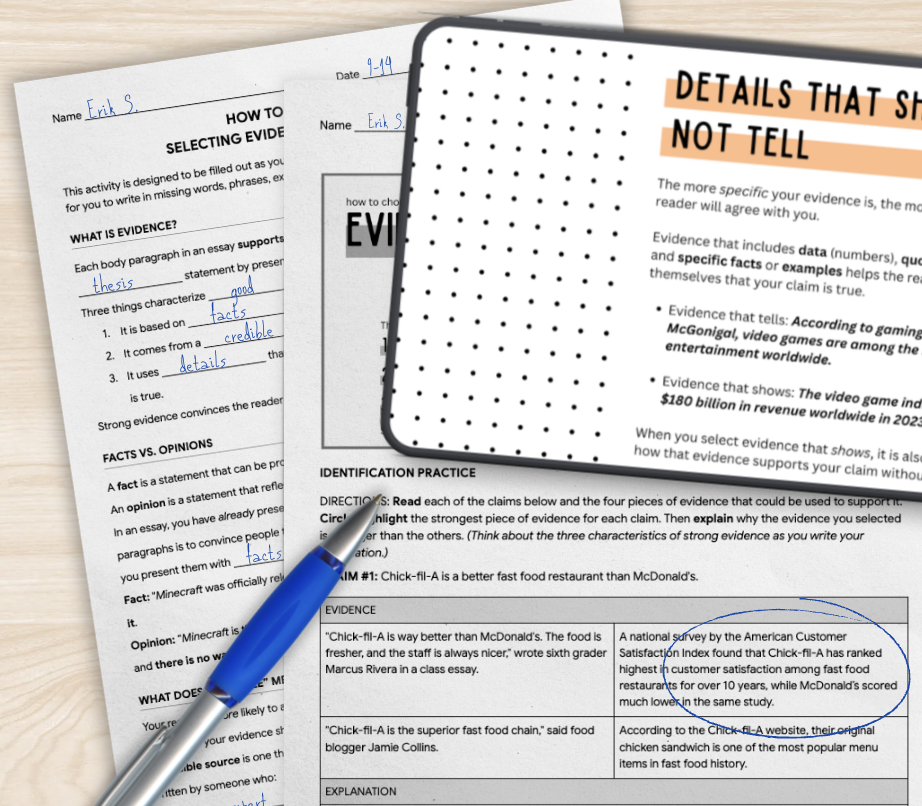
Evidence that “tells” repeats the claim or explains itself, so students have nothing left to say in their commentary. Evidence that “shows” includes specific details or data, leaving room for students to explain how those details prove the claim.
| Weak (Telling) | Strong (Showing) |
|---|---|
| Homework takes up too much of students’ time. | Students in the same study reported averaging more than three hours of homework per night. |
| Problem: This generalization restates the claim in different words and leaves little to explain. | Why It Works: This version gives the student something to do in their commentary. Add three hours to a seven-hour school day, and a teenager is working a 10-hour day before practice, a job, or sleep. Those details illustrate why homework should be optional. |
Our test for this was simple: ask students what they’d write about their evidence. If they can’t think of anything that doesn’t just repeat the claim, their evidence is telling rather than showing.
It comes from a credible source.
In the Internet age, our students need constant reminders to check that their evidence comes from trustworthy sources. The strongest evidence comes from experts whose work has been checked by other experts, like a peer-reviewed study.
| Weak (Not Credible) | Strong (Credible) |
|---|---|
| A TikTok creator with two million followers says homework is outdated and schools should ban it. | A peer-reviewed study published in The Journal of Experimental Education linked heavy homework loads to higher stress, physical health problems, and less time for family and activities. |
| Problem: Follower counts measure popularity, not expertise. | Why It Works: The study’s authors include a senior lecturer at the Stanford Graduate School of Education, and the work was published in a peer-reviewed journal. |
Students don’t need a full research unit to grasp the basics of credibility. Teach them to ask, “How does this person know?”
Strong supporting evidence is relevant, factual, specific, and credible. The better students get at selecting evidence that meets these criteria, the more their writing will improve.
5 Strategies to Help Students Choose Strong Supporting Evidence
1
Preselect an evidence bank for your students.
Early in the year, you might consider preselecting quotations students can choose from to support their claims. This models strong supporting evidence and allows students to focus on writing strong commentary. Providing a variety leaves room for student choice (and makes the final drafts more enjoyable to grade).
How and When to Use This in Your Classroom
- No matter what grade or level you teach, providing a quotation bank for your first writing assignment calibrates students to your expectations for strong supporting evidence.
- It’s okay if your students aren’t ready to move away from a quotation bank. Some students need to see strong supporting evidence modeled more than once, and some students need additional practice to master the skill of writing effective commentary. This meets your students where they are without lowering your expectations.
- As students gain skill, move from providing single quotations to short article sets. Students can practice finding relevant, factual, and specific evidence without worrying about credibility or navigating search engines.
2
Ask questions about key evidence as students read.
If your writing assignment will be based on students’ reading, construct your guided reading assignments with the writing assignment in mind. Ask questions that draw students’ attention to words, phrases, and sentences they can use as supporting evidence. Whether you call out a key word or phrase or ask students to identify evidence from a particularly rich section, you’re priming them to recall these details when it comes time to write.
3
Ask “Which is stronger, and why?”
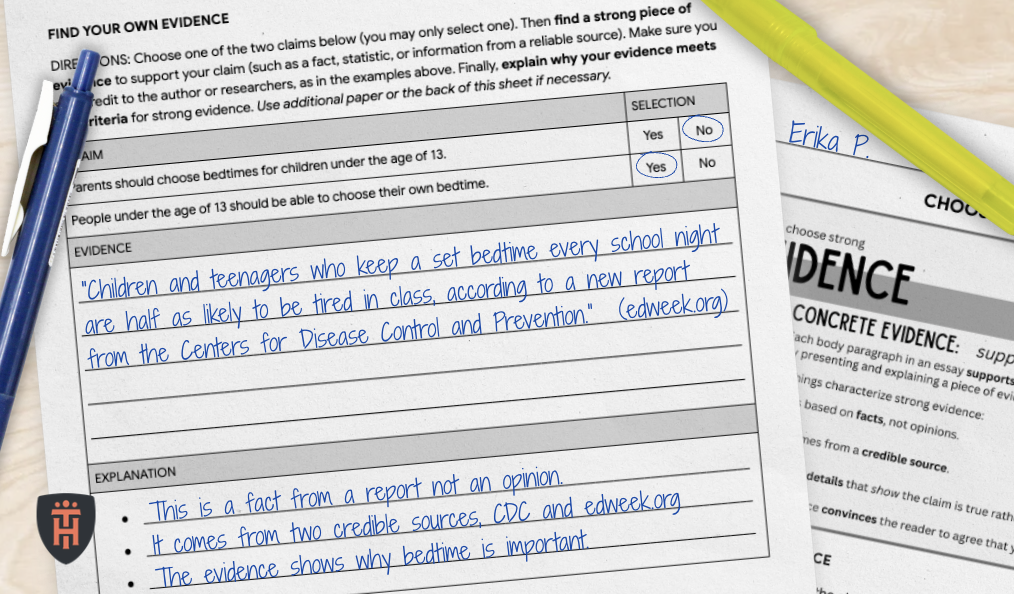
Present students with a claim and several options for supporting evidence. Discuss which piece of evidence would work best to support that claim and why, using the terms relevant, factual, specific, and credible. Modeling matters, but students also need to evaluate examples themselves. That’s how they learn to choose between weak and strong evidence on their own.
4
Practice selecting a single piece of evidence.
Give students a claim and have them find and justify a single piece of evidence. Students can focus on a single skill, and you only have to give feedback on a piece of evidence rather than an entire essay. This works as a graded individual assignment, a small group discussion, or even an exit ticket, and it’s a quick and targeted way to practice any (or all) of the four characteristics of strong evidence. Remind students to ask, “How does this person know?” when evaluating credibility and “What would I write about my evidence?” when looking for specific evidence that shows.
5
Make “specific details” your mantra.
Once students know what “showing” evidence looks like, make it non-negotiable. When we taught freshman honors, we frequently assigned students to write single analytical paragraphs. If students submitted a paragraph with “telling” evidence, we stopped reading and sent it back for revision. As our students increasingly relied on “showing” evidence to support their claims, their commentary became more meaningful, and their writing improved significantly.
Strategies 3–5 are the backbone of our supporting claims with evidence lesson, which walks students from modeled examples to choosing and defending their own evidence, with a Pixar short providing low-stakes context for practice. It includes guided notes, print and digital practice with an answer key, and classroom posters. We built it for middle school, but we would have used it with our 10th graders without changing a thing.
Leveling Up: Choosing Evidence for Literary Analysis
Learning to choose strong supporting evidence isn’t just a middle school skill. Once students can select relevant, factual, specific, and credible supporting evidence, they’re ready to use that skill for increasingly challenging writing tasks.
In particular, our more advanced students need to apply the same four criteria for strong evidence to literary analysis, a foundational writing skill in AP Literature.
We have three suggestions for helping your students make that transition:
Clarify how credibility works in literary analysis.
At the high school level, most of us aren’t having students support their arguments with peer-reviewed research. This means the text students are analyzing is the authority. The question is no longer “Is this source trustworthy?” but “Is this actually from the text?” (not their summary, a study guide’s explanation, or their memory of the movie).
Emphasize that the other criteria matter even more.
Weak evidence selection causes some of the biggest problems in literary analysis, and the “already interpreted” trap is especially sneaky. A quotation where the narrator states, “She was brave,” relies on the narrator’s judgment, leaving students nothing to analyze. A quotation describing what the character does gives students details to explain, and their commentary becomes the place where they prove her bravery. We used analytical paragraph prompts like this to practice with our freshman honors students.
Set a word limit on quotations.
It doesn’t work for every assignment, but requiring students to keep quotations to a limit like “five words or fewer” forces them to think critically about which words most effectively show the truth of their claim. This works particularly well for poetry analysis and with advanced students (and it often has the bonus of strengthening their quote integration because they have to provide context for their brief quotation).
Ready to put these skills to work? Check out our step-by-step guide to teaching the literary analysis essay and our three foundational writing skills for AP Literature.
What Comes Next: From Choosing Evidence to Using It
Choosing strong supporting evidence is only the first step. Once students have their evidence, they need to learn how to use it.
- Use the 5C paragraph structure to write strong commentary that explains how the evidence supports a claim. Its context sentence replaces the paraphrase that produced all those “Adventure is out there” repeats. We use this structure for everything.
- Teach students to use textual evidence correctly by punctuating, citing, and embedding quotations. Mastering these rules polishes students’ writing, even if they aren’t advanced writers.
- Use sentence starters to help your struggling writers express their thinking. Many students know what they want to say but struggle to say it. Sentence starters can help them focus on their ideas first.
Those “Adventure is out there” paragraphs were rough, but the problem was never that students had nothing to say. Their evidence had already said it for them. Once they learned to choose evidence that was relevant, factual, specific, and credible, their writing became less repetitive and far more meaningful.