
Why the 5 Paragraph Essay Still Works (When You Teach It Right)
The 5 paragraph essay: English class staple or formulaic cliché?
We’ve heard plenty of criticism of the 5 paragraph essay over the years. It’s too formulaic. It stifles creativity. AP students should move beyond that simplistic structure.
But in our experience, the biggest problems in our students’ writing—whether they’re emerging writers or our top AP students—have nothing to do with formulas or creativity.
Our students, both struggling and advanced, are writing a single, massive paragraph. Or they’re producing three disorganized paragraphs that don’t build a clear line of reasoning. Or they’re staring at a blank page because they have no idea where to start.
We have yet to encounter a student who is held back by the 5 paragraph essay. The vast majority of our students haven’t yet mastered the 5 paragraph essay—and for many of them, this structure launches their writing rather than limiting it.
This isn’t to say that there’s no merit to the criticisms the 5 paragraph essay structure faces. Used poorly, it can come off as amateurish and formulaic writing. But in this post, we’re making the case for why the 5 paragraph essay structure still works for middle school, high school, and even AP students—when you teach it as a flexible framework instead of a rigid formula.
What Critics Get Wrong About the 5 Paragraph Essay
There are four main arguments we’ve heard against the 5 paragraph essay.
- It creates formulaic writing: “In this essay, I will prove . . .” followed by paragraphs that start with “First,” “Next,” “Finally,” and “In conclusion.”
- It’s too simplistic for advanced students.
- It limits creativity and complexity.
- Real writers don’t write this way.

There is some validity to these concerns. Many 5 paragraph essays do read as simplistic, and professional writers do write articles that follow a more complex structure. But for our purposes, the structure itself isn’t the problem.
Most Students Aren’t Ready for “Flexible Organization.”
The biggest problem we encountered in students’ writing was a lack of organization and a tendency toward single-paragraph responses—in both standard-level and AP classes. (And this was before the post-pandemic resistance to rigor that many of us battle daily.)
This isn’t just because we taught in a low-income school district with many English Language Learners. Steph now teaches AP Seminar and AP Research at an online private school, and she struggles with the same issues (and a surprising number of students who gravitate toward a four-paragraph essay).
The Structure is Appropriate for the Contexts Students Actually Write In
It is 100% true that “real” writers tend to write more than five paragraphs. But in our standard-level classes, we’re not trying to produce professional writers and researchers. We want students to write an organized argument with sufficient evidence—a task that takes up plenty of our limited time.
In AP Lit and Lang, we’re preparing students for an end-of-year exam in which they’re expected to write three essays in two hours. Five paragraphs is just about right for a well-supported essay crafted in 40 minutes—and it aligns perfectly with the College Board rubric (1 point for thesis, up to 4 for evidence and commentary, 1 for sophistication). Focusing on strong writing within this structure still leaves us with plenty to work on.
Of course, there are times—research papers, creative writing—when it is appropriate to teach a different structure. But for most of what we do, the 5 paragraph essay is practical and achievable within our time constraints.
Students Want Structure
The concerns we hear about the 5 paragraph essay structure come from teachers, not students. Most students are relieved to have a clear framework to follow when writing. Yes, we occasionally need to remind them that an essay doesn’t have to be five paragraphs if there’s a reason to structure it differently, but the structure gives students confidence when facing the daunting task of writing an essay.
The problem, then, isn’t the 5 paragraph essay structure. The problem is teaching it as a formula instead of a framework.
Formula vs. Framework: What Makes the Difference
When critics talk about the 5 paragraph essay as formulaic, they do have a point. Many emerging writers produce essays characterized by:
- The “chicken-foot” thesis: a claim supported by three reasons that align with the body paragraphs
- Scripted transitions like “First, second, third” or “In this essay, I will . . .”
- Rigid organizational patterns that don’t align with the complexity of the argument
- Choppy, list-like essays that feel mechanical
But the five-paragraph essay doesn’t have to look like this if it’s taught as a flexible framework rather than a plug-and-play formula to follow.
Flexible Organization
Yes, asking our students to write a five-paragraph essay means they’ll all have an introduction, three body paragraphs, and a conclusion. But there is room for variety in how those three body paragraphs are organized.
Argumentative and expository essays might still have three reasons or key points, but they don’t have to. One paragraph might be a counterargument. Perhaps there’s a compare-contrast structure or an advantages-disadvantages structure. Literary analysis essays often work best with a chronological structure—examining how the author develops a theme or technique through the beginning, middle, and end of the text.
The intro-body-conclusion structure adapts to the argument, not the other way around.
Complex Thesis Statements
The quality of students’ five-paragraph essays can be dramatically improved by focusing on thesis statements. It’s relatively easy to write a thesis statement that amounts to “claim + reason 1, reason 2, reason 3.”
But when our students learn to write thesis statements that identify a complex theme or argument, those thesis statements can be broken into parts that students support one at a time.
Let’s take a look at an example: “The author’s portrayal of nature evolves from menacing to nurturing, ultimately suggesting hope emerges from darkness.”
The essay that supports this thesis statement will follow a structure driven by the argument, not a formula. The student can start with a paragraph about nature as menacing, move to one about nature as nurturing, and then end by explaining how that shift suggests that hope emerges from darkness. This student is building a line of reasoning rather than presenting three loosely-related ideas.
Teaching students to write three-part claims is also much easier than teaching the abstract concept of “sophistication” that proves ever so elusive on the College Board rubrics. A three-part theme statement doesn’t guarantee the sophistication point, but it moves students in that direction.
Bridge Sentences, Not Transitions
Five-paragraph essays often feel formulaic because students don’t know how to transition smoothly between ideas, so they lean on clunky transition words.
When we teach our students to use their topic and conclusion sentences as bridges that guide the reader from one paragraph to the next, their writing jumps in quality and sophistication without a shift in structure. This is a great place to use sentence starters with students of all levels: it allows you to model how to do this in a way that feels natural.
The 5 paragraph essay structure can hold complex thinking. It’s not the number of paragraphs that makes writing formulaic—it’s how you teach students to develop ideas within those paragraphs. And that’s where paragraph structure becomes crucial.
The Missing Piece: Paragraph Structure That Builds Thinking
Even with the basic intro-three body paragraphs-conclusion structure, students struggled with a couple of things, leading us to revise our framework further.
First, they struggled to write commentary. Most of us teach our students that every piece of evidence must be followed by commentary (often two sentences of it), but students struggle to know what that looks like.
Second, our students struggled to move between genres. Every time we tackled a new style of writing—narrative, argumentative, expository—it felt like we were starting from scratch. We struggled to articulate what commentary looked like in each writing type, which made us realize just how challenging the task was for students.
We started to consider how we could apply our favorite 5C paragraph structure—claim, concrete evidence, context, commentary, connection sentence—to every type of writing. This worked for three key reasons.
1
It eliminates the vague “write two sentences of commentary” instruction.
By separating the “two sentences of commentary” into context and commentary, we avoided meaningless repetition and gave our students more direction on how to write commentary. Asking students to place their evidence in context also led to writing that was easier to follow.
Without 5Cs:
“The author uses the green light as a symbol of Gatsby’s dreams. This shows that Gatsby wants something he can’t have.”
With 5Cs:
“The green light appears across the bay at Daisy’s dock, first introduced when Gatsby reaches toward it in Chapter 1. By placing this symbol at a physical distance Gatsby cannot cross, Fitzgerald suggests that the American Dream itself is defined by its inaccessibility—we are sustained not by achieving our dreams but by the act of yearning for them.”
More advanced students could also ‘level up’ their writing by including multiple pieces of evidence within a single body paragraph—each with its own concrete evidence-context-commentary sequence.
Free paragraph template
Sign up below to join the free resource library.

2
It prevents formulaic writing while maintaining structure.
An easy-to-remember structure allowed students to focus on the content rather than the mechanics of essay writing. Because the 5Cs naturally move students beyond summary to analysis, the paragraph structure guides their thinking, not just their organization.
3
It creates consistency across genres.
The biggest game-changer for us was working out how to adapt context and commentary for each writing type.
- In narrative essays, the context sentence adds detail and background information to the student’s story; the commentary reflects on the meaning of the events.
- In expository writing, the context addresses the credibility of the evidence; the commentary explains the implications of that evidence.
- In argumentative writing, the context also addresses the credibility of the evidence; the commentary connects the evidence to the student’s larger argument.
Same reliable structure, different content focus. Students didn’t have to relearn how to write a paragraph—they just needed to understand what context and commentary meant in each genre.
As we made the process of writing any essay more consistent, our students stopped acting like they’d never written an essay every time we switched genres. They built confidence and got better at the actual thinking work, leading to less formulaic essays . . . that just happened to be five paragraphs long.
What This Looks Like in Practice: Inside Our 5 Paragraph Essay Bundle
The success we experienced inspired us to create our 5 Paragraph Essay Writing Bundle. We wanted to give teachers the tools to teach the 5 paragraph as a framework, not a formula, with consistent structure across genres.

What You Get:
- How to Write Hooks
- How to Write a Paragraph
- How to Write a Personal Narrative Essay
- How to Write an Argumentative/Persuasive Essay
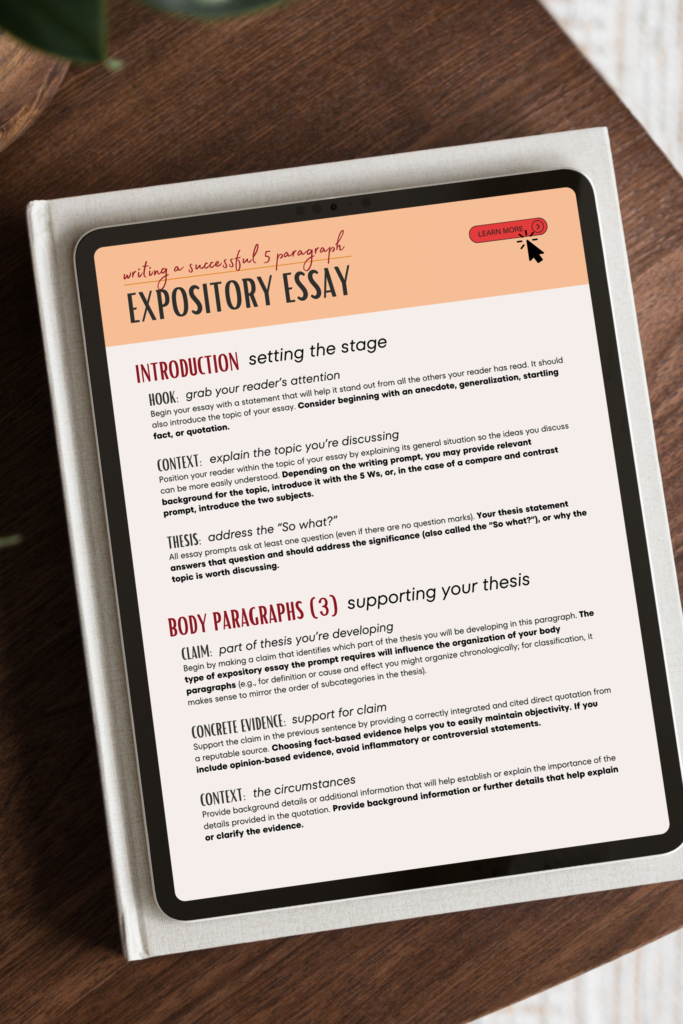
- How to Write an Expository Essay
Each product comes with visually engaging Google Slides for instruction, a visual reference guide students can keep in their binders or access on your LMS, and practice activities where students apply what they’ve learned.
What Makes It Different:
First, we provide sentence-by-sentence guidance for students. These aren’t just blank graphic organizers that students don’t know to fill out. Instead, we provide specific directions that walk students through each sentence, taking the guesswork out of what commentary looks like in each genre.
For example, when students write commentary in a narrative essay, we guide them to reflect on the personal meaning of events and hint at broader significance. In argumentative writing, those same students learn to establish source credibility and explain how evidence supports their claim. Same paragraph structure—context and commentary—but the thinking work shifts to match the genre.
This means you can hand students a graphic organizer and actually have them work independently—no more circulating the room answering, “What do I write here?” twenty times.
Second, our 5C paragraph structure (introduced in the “How to Write a Paragraph” activity) applies the same basic structure to each of the three writing types, providing genre-specific adaptations so students understand how to apply that structure. In the three “How to Write an _______ Essay” products, we also provide consistent introduction and conclusion structures, adapted for each genre.
Rather than providing pre-written sentence starters that only work for specific prompts, we give students the structural understanding they need to tackle any essay question—making this equally useful whether you’re teaching The Great Gatsby, To Kill a Mockingbird, or a research-based argument.
The bundle includes everything you need to teach students a consistent, clear approach to essay writing that works across the curriculum—not three separate writing units where you start from scratch each time.
Why This Matters Especially in Grades 7–10 (and Beyond)
Grades 7–10 are the foundational years when students move from writing paragraphs to writing full essays.

When you teach beginning writers, you’re likely seeing wandering ideas with no clear throughline, weak or missing thesis statements, one or two pieces of evidence with no analysis, or the dreaded one-paragraph response from students who can’t sustain writing for more than a few sentences.
The 5 paragraph essay, when taught as a framework, gives students confidence because they know what to do and feel successful. It gives them a baseline that they can adapt and expand on once they’ve mastered the basics. It also teaches students transferable skills—providing claims, evidence, and analysis—that will apply later in their academic careers, regardless of length or format.
Even in advanced classes like AP Language and AP Literature, the 5 paragraph essay structure can produce complex (dare we say, sophisticated) writing that is practical for the timed AP exam conditions students will face at the end of the course.
Conclusion: Structure Isn’t the Enemy of Good Writing
The 5 paragraph essay gets criticized, but the far more common classroom problem is students who can’t organize their writing at all. The structure works best when it’s taught as a flexible framework, not a rigid formula. Adding additional paragraph structures, like the 5Cs, helps students stay organized while developing their ideas, and consistency across genres helps students build confidence as they focus on thinking rather than relearning structure.
The goal isn’t to have students write 5-paragraph essays forever. The goal is to give them a foundation they can build on—and that might come after they leave your class, not during. Structure isn’t the enemy of good writing—it’s what makes good writing possible for developing writers. And when you see a struggling writer produce their first coherent, well-supported essay using this structure? That’s when you remember why you do this work.
If you’re looking for a clear, consistent way to teach essay writing across genres—one that gives students structure without feeling formulaic—our 5-Paragraph Essay Writing Bundle is designed exactly for this. It’s the sentence-by-sentence guidance and genre adaptations that we refined during (and even after) our time in the classroom.


