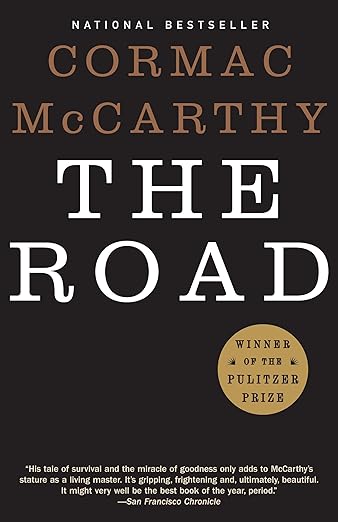
The Road by Cormac McCarthy: The AP Literature Novel That Does Everything
We didn’t choose it. Our students did.
Our first year teaching AP Lit, way back before we were officially Kate-and-Steph (the full story is here if you’re curious), we ended the year by allowing students to choose our final novel. We gave them a list of nine contemporary (ish) titles and summaries, and each class voted on their preference.
Steph’s class selected The Road by Cormac McCarthy. In all honesty? Steph was disappointed. It wasn’t her genre of choice, and it had been published fewer than two years prior, which meant the available resources for teaching it were limited.
But her students loved it, and Steph quickly realized it’s an excellent choice for AP Literature.
Steph recommended that we add The Road into our curriculum, and we taught it every single year after that.
Eventually, we decided that the novel works perfectly as the first novel of the year in AP Literature. Here’s why we think it belongs at the start of your AP Lit year—and how we taught it.
Why AP Teachers Overlook The Road (And Why That’s a Mistake)
If you’ve been hesitant to teach The Road by Cormac McCarthy, we get it. There are a couple of common hesitations:
Hesitation #1: It’s Not a “Classic”
As AP Lit teachers, we tend to gravitate toward older canonical texts, especially if we’ve been teaching the course since the days when students were explicitly instructed to write about a book of literary merit on their exam. This is partly because we know these books, partly because we think our students “should” read them and won’t on their own, and partly because they’re the books our schools have already purchased or our school boards have already approved.
Because the novel is contemporary, however, students are interested in it and comfortable with the language. They can read the novel independently, which matters a lot in the early weeks of the year when you’re busy establishing routines and laying a foundation.
Additionally, the College Board has listed The Road several times on its recommended titles for Q3, giving the novel academic legitimacy, and the novel won the Pulitzer Prize for Fiction in 2007, addressing the “literary merit” argument.
Hesitation #2: It Has Violent Content
This is a legitimate concern—McCarthy’s characters live in a bleak and gruesome world, and a couple of scenes are tough to read. People are so desperate to survive that cannibalism is rampant, and children are easy prey rather than off-limits.
However, McCarthy’s violence is purposeful and thematically significant rather than gratuitous. We’re confronted with the same truth that countless authors have explored: when the restraints of civilization are stripped away, humans are far more likely to resort to selfish cruelty than to cling to morality and compassion.
In our experience, the violent content is also (sadly) on par with the content many students encounter in media outside of school, and, in many communities, violent content tends to be less fraught than sexual content. You know your students and your community best, but in our experience, the conversation the novel generates is worth it.
Why The Road Works So Well at the Beginning of the Year
While a good novel can be used successfully anywhere in your curriculum, we found that The Road by Cormac McCarthy works particularly well at the beginning of the year for four key reasons.
Accessibility
McCarthy writes in contemporary prose—no archaic language or footnotes, and no historical background required. Students can read the text on their own without getting lost, which is rare in AP Lit. This is especially helpful in August and September when you’re still building reading stamina and independence—not to mention trying to cover a variety of foundational skills.
Engagement
The post-apocalyptic setting appeals to students, and the father-son relationship at the heart of the novel resonates deeply with them. Because the novel describes the pair’s attempts to survive a dangerous world, there are moments of high action and suspense.
Students connect to the novel emotionally before they analyze intellectually, and that emotional investment carries through the whole year. (One year, Steph’s students literally made T-shirts memorializing their AP Lit experience with a line from the novel: “Nobody wants to be here and nobody wants to leave.”)
Thematic Richness
The accessible surface is a bit of a trick—there is enormous depth underneath. The novel supports meaningful discussions about morality, survival, parenthood, hope, and humanity, all without requiring extensive background knowledge from students.
Perfect Bridge from How to Read Literature Like a Professor
Many of us start the year with Thomas C. Foster’s How to Read Literature Like a Professor, and The Road pairs perfectly with that starter text. In fact, it’s such a natural pairing that this point deserves its own section.
The Road and How to Read Literature Like a Professor
Like many AP teachers, we assign How to Read Literature Like a Professor in the first couple of months because it helps students build the analytical vocabulary they’ll need all year.
Assigning The Road at the same time works beautifully because the novel is practically a teaching text for Foster’s concepts—12 of Foster’s chapters are clearly illustrated in McCarthy’s novel (we’ve written about the chapters we consider most essential here).
|
Foster’s Chapter
|
McCarthy’s Novel
|
|---|---|
|
“Every Trip Is a Quest (Except When It’s Not)” |
The father and son are on a journey from page one of the novel, and students can identify Foster’s five elements of a quest almost immediately. |
|
“Nice to Eat With You: Acts of Communion” |
The scenes where the father and son share food take on ritual significance, functioning exactly as Foster describes. |
|
“. . . Or the Bible” |
The novel is rich with biblical imagery that points directly toward the novel’s themes. Some of it is apparent to non-religious students, and some of it clearly illustrates what Foster calls the “resonance test.” |
|
“It’s More Than Just Rain or Snow” |
Survival becomes even more difficult when rain and snow get involved, and the covering of ash on top of the snow adds a layer to the discussion. |
|
“Never Stand Next to the Hero” |
Characterization is the most important part of The Road, and everything Foster has to say in this chapter applies to the roles both the father and son play in the novel. |
|
“. . . More Than It’s Gonna Hurt You: Concerning Violence” |
We’ve already mentioned the violence in the novel—it’s a great opportunity to highlight the larger purpose that violence serves. |
|
“Is That a Symbol?” |
Symbolism is significant in the novel—no discussion of it can be complete without discussing the way McCarthy uses fire. |
|
“Yes, She’s a Christ Figure, Too” |
It’s fairly obvious that the boy—the moral center of the novel—is meant to be read as a Christ figure, and this positioning is essential to the novel’s themes. It’s a great opportunity to illustrate Foster’s point that biblical imagery and symbolism point to larger messages rather than serving as literal endorsements of Christianity. Note: This chapter is only included in the first and second editions of the text and has been removed from the third edition. |
|
“If She Comes Up, It’s Baptism” |
Yep, we’ve got a literal baptism scene, and McCarthy does us the favor of specifically calling it out. |
|
“Geography Matters . . .” |
For most of the novel, the father and son are traveling south to the coast, ideas that Foster touches on in his text. What the father and son find when they get there opens up opportunities to discuss a 13th relevant chapter (“Is He Serious? And Other Ironies”). |
|
“It’s Never Just Heart Disease . . . And Rarely Just Illness” |
The father suffers from some sort of lung disease throughout most of the novel, which causes him multiple internal conflicts and contributes to discussions of theme. Note: This chapter has been combined with “Marked for Greatness” in the third edition. |
|
“The Road Goes Ever On” |
The third edition of Foster’s text literally includes a chapter specifically about roads. Needless to say, that chapter is relevant here. Note: This chapter is not included in the first and second editions of the text. |
The Road makes Foster’s ideas visible to students in a way that more obscure or stylistically difficult texts don’t.
How to Read Literature Unit
THE PERFECT COMPANION FOR TEACHING THE ROAD

How We Taught The Road: Our Unit Framework
Our unit on The Road by Cormac McCarthy follows the same framework we use for all AP Literature novels— if you want the full breakdown, you can find it here—so in this post, we’ll focus on what made this particular unit distinctive.
Our discussions moved from the outside in: we started with the world McCarthy builds—setting, society, the “bad guys”—before turning to style, then to the characters themselves, then to symbolism, and finally to theme. By the time students are asked what McCarthy is saying about humanity, they’ve built that answer brick by brick.
Focus #1: Setting and Style
Our first few discussion questions prodded students to describe the setting and the characterization of society at large (in contrast to the boy and the man). The post-apocalyptic context drives everything else: it motivates the characters’ actions, drives the plot, and points us toward the novel’s theme.
This led naturally to a discussion of McCarthy’s stylistic choices—the missing punctuation, the unnamed characters, and the fragmented syntax. Because these stylistic choices mirror the setting, it makes sense to discuss them here, and it introduces students to the foundational AP skill of connecting form to meaning.
This opportunity, we’ve found, is crucial. The students who came to us from AP Language were often eager to discuss syntax but unaware of how to do so effectively in the context of literature. By showing them early on what a literary analysis of this device looks like, we tried to head off disastrous essays later in the year.
Focus #2: Character and Symbolism
Once students understand the world McCarthy has created, they’re ready to analyze the primary characters: the boy, the man, the mother, and the enigmatic Ely, the only named character. These characters react to the world they find themselves in, and it’s their reactions to that world that set them apart from others (referred to as “the bad guys”).
As students focus on the boy and the other characters’ reactions toward him, they naturally move into a discussion of symbolism. The primary symbol in the novel—the fire—is part of what differentiates the man and the boy from the other people. After discussing the boy’s clear significance to other characters, students are ready to unpack the religious imagery and the boy’s role as a Christ figure.
Focus #3: Theme and Q3 Application
The discussion culminates in students crafting their own theme statements for the novel. There are many theme statements that students might develop from the discussion. However, the scaffolded progression lends itself particularly well to highlighting themes about humanity’s natural tendency toward selfishness and cruelty, what it takes to resist it, and—most importantly—what it takes to survive as a species.
To transition into the assessment stage of the unit, we introduced the Q3 prompt to students at the end of the discussion, exploring how they might use the novel—and the theme statements (“meaning of the work as a whole”) they just identified—on the exam.
We’ll acknowledge that this isn’t the flashiest of units. But it allowed the novel to do the work, which is important, especially as students developed the foundation they would build on throughout the year. The progression of discussion questions helped students to see for themselves what’s already in the text.
Free Bookmark
Sign up below to join the free resource library.

Wrapping Up the Unit
The assessment piece of our unit also followed our typical framework for all AP Literature novels, but there are a couple of elements we want to highlight.
Using The Road at the beginning of the year allowed us to provide direct instruction on the end-of-novel project we assign with every novel and play. We took time to explain our expectations and scoring rubric and to establish a purpose: this isn’t busy work; it’s a tool students will use at the end of the year to review the texts they’ve read. Our discussion also covered the key elements students include in the project—setting, point of view, conflict, characterization, plot, and literary devices—so they were well-prepared to succeed.
Because students understood the novel well and the discussion helped them see how all the individual elements point toward a theme, they were also prepared to write their first literary analysis essay on The Road. Some years, we made this a process essay; other years, it was timed. But because students had something to say about the novel, it removed much of the intimidation from the first major essay of the year.
Teaching The Road early in the year benefited our students in many ways, leaving a lasting impact. Even though this was the first book students read, they referenced it regularly in our exam review activities. A book that our students have something to say about nine months after reading it? That’s a goldmine.
We’re considering developing our full unit for The Road by Cormac McCarthy into a resource for our store—if this is something you’d use, let us know at hello@threeheads.works or on Instagram @threeheads.works.
If you’d like to hear more about our approach to teaching AP Literature, our full-year calendar is a great place to start! We also have an AP Lit Jump Start Kit to help you build a strong foundation with your students at the beginning of the year. It includes our student-friendly literary terms and allusion lists (with review materials and quizzes), How to Read Literature Like a Professor unit, Pixar theme activity, analytical paragraph lesson, and literary analysis essay mini-unit that you can use to introduce Q2. We’ve included everything you need to implement these materials right away.


