
How to Write a Thesis Statement: A Simple, Repeatable Strategy Students Can Actually Use
Of all the elements that make up writing instruction in middle and high school, the thesis statement is, by a long shot, the most essential.
Sure, your students’ essays won’t be great without evidence, commentary, clear organization, and smooth transitions, but without a clear thesis statement, their essays can’t even get off the ground.

Teaching students how to write a thesis statement gives them a foundational skill that they’ll use throughout their academic careers, whether they’re a rising sixth-grader making their first foray into academic writing or an AP senior analyzing a poem in a 40-minute timed write.
Yet this isn’t a skill we’re always sure how to teach well. Published writing curricula may briefly refer to thesis statements as part of a longer lesson on a particular writing genre, using abstract language to direct students to make their argument clear to their reader. College writing guides define a thesis statement in detail but assume an audience with some level of writing experience and the motivation to figure it out for themselves. And we often overcorrect, either drilling-and-killing formulaic sentence structures with no room for creativity or creating elaborate mini-units that highlight all the possibilities and leave our students overwhelmed and unsure where to begin.
But here at Three Heads, we strive for a simple, straightforward approach. You can teach your students how to write a thesis statement in a single class period, giving them a reusable strategy that they can adapt to any prompt, whether they’re in 6th grade or 12th grade, remedial English or Advanced Placement. If this sounds like what you’re looking for, keep reading for simple guidelines and a ready-to-use lesson plan.
The Thesis Statement Is the Backbone of the Essay
It’s worth taking a moment to consider why learning how to write a thesis statement matters: after all, it’s only one sentence. There are three primary reasons.
1
The thesis statement focuses the writer and the reader.
Beginning an essay with a clear statement of the writer’s primary argument helps the reader approach the rest of the essay intentionally: they’re looking to see how well the student supports, or argues for, their main claim. Without it, the reader is left wondering where the essay is headed or what the point is, making it difficult to pay close attention. And a writer without a thesis statement is a writer without a plan, which leads to an essay that is underdeveloped, rambling, or contradictory.
2
The thesis statement provides a roadmap for the essay.
When written effectively, thesis statements tell the reader (and remind the writer) not only what the main point is but the road the writer will follow to make that point. It provides a mini-outline for the essay, showing the reader what to expect and leaving the writer with a solid game plan to refer back to.
3
The thesis statement carries weight on writing rubrics.
Because the thesis statement is the foundation of an organized, focused essay, writing rubrics often give the thesis statement its own row. In AP Language and AP Literature, the thesis statement alone accounts for 1 of 6 points, 17% of the overall essay score. This concrete, practical value of a thesis statement helps us and our students recognize its importance.
Just because a thesis statement is essential, however, doesn’t mean it’s easy. We found that our students struggled to write an effective thesis statement in predictable ways.
Why Thesis Statements Trip Students Up
Some students won’t include a thesis statement unless we explicitly remind them to, but when they do, these are the most frequent errors we see (and we’re confident you’ve seen these patterns before).
Reason #1: Students merely repeat the prompt without answering the question.
Our students may have learned that they need a thesis, but because they haven’t decided what they’re going to say, they write themselves into the essay by rephrasing what’s been given to them. This might get their pen moving, but it doesn’t give them a roadmap, and the essay that follows is often disorganized and illogical.
Reason #2: Students make non-debatable claims.
When students are scrambling to come up with something to say, they often go with the first thing that comes to mind. In many cases, this is a fairly obvious statement that no one would disagree with, meaning it doesn’t need to be argued. And if it doesn’t need to be argued, the essay that follows is likely to be superficial or repetitive.
Reason #3: Students cling to formulaic sentence starters that lack a “so what.”
Many students learn some form of what one of Steph’s students called the “chicken-foot thesis”: a position or topic followed by three reasons. While better than no thesis at all, these formulaic thesis statements often set up mechanical essays that are limited in analysis because the student hasn’t considered why their argument matters.
It’s easy for our students (and for us) to see the value of the thesis statement described in the previous section as arbitrary: it’s there because someone long ago decided that’s how a good essay is written. But when we look at common error patterns, we can see how a problematic thesis statement ripples through the rest of the essay. We’ve written before about foundational writing skills—thesis statements are where they all start.
The Three-Part Thesis Statement Formula
While we’ve noted that overly formulaic thesis statements can be a problem, don’t get us wrong: we’re all about giving our students repeatable formulas, strategies, and yes, even sentence starters.
Experienced writers know how to craft an original sentence that concisely articulates the claim we plan to argue in a piece of writing. But our students aren’t experienced writers, and they often need us to break down the thinking process.
Over time, we developed a three-part thesis statement formula that shows students how to write a thesis statement without removing all room for creativity.
It starts with making sure students understand that every prompt is secretly asking a question, even if they don’t see a question mark. For example, consider this prompt:
Many schools are debating whether to require students to complete community service hours before they can graduate. Write an essay explaining whether schools should require community service and support your position with reasons and examples.
Students need to recognize that this prompt is essentially asking, “Should schools require community service?”
While this may seem obvious to us, it’s not always obvious to students, and directly teaching them to find that question—and practice the skill—is a crucial first step in teaching thesis statements that we often overlook.
Once students have identified the question, they’re ready for the three-part formula. A strong thesis includes:
- An answer to the question in the prompt. Students must take a specific, debatable* stand on whatever topic the question asks about.
- A preview of how the stand will be supported. Students should preview the reasons (or main ideas) that will support their argument. This provides the organizational roadmap for the essay that follows.
- An explanation of why the stand matters. This is the piece that many strategies skip. To set themselves up for a strong essay that invites meaningful analysis, students need to articulate why their stand matters, or the “So what?” of their argument. When they include this element, the commentary in their body paragraphs becomes more meaningful because they have something more to explain than just reiterating their main claim.
What do we mean by “debatable”? A reasonable person must be able to disagree. For example, in response to our sample prompt, “Volunteering helps the community” is not debatable: that is the entire idea behind volunteering. In contrast, “Schools should require community service hours before graduation” is debatable. Someone might recognize the value of volunteering but not believe it should be mandatory in schools for multiple reasons.
Let’s take a look at the three-part thesis statement formula in action.
Example: Weak vs. Strong Thesis Statements
After teaching students the three parts, we take time to show them what that looks like in practice.
Here’s an example of a weak thesis statement in response to the community service prompt:
Community service hours are good for students.
While this thesis statement does answer the question in the prompt, it’s vague (what does “good” mean?), not particularly debatable, provides no roadmap for the essay, and lacks the “why it matters” piece that sets students up to write meaningful commentary.
Here’s an example of a strong thesis statement in response to the community service prompt, broken into the three parts:
Schools should require community service hours before graduation because it teaches students responsibility, strengthens their connection to their community, and gives them hands-on experience solving real problems in ways that prepare them to be engaged, capable adults.
Answer: Schools should require community service hours before graduation
Reasons: it teaches students responsibility, strengthens their connection to their community, and gives them hands-on experience solving real problems
Why It Matters: prepare them to be engaged, capable adults
Now, students have a clear argument to support, a roadmap to follow as they write their essay (each reason gets its own body paragraph), and in their commentary, they can explain how each reason prepares students to be engaged, capable adults.
Teaching Thesis Statements in One Day (or Maybe Two)
Students can pick up this formula in a single class period (or maybe two if they need extra practice) while still receiving real, scaffolded practice. Here’s the shape it took for us.
Direct Instruction and Modeling
We started with a short presentation describing the three-part formula, showing multiple examples of prompts turned into questions and weak versus strong thesis statements side by side, and illustrating how a strong thesis becomes a roadmap for the essay that follows. To keep students engaged, we paired the lecture with fill-in-the-blank notes and a short video clip to anchor the practice prompt that came next.
Scaffolded Practice
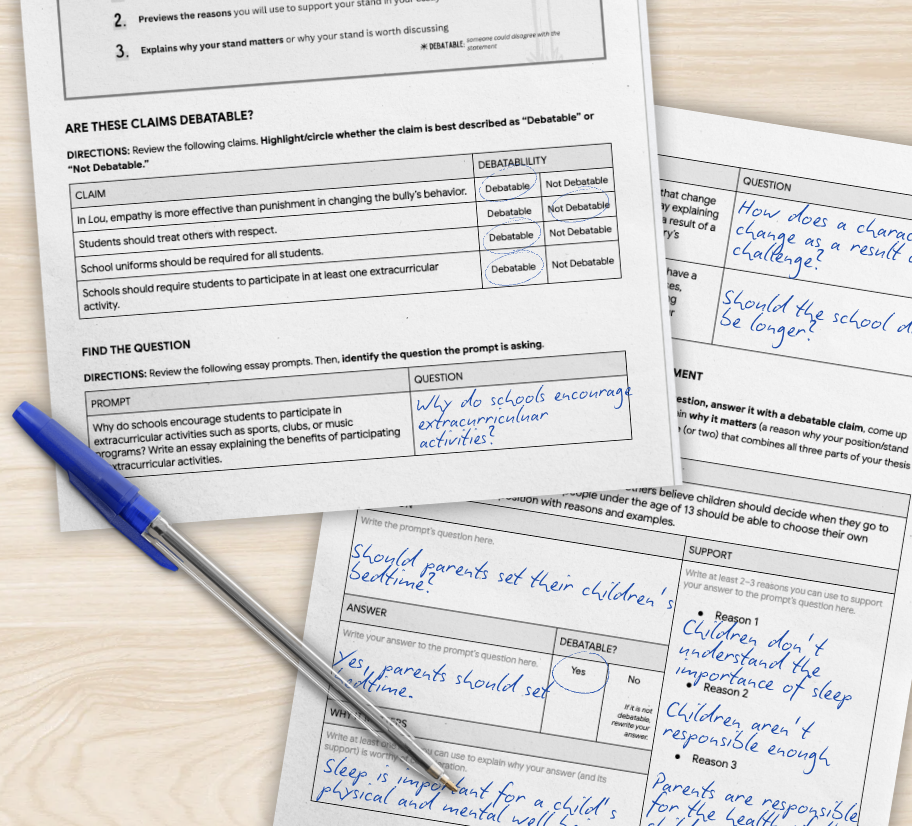
From there, students moved through several rounds of practice, each one removing a bit more support: sorting example claims as debatable or not, hunting for the hidden question inside a prompt, building a thesis statement piece by piece using a guided chart, and finally writing a thesis statement from scratch with just a prompt and no scaffolding at all. We wrapped up by giving students a finished thesis statement and asking them to map out which body paragraph each reason would become.
This kind of layered practice can be done individually, in pairs, or in small groups, and reviewed as a class or collected for a grade—whatever fits the time and support your students need.
Adapting the Formula to Other Genres
While this three-part formula most closely aligns with the demands of argumentative writing, it can easily adapt to other genres.
In expository/informative writing, the three reasons become main ideas. In personal narrative writing, the three reasons aren’t needed since most narratives are organized chronologically. In literary analysis essays, the reasons may need to be adjusted to fit a specific prompt, and the “why it matters” may take the form of a theme statement.
Students learn one formula that reminds them how to write a thesis statement; then, they learn how to adapt it slightly by genre.
Why This Approach Works for All Students
This three-part formula and scaffolded teaching approach might sound like it’s most appropriate for middle school students, and that is the audience we originally designed it for.
But we also would have used the same materials with our standard-level sophomores, most of whom came to us behind grade level. Many of our students aren’t ready for grade-level writing. As the 2025 PISA results confirmed, reading performance among U.S. teenagers has fallen to its lowest point in 25 years, and a quick review like this is an easy way to meet students where they are without lowering your overall standards. Students can address a grade-level prompt, but a quick review like this reinforces (or directly teaches) the skills they’ll need without using up valuable class time.
And if you have students who are on grade level, the formula alone can be a quick way to make sure all students are on the same page with your expectations (while discreetly catching up any individual students who need it), or the examples and practice activities can become more sophisticated along with your students.
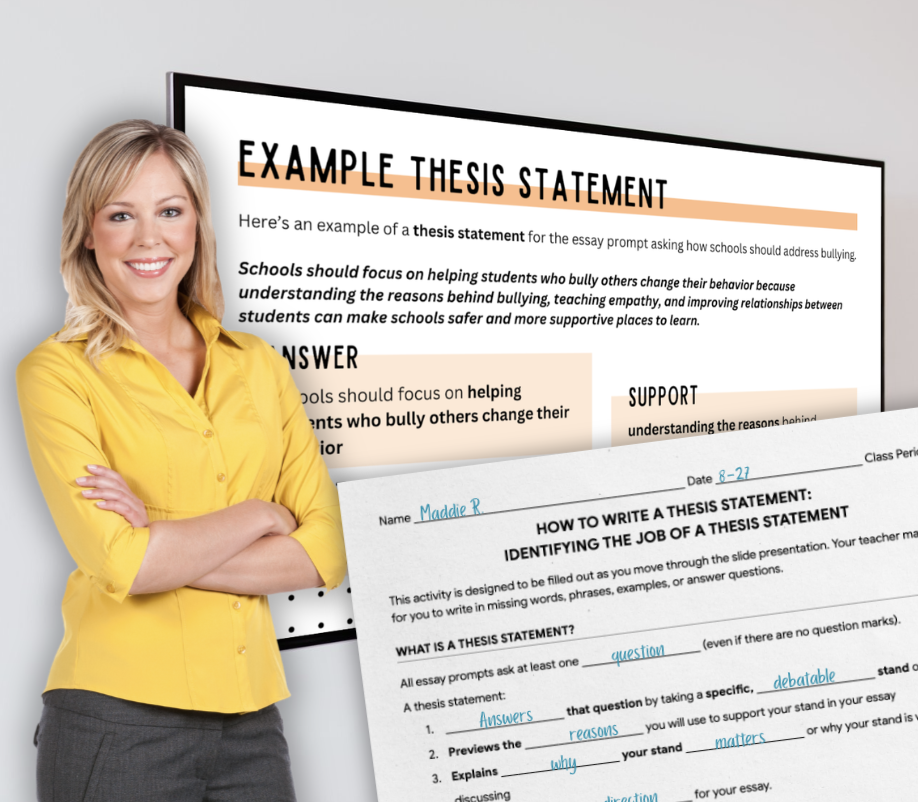
Thesis statements don’t need to be complicated, but a strong one sets students up for their entire essay. This means a quick lesson on how to write a thesis statement is a good use of our time, no matter what group of students we’re teaching.
If you’d like the thesis statement lesson described in this blog post pre-built with everything you’ll need—modeling slides, fill-in-the-blank notes, guided practice worksheet (print and digital), visually appealing posters summarizing the formula, and a teacher implementation guide—so you’re not building it from scratch tonight, you can find it here. While it was originally built for middle school, the scaffolding makes it a strong fit for high schoolers who need the extra support.