
The AP Literature Essay Starts Here: 3 Foundational Writing Skills to Teach First
It’s tempting, when teaching AP Literature and Composition, to jump straight into literary analysis. After all, most of us are much more excited about the Literature part of our course than the Composition part. Who wouldn’t prefer to watch Hamlet wrestle with the daunting task of avenging his father’s murder, cringe at Mr. Darcy’s “not handsome enough to tempt me” jab, or cheer on Janie’s freedom from three disastrous marriages over writing an AP Literature essay about them?
If we don’t ensure our students have a strong foundation in writing from the very beginning, however, we’re doing them (and ourselves) a huge disservice.
Even students with well-thought-out insights about a character or theme often fall short on the AP Literature essay—not because they’re not thinking deeply but because they lack the writing tools to express their ideas clearly.
We consistently saw three main issues in our students’ early attempts to write an AP Literature essay:
All three issues prevent students from scoring well on the AP Literature essay rubric. After (too many) years of frustration, we finally realized that before diving straight into a full-blown AP Literature essay, students need to develop writing foundations that stick.
In this post, we’re sharing three essential early-year writing skills that build toward success on the AP Literature essay, along with ready-to-use tools that make it all easier—for you and them.
3 Essential Skills to Teach Before the AP Literature Essay
Writing a Real Theme Statement (Not Just a Topic)

Why It Matters
All three AP Literature essay scoring rubrics assign a point for students’ thesis statements based on the following criterion (which varies only slightly for the three different questions):
“Responds to the prompt with a thesis that presents a defensible interpretation of the selected work.”
“Defensible interpretation” refers to what we traditionally call theme. This is especially true for FRQ 3, which asks students to provide “an interpretation of the work as a whole.” (This is probably a topic for another day, but FRQ 1 is about a poem, which sometimes—but not always—conveys a theme, and FRQ 2 is about an excerpt from a larger work, so it generally works better for students to discuss the purpose of the specific passage rather than attempt to craft a theme statement.)
Students who begin with a strong theme statement are better prepared to write a strong thesis statement, setting themselves up to write a more focused and sophisticated essay.
What Goes Wrong
Students tend, especially at the beginning of the year, to write “love,” “revenge,” or “power” and assume they’ve nailed the theme. Their thesis statement remains vague, and while it may technically qualify as a “defensible interpretation” that earns them the thesis point, their line of reasoning tends to fall apart (if it exists at all), and they miss out on the elusive and coveted “sophistication point.”
How to Fix It
1
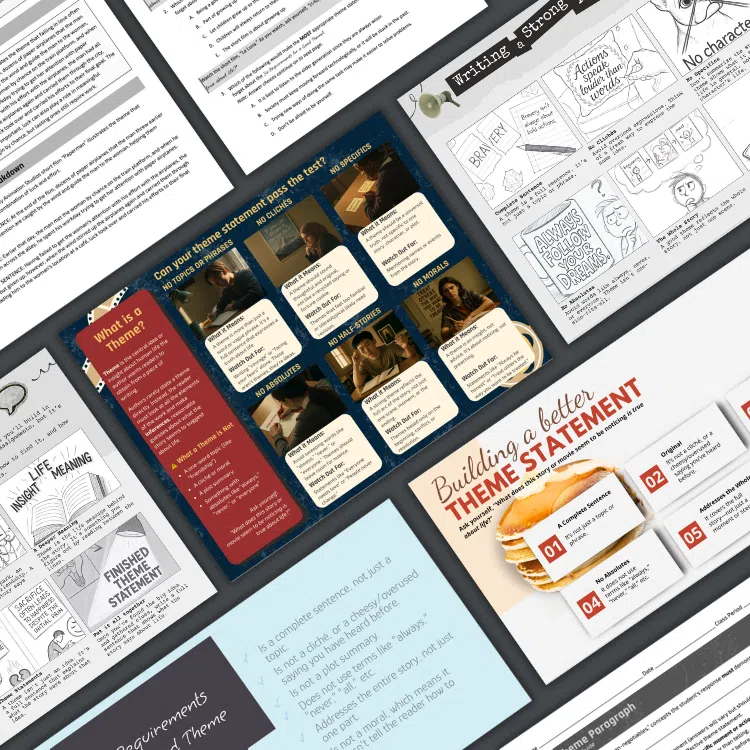
Teach students, in the first few weeks of the year, the six characteristics of a good theme:
- It is not just a topic or phrase, but a complete sentence.
- It is not a cliché (a cheesy or overused saying).
- It is not a plot summary.
- It does not use absolute terms like “always,” “never,” “all,” etc.
- It covers the whole story, not just one part.
- It is not a moral, which means it doesn’t tell the reader how to behave.
2
Use short films (hello, Pixar) to model the concept that a theme is a full statement about the human experience.
Short films are great for teaching students how to write theme statements because they’re short, easy to understand, and lack dialogue.
Students need multiple opportunities to practice writing an effective theme statement before tackling the more challenging task of identifying a theme statement for a complex text.
3
Offer students opportunities to practice revising ineffective theme statements.
When students focus on revising theme statements rather than simply writing them, they’re forced to pay closer attention to the characteristics of an effective theme statement and what those characteristics look like in action.
Why It Works
It’s fairly easy for students to earn the thesis point as long as they actually make a claim, and AP prompts and passages tend to vary enough to make a one-size-fits-all sentence frame challenging. Taking the time early on for a quick lesson that ensures students can write an effective theme statement, however, sets them up to score higher in all rows of the AP Literature essay rubric, not just the first one.
Finally — A Clear, Step-by-Step Way to Teach Theme Statements
Struggling to get students to write strong theme statements? This scaffolded lesson set gives you a clear plan — from teaching the six key characteristics to helping them practice with theme using SparkShorts, and culminating in a theme analysis with a proven paragraph format.
Writing Paragraphs That Do More Than Summarize
Why It Matters
The biggest portion of the AP Literature essay rubric is dedicated to evidence and commentary (4 out of 6 points). Let’s take a look at the College Board’s scoring criteria for FRQ 3 (the wording for FRQ 1 and 2 is nearly identical):
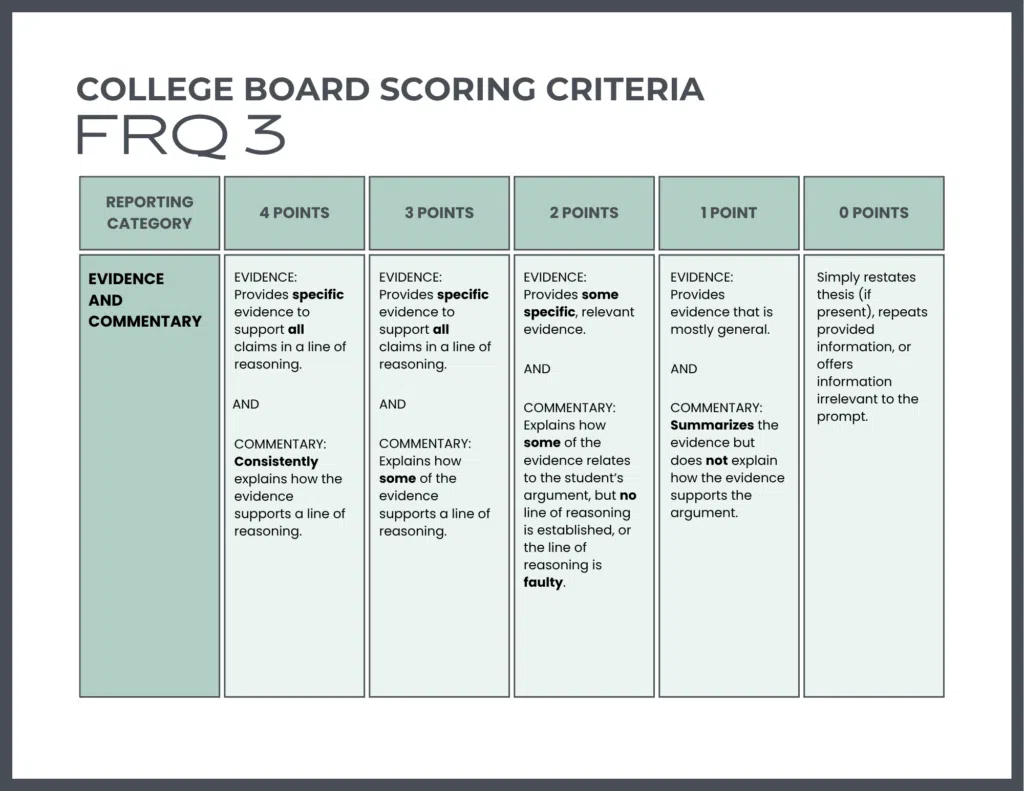
If you pay close attention to how the wording changes as you move left to right across the rubric (don’t get us started on the College Board’s insistence on printing rubrics with the high score on the far right), you see how much it matters that students provide (a) specific pieces of evidence, and (b) explicit commentary that connects each piece of evidence to their claims.
What Goes Wrong
Unfortunately, students often summarize the plot instead of crafting an argument, drop quotations into their essay without analysis, or provide commentary that is vague or disconnected. This is especially true for FRQ 3, where students must rely on paraphrasing evidence rather than quoting since the text is not in front of them.
How to Fix It
1
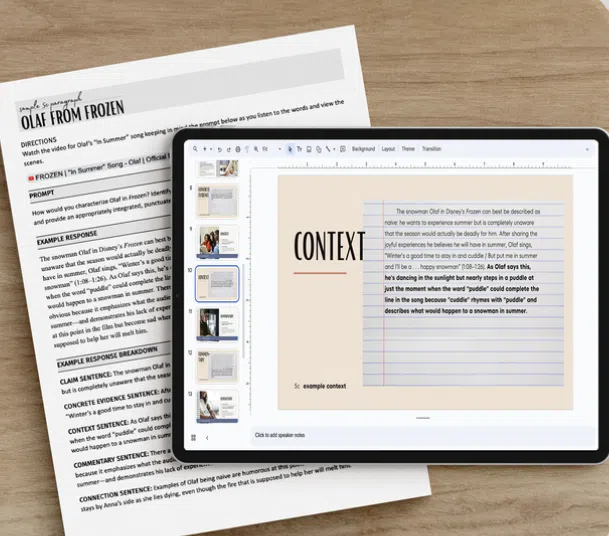
Review the elements of an evidence-based paragraph early in the year using a repeatable framework like our 5C paragraph: claim, concrete evidence, context, commentary, connection.
When students have a clear framework like this to follow, it’s easy for them to remember to include all of the elements on the rubric. Even if their commentary is weak, it’s there, which places them at a higher starting point.
2
Model how each part of the paragraph builds on what comes before, especially the commentary and connection sentences.
AP Literature students have likely heard the term “commentary” before, but that doesn’t mean they understand it. Whether you’re using released sample essays from the College Board or crafting a sample together, students benefit from seeing what effective commentary looks like.
By encouraging students to end a paragraph with “connection” rather than “conclusion,” you remind them to build a line of reasoning rather than repeating themselves.
3
Use sentence starters to build clarity and confidence.
We love, especially early in the year, providing students (yes, even AP students) with explicit sentence-by-sentence directions or sentence starters to help them get the feel for what each of the sentence types looks like.
We tend to customize our sentence starters for each specific task, but Gerald Graff and Cathy Birkenstein’s They Say / I Say provides a robust list of sentence starters (and examples) that students can use in academic writing. (They also offer a fantastic argument for why even advanced writers benefit from using sentence starters.) Steph provides her AP Seminar students with a list of sentence starters from this text as a go-to resource.
Why It Works
One of the most valuable things we learned in our first few years of teaching is that our students often know less than we assume they do, and there’s no shame in starting with a quick review of the basics. Providing students with a clear structure helps them remember all the elements they need to include in an essay, setting them up for higher scores before we even worry about improving the quality of their ideas.
Starting with a paragraph instead of a full essay also aligns with the AP Literature Course and Exam Description, which recommends having students write a literary analysis paragraph in Units 1 and 2 rather than a full essay.
A Ready-to-Use Framework for Clear, Evidence-Based Paragraphs
Ready to take the next step after teaching theme statements? This resource gives students sentence-by-sentence guidance for crafting 5C paragraphs, plus teacher slides featuring a model paragraph about Olaf from Frozen. Includes both standard-level and PreAP/honors samples so you can use it across multiple classes, and it transitions seamlessly into teaching the full AP Literature essay.
Building the FRQ 2 Essay with Confidence
Why It Matters
Once we’re confident that students can write a decent theme statement and an evidence-based paragraph that analyzes rather than summarizes, we like to introduce the AP Literature essay through a scaffolded approach. We start with FRQ 2 (the prose analysis prompt) because students tend to find it more approachable than poetry, and it lends itself better to a reusable format than FRQ 3, with its far greater room for variety.
While we feel confident that it’s a good starter essay, students often still freeze when they face a dense passage and a relatively wide-open prompt.
What Goes Wrong
There’s a lot that can go wrong with a prose analysis essay, especially at the beginning of the year. Students often misunderstand the passage or, desperate to find any literary device, write about irrelevant details. Many lack a clear organizational strategy and struggle to align their thesis statement with their body paragraphs.
This is a key reason that we take a scaffolded approach: students need to tackle the analysis separately from the writing, and they need explicit instruction both in how to analyze the passage and how to convey their ideas in writing.
How to Fix It
We structure our introduction to the AP Literature essay, specifically FRQ 2, in seven steps:
1
Teach a structured approach to breaking down the prompt.
Students often struggle to answer all parts of the prompt, so we like to make sure they’re confident in understanding the full task.
2
Guide our students through the passage.
While on the exam, students will have to analyze the passage independently, they need help the first time. We provide text-dependent questions to guide them through the passage, drawing their attention to the key elements. Students who are already fairly proficient in writing may be prepared to annotate the passage on their own.
3
Guide students through the brainstorming process.
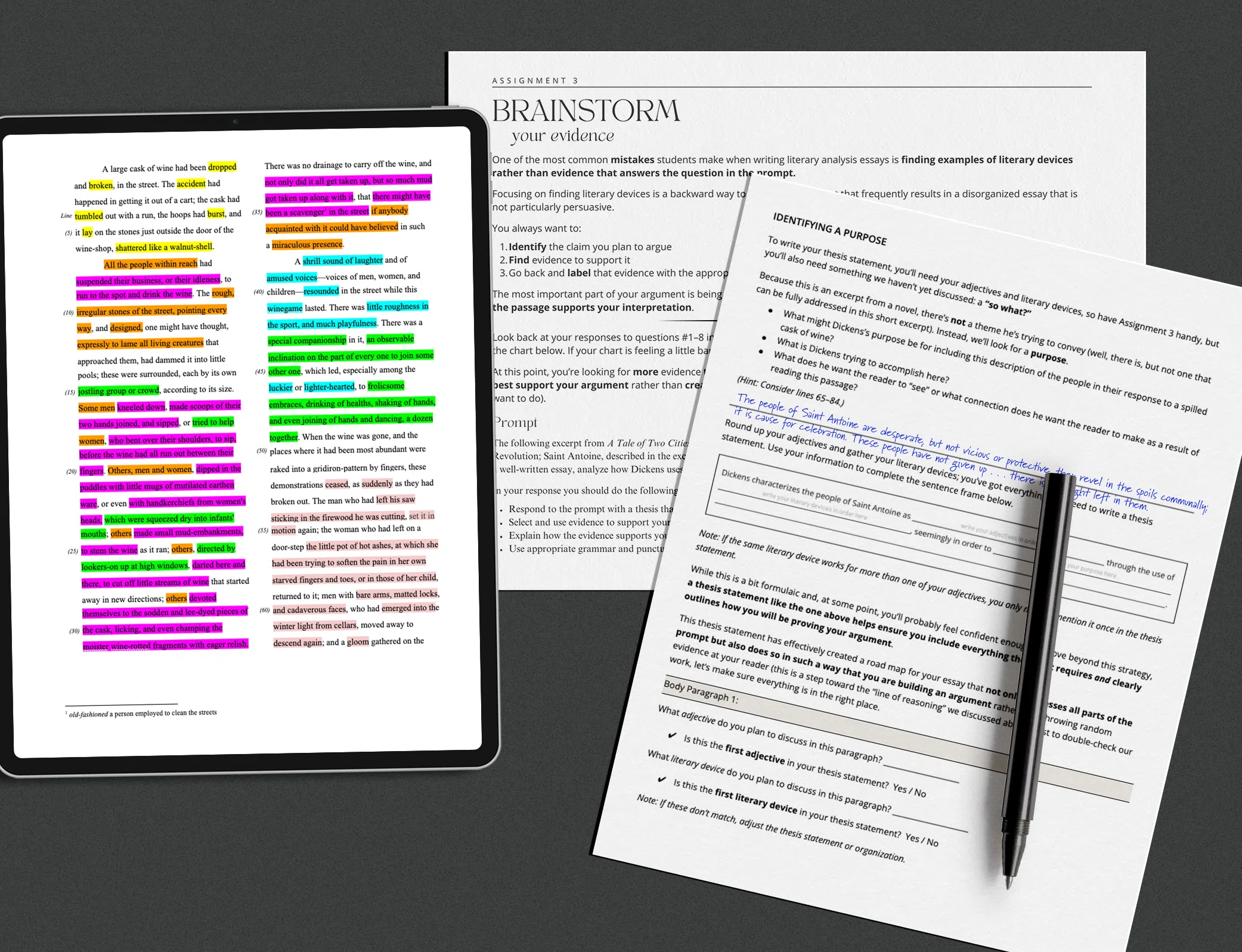
One of the most common mistakes on the prose analysis essay is that students go on a hunt for literary devices first rather than providing an accurate interpretation of the passage that addresses the prompt.
We help them figure out their interpretation of the passage first, find evidence to support it, and only then identify the literary devices the author uses in the evidence they’ve identified.
4
Help students construct an outline for the essay.

While we always encourage our AP Literature students to organize their essays chronologically (it helps build a clear line of reasoning), they do need some guidance in selecting the ideas and evidence from their brainstorm that will work best.
Focusing on selecting details before students write helps them build a clear line of reasoning that will connect and support the thesis statement all the way through the essay.
5
Guide students through writing a thesis statement.
It’s difficult to provide generic instruction in thesis statements in AP Literature: as long as they make a defensible claim, there is no specific format they must follow, and we’ve found that because interpretations can vary so much, requiring students to follow a specific format can backfire. We prefer to review the elements of a strong thesis statement in the context of a specific prompt and passage, so this is a good place to do so.
Writing the thesis statement after selecting the ideas and evidence they plan to use also ensures that their thesis statement incorporates all of the ideas they plan to discuss.
6
Show students how to use the structured evidence-based paragraph format to build a full essay, one sentence at a time.
It’s essential to show students how these skills build: the work they did to write a structured paragraph is a building block that will help them to write a strong essay.
When students see this, they’re able to feel more confident that they do know how to write an essay, and they’ll be more likely to remember the key elements they must include.
7
Allow students to try it on their own.
Only after we’ve gone through this scaffolded approach do we assign students to try writing a prose analysis essay on their own, whether it’s immediately after this mini-unit or a few weeks later.
Why It Works
Many students feel apprehensive about writing their first AP Literature essay, so building an easy-to-remember approach that breaks the process down into manageable steps that are aligned with the rubric helps them to feel confident that this is a task they can master.
The process for writing the prose analysis essay (FRQ 2) is identical to the process they’ll later use to write the poetry analysis essay (FRQ 3), and the structured approach also transfers well to FRQ 3, though there are some slight modifications.
Take the Fear Out of the First AP Literature Essay
Help students approach their first AP Literature essay with confidence using a clear, manageable process that aligns with the College Board’s rubric. This mini-unit walks them through seven proven steps using an excerpt from A Tale of Two Cities, with everything you need — answer keys, presentation slides, and a structured approach that works for both the prose analysis (FRQ 2) and poetry analysis (FRQ 3) essays.
When to Teach These Foundational Writing Skills
We recommend reviewing theme statements within the first or second week of the school year. It’s a great transition into AP-level work after summer, and it’s a skill they’ll use with every text you read throughout the course.
We introduce the 5C paragraph structure in Week 2 or 3, alongside our first full text of the year. We have our students use this format for short-answer responses throughout the year, so it’s one of our core skills to teach.
Finally, we introduce FRQ 2 in Weeks 4–6, when students have begun to show mastery of the 5C paragraph approach. Instead of cycling through the nine units exactly as recommended by the College Board, we rearrange the units slightly, focusing on short stories (Units 1, 4, and 7) first semester and poetry (Units 2, 5, and 8) second semester, with longer texts (Units 3, 6, and 9) woven throughout. This means that after a few weeks of looking at short stories, our students are ready to tackle their first prose analysis essay.
You can then spiral these skills all year long, whether you continue to use Pixar short films as bellringers, require students to write evidence-based paragraphs as short answer responses, or just require students to write and revise theme statements for every text you read and discuss together. Students need frequent practice, and these are the core skills they’ll use most in the course.
Final Thoughts: Writing Foundations Make or Break the AP Literature Essay
Students don’t need to write a perfect AP Literature essay in September, but they do need to start building and practice the skills they’ll use throughout your course. Without a road map, even your strongest readers can fall apart on test day. When you start the year by teaching students what a real theme looks like, how to write evidence-based analytical paragraphs, and how to combine those paragraphs to structure a full essay, you’re setting them up for clarity, confidence, and maybe even a shot at the coveted and elusive sophistication point.
Take the Fear Out of the First AP Literature Essay
Help students approach their first AP Literature essay with confidence using a clear, manageable process that aligns with the College Board’s rubric. This mini-unit walks them through seven proven steps using an excerpt from A Tale of Two Cities, with everything you need — answer keys, presentation slides, and a structured approach that works for both the prose analysis (FRQ 2) and poetry analysis (FRQ 3) essays.