This Writing Activity Got Our Reluctant Students to Write More Than 10 Sentences
Assigning a writing activity in September brings a big thudding halt to whatever momentum you’ve managed to create through several days (or weeks) of icebreakers, review activities, and energetic introductory lessons.
Students stare at blank computer screens, struggle to produce a single word without running it past you first, and repeatedly plead, “But how do I start?” And this is just the writing process.
If you’re asking students to write any kind of literary analysis, it means you’ve asked them to read and think about a text: something many of them haven’t done in several months. And let’s face it. The stories, essays, and poems that fill most textbooks just can’t compete with the latest TikTok trend.
No matter what writing activity you assign, students seem to shut down before they start.
This is the perennial challenge we face as English teachers: How do you teach analytical writing when students won’t engage with the texts that fill our curriculum?
After many years of trial and error, we discovered the secret wasn’t in what writing activity we assigned, but in how we guided students through it.
The Traditional Approach That Failed
Why Our First Attempt at Theme Paragraphs Was a Disaster
An early writing activity in our curriculum guide required students to write a paragraph in support of a theme statement. Simply writing a theme statement is challenging enough. Our textbook didn’t help: one of our core texts was a short story about fishing and the Dartmouth crew team, not particularly relatable to our predominantly Hispanic students in Southern California.
We’d already had success using Pixar shorts for teaching theme statements, but their brevity limited our options for a full analytical paragraph. Up seemed like the perfect solution: a full Pixar film with dialogue and clear themes.
Wanting to remind students that we were doing literary analysis and not just “watching a movie,” we provided copies of the script for citing textual evidence and a paragraph structure we’d learned about in professional development: TEPAC, which stands for Topic Sentence, Evidence, Paraphrase, Analysis, Conclusion.
It. Was. A. Disaster.
The vast majority of our students decided that the theme of Up was “Adventure is out there.” Their textual evidence? “Adventure is out there.” Given that these aren’t particularly challenging words, their paraphrase? You guessed it. We literally read multiple paragraphs that sounded something like this:
The theme of Disney Pixar’s Up is adventure is out there. For example, Charles Muntz says, “Adventure is out there.” In other words, adventure can be found in the world. This means that adventure exists. In conclusion, adventure is out there.
We read circular analysis after circular analysis, wondering how this fun writing activity could have gone so wrong.
We realized that our students needed two things: a text where the theme flowed from a more obvious character change, and a paragraph structure that didn’t force artificial steps. The TEPAC format required students to paraphrase every quotation (even when unnecessary) and write conclusion sentences that inevitably just repeated the topic sentence. Our developing writers needed a structure that guided them toward meaningful analysis, not one that trapped them in circles.
The Secret: Scaffolded Success with Unexpected Content
Enter LEGO Batman: The Game-Changer
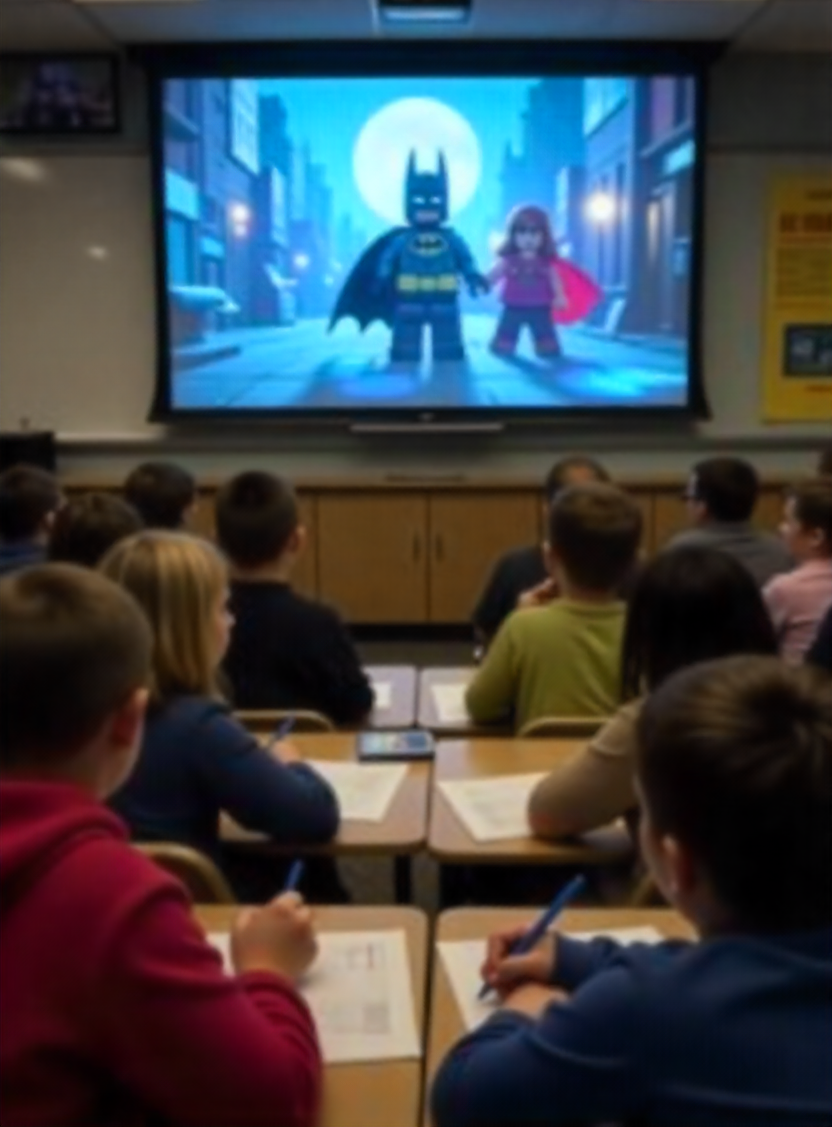
Kate found the perfect solution: Chris McKay’s 2017 film The LEGO Batman Movie.

Still a kid’s film (and thus appropriate to show in class), the film traces Batman’s development from selfish, lonely, and stubbornly independent to open-minded, cooperative, and appreciative when he has to work with Robin, Batgirl, his butler Alfred, and his trusty ‘Puter to rescue Gotham City from the Joker’s evil plans.
What our students didn’t understand—and, honestly, what we didn’t understand until after the disastrous Up writing activity—is that a strong theme paragraph traces the development of a theme over the course of an entire story. If, as we teach students in our six principles for an effective theme statement, “A theme addresses the entire story, not just one part of it,” then a paragraph supporting that theme statement cannot have only one piece of supporting evidence.
To make this concept accessible, we needed a story with a dynamic character: tracing a character’s change over the course of a story inevitably leads to a story’s theme.
Batman was the exact dynamic character we needed. We structured our mini-unit to approach the writing activity in a three-part structure: Part 1 establishes what Batman is like at the beginning of the movie, Part 2 details the events that cause Batman to change, and Part 3 establishes what Batman is like at the end of the film.
Not only did we guide students through the process of analyzing these three parts (more on that below), which eliminated the “I don’t know what to write” problem, but we translated that three-part structure to the students’ final writing activity, combining three sets of claim-evidence-commentary to create a “supersized” paragraph that fully supported the theme statement students laid out in their topic sentence.
Of course, viewing The Lego Batman Movie was more fun than reading a “boring” short story (and don’t worry, we did return to those eventually), and removing the reading challenge allowed students to focus on the writing challenge.
But more importantly, we scaffolded the writing process in a way that taught students a paragraph can be more than five sentences. This systematic approach created a foundation that would later allow us to bridge from our three-part paragraph to full five-paragraph essays about more complex texts.
The Day-by-Day Breakdown
How We Built to 14 Sentences in Six Days
A Note about Context
We taught this unit after a lesson on writing effective theme statements. While this writing activity works as a standalone, students’ paragraphs will be stronger if they’re familiar with writing theme statements.
Days 1–3: Building a Foundation
Before our students could begin writing, they needed to watch the film in its entirety. We broke the film into three parts, timed to fit within three class periods (about 35–40 minutes each).
Each day followed the same pattern: students watched their assigned portion and completed a viewing guide that had them select adjectives describing Batman and identify quotations that supported those adjectives. The guides were slightly different for each section—Part 1 focused on Batman’s initial character traits, Part 2 on moments that motivated him to change, and Part 3 on his transformed character.
Breaking up the viewing this way allowed us to provide feedback throughout the process. As students viewed Part 2, we quickly reviewed their selections for Part 1, adding notes if someone was headed in the wrong direction.
Days 4–6: From Notes to Paragraph
Students spent the next three days working through our scaffolded writing activity. Originally, we walked students through it step by step. Once we switched to a flipped classroom model, we recorded screencasts that guided students through the steps at their own pace, freeing us up to provide one-on-one assistance.
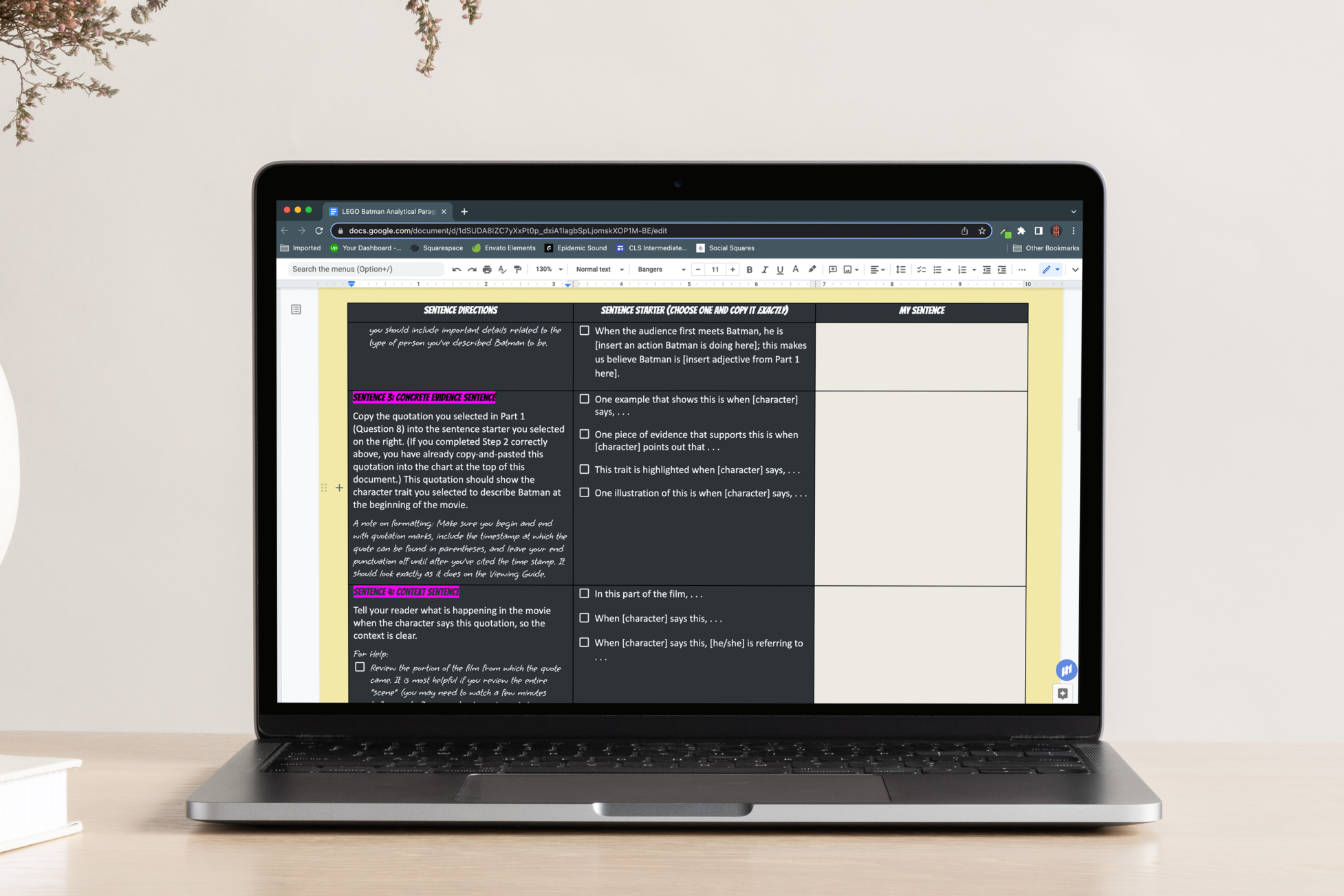
We provided students with a 14-sentence structure that expanded our 5C format into three complete analytical cycles. Each cycle followed the same pattern: Concrete Evidence (quotation), Context (what was happening in the scene surrounding the quotation), and Commentary (analysis), connected by transition sentences that moved readers smoothly from one part of Batman’s journey to the next.
Students had already done most of the analytical thinking during the viewing guides, so the writing activity became a matter of transferring their insights into our structured format. We provided sentence starters for each of the fourteen sentences, with multiple options for each.
Finally, students copied their sentences into a final MLA-formatted draft. We skipped peer review since the assignment was so heavily scaffolded, and ended with a confidence-building quiz about the movie that most students aced.
The Results That Surprised Us
From “I Can’t Write” to 14 Sentence Analysis
Nearly every student completed this writing activity, even during remote learning when engagement hit rock bottom. One of Steph’s students, upon proudly clicking submit on their final draft, declared, “This is the most I’ve ever written.”
This student was not alone. Most students had never written a paragraph that long before, and many of our students habitually wrote essays that were shorter than their final drafts on this assignment. Our students were proud of the work they had done, the outcome we value most.
Students’ success on this assignment carried them forward into the rest of the year. Students used the 5C paragraph (albeit in its original five-sentence form) constantly during the school year, improving their writing quality through repeated practice. Our sophomores went on to write a five-paragraph essay describing Elie Wiesel’s change in Night, directly building upon the skills they developed in this unit. We even changed the way we taught writing in AP Literature. We began guiding students to use this chronological character development approach in their Q3 essays about novels and plays.
Once we saw the strong foundation this writing activity created for our students, we made it our first unit of the school year, using students’ early success to build momentum as we moved to more complex texts and tasks.
What Made This Unit Different
Scaffolding That Actually Works
Our revised writing activity improved on our original Up assignment in a few key ways.
First, our revised 5C paragraph format led to more meaningful, cohesive writing. By replacing paraphrase with context, we reduced unnecessary repetition and helped students make their ideas clearer for a reader. Adding transition sentences showed students how to summarize purposefully, and replacing the conclusion sentence with a connection sentence guided them toward a conclusion that summarized their ideas while also sharing a new insight, a perennial challenge for writers of all ages.
Second, as we hoped, our movie choice led to stronger themes that were well-supported. By teaching students to focus on the way a character’s change points toward a theme, we not only showed our students how to write theme statements that covered an entire work, but we also gave them a way to support that theme statement without merely summarizing the text.

Third, our writing activity included multiple layers of differentiation. Despite the extensive scaffolding, students selected their own adjectives, quotations, and sentence starters, so they still felt ownership of their interpretations. Many of the scaffolds, like sentence starters and pre-selected adjectives and quotations, can be removed for more advanced students. Because of this, the approach works for students of all levels—middle school to high school, students with IEPs, English language learners, and high achievers.
Fourth, the flipped classroom videos allowed students to select the level of support they needed, freeing us up to provide the truly differentiated individual instruction we don’t ordinarily have time for.
Finally, setting up our writing activity as a systematic approach made it adaptable for later texts. Our students learned a paragraph structure that they used repeatedly in our class, what to look for when developing a theme statement for a more complex text, and how to support that theme statement fully in writing.
How to Adapt This for Your Classroom
Making This Work with Any Text
This approach works with any text that features character change. Keep these four principles in mind:
- Choose texts with obvious character change for students’ first attempts, then progress to more subtle transformations.
- Break complex analysis into manageable steps rather than giving easier tasks. By doing this, you show students they can handle rigorous work when properly scaffolded.
- Provide choice within structure so students feel ownership while still receiving necessary support.
- Build systematically from simple to complex both within the unit and across your year.
This method works well with most animated children’s movies (we’ve used The Lego Movie as an alternative), superhero origin stories, or short stories with clear character development like Judith Ortiz Cofer’s “Catch the Moon.” Even Up might have worked with better scaffolding!
If you want our complete day-to-day materials for The Lego Batman Movie, we’ve created everything you need: standard and PreAP versions, digital and print formats, scoring rubrics, quotation banks, character adjective lists, and a comprehensive teacher’s guide. For students new to theme statements, these materials bundle perfectly with our bestselling Pixar Theme Activity.
The best part? You’ll never have to hear, “But I don’t know how to start!” in September again.