How to Teach Plot Elements with Pixar Shorts (and Actually Make It Stick)
One of the most frustrating things about teaching is the amount of re-teaching required.
One of Steph’s biggest mistakes in her first year was assuming that students were ready for grade-level content on the first day. She jumped straight into a full-period lesson on types of phrases without reviewing the basics—parts of speech and parts of a sentence. Needless to say, it was a disaster.
We made a similar mistake with plot elements.
According to the Common Core Standards, our students learned the basic parts of a plot in second grade. By the time they reach high school, they’re supposed to be learning how to analyze an author’s choices in structuring a text and how those choices create suspense.
Just like with grammar, however, if students don’t remember the foundational plot elements, they’re not able to recognize the effect created when an author chooses to use them in conventional—or unconventional—ways.
But teaching plot elements can be frustrating: our students have seen a plot diagram before—many times—so they’re not particularly engaged when we ask them to fill out yet another one. And while they might be able to rattle off a definition for each part of the plot, this doesn’t mean they’re able to accurately identify them, much less discuss the purpose these plot elements serve.
While it took us a few years to refine and develop our approach, we found success when we stopped jumping straight into a grade-level text and instead created a scaffolded mini-unit that builds from accessible (and engaging) texts toward a genuinely challenging one.
In this post, we’re sharing how we structured our mini-unit—which has been used with students in grades 6–10 and works particularly well for English learners and students with learning disabilities—and why it works. Even better, we’ve included a link to the full unit so you can use it in your classroom—no additional prep required!
Free LITERARY TERMS LIST!
Sign up below to join the free resource library.
Why Plot Elements Are Worth Teaching (Even in High School)
Planning a lesson that reviews basic plot elements can feel uncomfortable for high school teachers. Isn’t this elementary-level work? Don’t our students know this? What’s the point of drawing yet another plot diagram?
But in the same way that reminding students of the parts of speech gives them the building blocks they need to discuss more advanced grammar concepts, reviewing basic plot elements gives students a foundation to build on as they develop their literary analysis skills. We created an infographic to display at the beginning of the unit that reminds students that plot is the foundation of a text—we can’t understand character, setting, conflict, point of view, or theme without it. Without plot elements, we don’t have the conflict that drives the character change that points to the theme.
Students also struggle with a few key misconceptions related to plot elements. Instead of carefully selecting events from the story that truly complicate the conflict introduced in the story’s exposition (or basic situation), students fill the “rising action” side of the plot diagram with random events from the story. They also tend to think any exciting moment can be considered the climax, a misconception reinforced by symmetrical plot diagram templates that place the climax in the center.
To help address these misconceptions, we reimagined the plot diagram as a journey into the mountains to help students recognize that the parts of a plot aren’t evenly divided.
Addressing these misconceptions matters even more in honors and AP courses, where texts deliberately experiment with structure. If students don’t recall the traditional structure, they’re unable to recognize, much less discuss, the complex choices an author might be making. Even in these courses, students benefit from a quick review of the basics.

Start with What Students Already Love—Pixar Shorts
Before students can apply a concept—any concept—to a challenging text, they need low-stakes practice with accessible ones.
Ever since we used Pixar shorts to create a theme statement lesson we love, we use these short videos whenever we can. The stories are short, self-contained, usually dialogue-free, and engaging without being distracting—all qualities that make them perfect for skills practice activities. In our experience—and based on feedback from teachers who’ve used this unit—students are genuinely excited to work with these texts.

We decided to start our mini-unit on plot elements by having students create plot diagrams for three Pixar shorts: Feast, Lava, and Paperman. These three work particularly well for plot because they are straightforward—some Pixar shorts explore complex themes, but these are more action-oriented.
To scaffold the skill, we provided students with a list of events from each short film, which they placed in the correct places on the plot diagram. This is easy to assign through your LMS as a drag-and-drop activity using Google Slides, but it works equally well as a cut-and-paste activity on paper.
For more advanced students, we removed some (or all) of the event boxes so that students had to generate events on their own. This simple differentiation move raises the ceiling without requiring a separate assignment.
Because students already love these short films, they’re able to understand the plot elements in each one more quickly than they do for more complex, unfamiliar texts. And after three practice opportunities, students are ready to take on a more challenging task.
Add Complexity By Identifying Plot Elements in a TV Episode
After reviewing the basic parts of a plot—exposition (basic situation), complications, climax, and resolution (denouement)—with Pixar shorts, students are ready for something longer and more structurally complex.
We decided to transition to an episode of Modern Family called “Fizbo” (S1E9). Not only is the show engaging for students and appropriate for the middle and high school classroom, but the episode has multiple storylines and unfolds in flashback, which means students have to do more cognitive work to build the plot diagram.
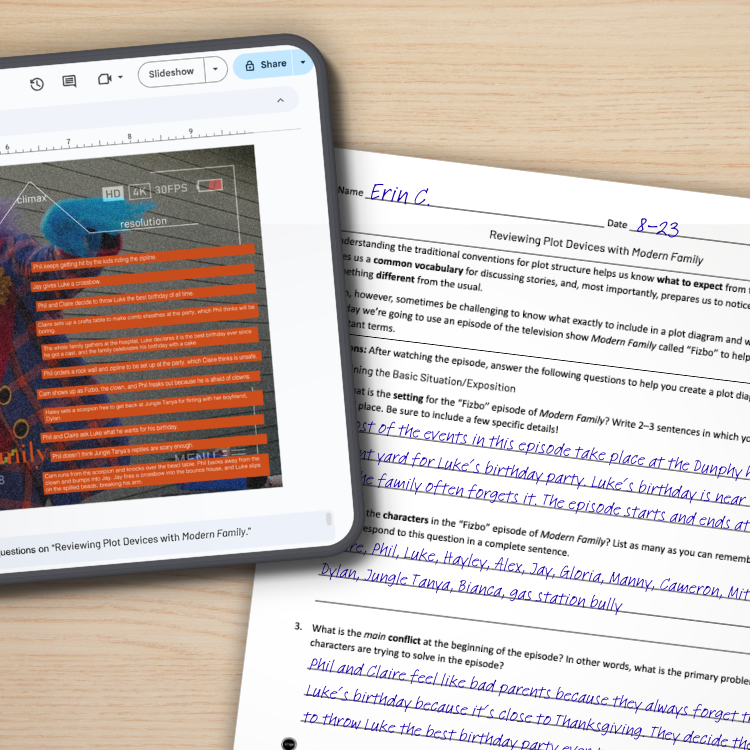
After students watched the entire episode, they fleshed out their understanding of the exposition’s function by identifying the episode’s setting, characters, and primary conflict.
Then, students built their plot diagram, focusing on the main storyline. Because the structure of the episode added a challenge, we still provided students with a list of events (digital drag-and-drop or paper cut-and-paste), but this scaffold could easily be removed for more advanced students.
Students then answered questions about the function of additional plot elements. First, they identified examples of foreshadowing by reviewing their plot diagram to find clues about the story’s eventual resolution. Then, they began to consider the function of the nontraditional structure—why the story started in the middle of the action before going back in time. Finally, we asked them to identify examples of both an internal and external conflict from the episode, highlighting that there are often multiple conflicts in a story—not just the main one laid out in the exposition.
By completing the activity in this order, students see how the plot diagram fits into a larger understanding of the text rather than serving as a standalone activity.
Just like the introductory Pixar shorts activity, this can be easily differentiated for varying levels. If your students need extra support, it may be helpful to replay the episode as they work on the activity. If you have more advanced students, in addition to removing some of the scaffolds, you might assign them to complete a smaller plot diagram on their own for the two additional storylines. This last suggestion doesn’t only apply to honors and pre-AP students—it’s something our standard-level students were able to do.
Analyze Plot Elements in a Real Text: “The Lady, or the Tiger?”
By this point, students have practiced creating plot diagrams for three Pixar shorts and a TV episode, and they’ve been introduced to the terms they’ll need for analysis. They’re ready for a short story.
At the middle and high school level, we find it helpful to choose a short story in which the author deviates from the traditional plot structure in some way. The relevant grade-level content standards ask students to compare and contrast structural choices or to analyze their effect, and there isn’t always much to discuss when stories follow conventions.
For this mini-unit on plot, we decided to use Frank R. Stockton’s “The Lady, or the Tiger?” This is a deliberately challenging choice: students must grapple with challenging vocabulary, and, most importantly for our purposes, the ending is unresolved. This means students have strong opinions, which makes discussion of why the author might have chosen to end the story in this way productive rather than perfunctory.
We used our standard approach to guided reading questions, embedding multiple-choice questions in the text to guide students through the reading with a particular focus on applying the plot elements students reviewed earlier in the unit. At the end, we asked students one short-answer question—an approach that allows us to provide meaningful feedback without burying ourselves in extra grading.
We—and other teachers—have used this unit successfully with students across a range of ability levels, including ELLs and students with learning disabilities. Our unit comes with three differentiated versions of the guided reading questions: a standard version (with challenging vocabulary defined in-text), a PreAP version (with definitions), and a PreAP version without definitions. The questions are the same in each version, but the standard version includes cues about the number of correct answers, and the PreAP version has more rigorous expectations for the short-answer response. For teachers who want an additional layer of enrichment, we’ve also provided a blank plot diagram students can fill in using their guided reading responses—a useful tool for visual learners.
Wrap Up with an Assessment That Goes Beyond Memorization
Because this is a review unit rather than a deep dive, we kept the assessment simple but meaningful.
We gave students a multiple-choice quiz with 20 questions that covered key literary terms and students’ ability to apply those terms to the unit texts. While there are a few definition questions, the majority of the questions test application, not just recall. Students have to demonstrate that they understand both the texts and the function of the plot elements we reviewed—not just that they memorized a list.
Our unit includes two versions of the quiz to deter academic dishonesty as well as a link to a Kahoot! review game for low-prep, high-engagement review before the quiz.
It took us a few years to stop assuming our students were ready for grade-level work from day one—whether we were teaching grammar or plot elements. No matter what grade level we teach, our students need a review of key terms and basic plot structure before they can analyze the effects of structural choices. The mini-unit we created works as an early-in-the-year review because it scaffolds deliberately, starting with accessible texts before adding complexity incrementally and assessing to confirm actual understanding.
Interested in trying our plot mini-unit out for yourself? The 4–7 day mini-unit includes all the materials you’ll need for the activities described above—standard and PreAP, editable digital and print versions—including answer keys, a plot infographic, and a list of plot elements with student-friendly examples.