
Reading in Class: How to Teach Elie Wiesel’s Night When Students Won’t Read at Home
Reading in class used to be an occasional treat—something English teachers did to introduce a new novel or to fill time when discussion ended early.
But reading in class is increasingly the norm in many English classrooms.
Why? It’s complicated.
Assigning at-home reading has always posed a challenge for English teachers. We don’t have time to read multiple novels (and a selection of shorter texts) aloud in class, but there are always students who don’t read, limiting the effectiveness of our in-class activities.
But homework is also increasingly unpopular. Some schools and districts have explicit policies limiting the amount of homework teachers can assign; others rely on more subtle pressure. Some of us have had our own mindset shift about high school homework in the face of burnout and student mental health concerns. And then there’s the Internet and AI—we have to assume they’ll be involved any time students are assigned to do work outside of our classrooms.
Reading in class, however, requires a significant amount of time. Do we prioritize shorter texts, or is there still a place for complete novel units in this reality?
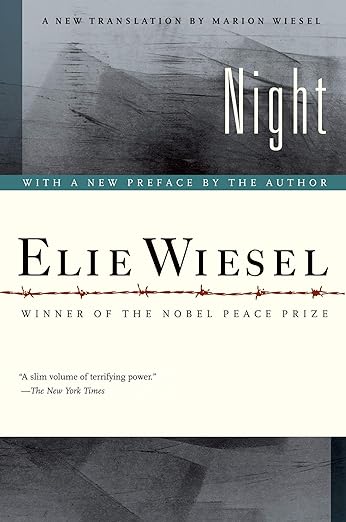
Night, by Elie Wiesel, is an excellent option for teachers who want to read a full-length novel—or in this case, memoir—while doing the reading in class. It’s short (only 120 pages), yet incredibly powerful.
Teaching Night worked wonderfully in our standard-level (often below-grade-level) sophomore English class, and today we’re sharing our complete and tested approach for teaching Night entirely in class.
Why Elie Wiesel’s Night Is Perfect for Reading in Class
As we mentioned above, Night is short. This is huge for struggling readers and in-class pacing. Whether you’re trying to read multiple full-length texts or (like us) incorporate activities alongside the reading, it’s doable.
Our final novel of the year used to be To Kill a Mockingbird. As we read more and more of it in class, our accompanying activities got simpler and simpler: we just couldn’t read 336 pages aloud and scaffold meaningful activities. Teaching Night allowed us to do both.
Students also connect with it. Many of our students are drawn to real-life stories about trauma and challenging experiences. They’ve also likely learned about the Holocaust before—our students had previous experiences with both The Diary of Anne Frank and The Boy in the Striped Pajamas.
Reading comprehension isn’t a significant barrier. Wiesel’s prose is accessible, which means there is room for students to think deeply about the context and implications rather than just trying to get through the text.
Finally, Elie Wiesel’s Night is culturally important. Our students need to learn about and engage with historical injustices, and literature allows them to feel empathy for their fellow humans who come to life in the pages of a book.
Our Biggest Concern About Teaching Night (And How We Addressed It)
Though we knew Wiesel’s book was important for our students to read, we had some concerns about how they would receive it.
Our students were predominantly Hispanic and Vietnamese, and Wiesel isn’t gratuitously graphic, so we weren’t worried about triggering students—there were other texts where that was a bigger issue.
Instead, we were concerned about insensitivity. Teenagers can be immature and unkind (especially when they are uncomfortable), and they are growing up in a culture where hateful rhetoric is increasingly normalized. We wanted to make sure they would treat Wiesel’s memoir with respect.
Our textbook placed Night in an essential questions unit about the Human Connection, but we decided to keep it simple, asking our students to consider, “Why is it important for us to learn and care about what happens to other people?”
This framing worked nicely for our students, and given that we taught Night for the first time amidst the COVID pandemic and Black Lives Matter protests, the question directly intersected with students’ experiences.
Building Context Before Reading in Class: Pre-Reading Activities for Night
Pre-reading activities were essential for teaching Night. We needed to set the tone of empathy and ensure that all students had a basic historical context.
We assigned the activities below as Actively Learn assignments, where we embedded definitions, explanations, videos, and guided reading questions. Students had the opportunity to revise these assignments after we provided direct feedback. If you’re interested in learning more about this process, we’ve explained it in detail in our post about universal scaffolding.
Activity 1: The Human Connection and Empathy
We began with a reflective assignment in which students considered why it’s important for us to learn and care about other people and how naturally this skill comes to them.
Then, we played a video clip from an interview with Bryan Stevenson, where he explains his work with the Equal Justice Initiative, and shared one of our favorite quotations from Just Mercy:
“We are all implicated when we allow other people to be mistreated. An absence of compassion can corrupt the decency of a community, a state, a nation. Fear and anger can make us vindictive and abusive, unjust and unfair, until we all suffer from the absence of mercy and we condemn ourselves as much as we victimize others. The closer we get to mass incarceration and extreme levels of punishment, the more I believe it’s necessary to recognize that we all need mercy, we all need justice, and—perhaps—we all need some measure of unmerited grace.”
We ended by sharing two YouTube videos (unfortunately, we can only access one now) that discussed why it’s important to learn about the Holocaust in our modern world, connecting our broader reflection specifically to the unit.

Activity 2: Hitler’s Rise to Power
We also felt it was important for students to understand the historical context, so we shared a TedEd video about Hitler’s rise to power, an article about the Hitler Youth, and a video from the US Holocaust Memorial Museum about the Nazis’ treatment of the Jews before the concentration camps.
Students reflected on how Germany was a democracy similar to ours—Hitler’s rise wasn’t anomalous or something that could only happen to “other people.”
Activity 3: Understanding the Concentration Camp System
Our final pre-reading assignment on Actively Learn guided students through an article from The New Yorker titled “The System” that explained the concentration camps. This article was challenging and required additional support (we recorded screencasts for difficult questions), but it provided essential background and connected back to Stevenson’s ideas about compassion.
Including reading in class and revisions, these activities took 5–7 days.
Our Reading in Class Approach for Night: First and Second Reads
Our textbook incorporated first reads (comprehension) and second reads (analysis). We followed this structure for early chapters but condensed later chapters into single reads to save time and maintain engagement.
Curious about our chapter breakdown? We read Chapter 1, combined Chapters 2–3, read Chapter 4, combined Chapters 5–6, and combined Chapters 7–9. We did first and second reads for Chapters 1–4 and only one read for Chapters 5–9.
First Read: Audio & Comprehension Questions
For our first read of each chapter (or chapter pairing), we played the audiobook as students read along. We paused the reading approximately 10–12 times for students to answer a multiple-choice reading comprehension question, clarifying any confusion before moving on.

This straightforward approach ensured all students, including struggling readers, could access the text and understand Wiesel’s narrative.
Second Read: Text Excerpts & Analysis Questions
The second time we read each chapter, we focused on specific excerpts and asked students deeper analysis questions. At least one (if not more) of those questions was a short-answer question, and students had to incorporate textual evidence in their response.
Extension Activities
The first time we taught the novel, we included extension activities—videos and excerpts from supplementary texts—at the end of each reading assignment. We cut some of those activities out in future years to save time for our writing activities.
We did keep two, however: we showed a TedED video about the White Rose, a group of German students who resisted the Nazis, and an excerpt from Primo Levi’s memoir, Survival in Auschwitz, about the Black Market that Wiesel describes in Chapter 4.
We kept the TedED video to show that not all Germans supported Hitler. We kept the Levi excerpt because it contextualized three key incidents from Chapter 4 (stolen shoes, dental crown removal, soup theft) within our empathy focus. Students completed this prompt after reading:
The details in this excerpt help us to understand that even though the people who stole from Eliezer were wrong, they probably did it because ________. Tragic events like the Holocaust show us that desperate situations can make normally honest and trustworthy people act out of character because _______. This idea adds to our understanding of why it is important for us to learn and care what happens to other people because _________.
The Reality of Pacing
We spent most of first semester on Night—a long time for 120 pages—and we acknowledge this may not work for everyone.
But it worked for us. We chose depth over breadth and experienced a relatively high participation rate. Most of our students actually read and engaged with an important text from beginning to end—something that definitely didn’t happen with every text we read. We also continued to incorporate our weekly bellringers (typing, grammar, and vocabulary) and our weekly independent reading day.
Writing About Night: Breaking the Essay into Manageable Pieces
Our Night writing assignment flowed directly from our LEGO Batman writing activity, the logical next step in our year-long scaffolded writing instruction.
Students had just learned our 5C paragraph structure while describing how Batman changes over the course of The LEGO Batman Movie. The Night essay built directly on that assignment, following a similar structure as students described how Elie changes throughout his experience in the concentration camps. This time, however, students transitioned from one oversized paragraph to a traditional 5-paragraph essay.
The Adjective and Evidence Selection Process
After each section of the novel (Chapters 1–3, Chapters 4–6, and Chapters 7–9), students completed an Actively Learn assignment in which they selected an adjective that described Elie in that part of the memoir and matched quotations from the text to specific adjectives.
All of the adjectives were appropriate to describe Elie (and defined for students), and most of the quotations supported multiple adjectives. This allowed students a variety of options to choose from as they considered how they wanted to describe Elie in that portion of the book.

By assigning this activity through Actively Learn, we could provide relatively quick feedback about our students’ adjective and evidence choices before they began writing. The assignment was similar to what we asked students to do in the LEGO Batman unit, so the assignment felt familiar to them.
Writing the Essay Across the Unit
After each section of the book, students wrote the body paragraph for that section. After writing all three paragraphs, students wrote an introduction paragraph (their thesis statement identified the three adjectives that described Elie’s change). Finally, they assembled their full essay into a final draft and added a conclusion paragraph that connected Elie’s change to our larger unit question about why it is important to learn and care about what happens to other people.
This approach made writing a full essay less overwhelming for our reluctant writers. As a result, most students submitted something rather than earning a zero for a major writing assignment.
Grading Strategy
Our grading strategy for teaching Night was simple but effective. We graded each body paragraph as students turned it in—a game-changer for two reasons. First, it was much easier for us. Grading one paragraph goes much faster than grading five at once. Second, it allowed us to give students feedback on their writing during the writing process, something we rarely have time to do.
The final draft was worth fewer points than the graded body paragraphs had been, but if students submitted a final draft with previously missing body paragraphs, we graded those retroactively.
Reviewing and Assessing Night
Since the scaffolded reading and writing processes took most of a semester, Night was assessed in our final exam. We asked questions about character identification, reading comprehension, the adjectives and quotations that described Elie at different points in the memoir, and the historical context.
Before the final exam, students completed an exam review activity on Kahoot! that incorporated many of the ideas they would be tested on.
Ultimately, our reading in class approach paid off. Most students submitted work and engaged with the unit, which was reflected in their final exam scores. They didn’t all do in-depth critical thinking, but they understood the basic narrative and treated it respectfully, an end result we felt good about.
Why Reading in Class Worked for Teaching Night
This wasn’t our flashiest unit, and it required time, patience, and an acceptance that depth is more important than breadth. But it was a valuable experience for our students, and we would absolutely recommend it to other teachers with struggling readers.
The approach worked for five key reasons:
- The slow pace made it doable. All students could keep up and actually finish a full book.
- We scaffolded every step. Incorporating audio, comprehension checks, excerpt analysis, and a spaced-out writing process helped all our students succeed.
- We kept the focus simple. With more advanced students, we might have tackled more complex analysis, but the emphasis on empathy and Elie’s characterization worked for our students.
- Students connected with the text. The short length and real-life experience resonated with them.
- Most students engaged. It wasn’t perfect (it never is), but we were pleased with the participation rate for our population of struggling readers.
Adapting This Reading in Class Approach in Your Classroom
We thought it might be helpful to share a few practical considerations for implementing an approach like this in your classroom.
- You don’t have to use Actively Learn for it to work. The structure could easily be adapted to Google Docs, printed worksheets, or other LMS platforms.
- We recommend using the audiobook instead of reading aloud yourself. You can get it on Audible or check it out from your local library.
- You don’t have to take a full semester. If you have other units to cover or students who can move at a faster pace, you could tighten the pace by doing only one read of all chapters, asking students to complete their revision for homework, or even asking students to do their reading outside of class. If we were teaching this to PreAP students, we’d take a different, more rigorous approach.
- The writing process can easily be adapted to your existing writing instruction: it doesn’t only require our 5C paragraph format.
- We’ve tried to provide links to the supplementary sources we used where we could. A few of them are no longer available, but we’re confident there are similar videos that would work nicely.
Final Thoughts on Teaching Night Through Reading in Class
Reading at home isn’t working for many teachers, but this doesn’t mean you have to adopt an “excerpts only” approach to teaching literature. Teaching one important text completely through reading in class can be more valuable than racing through multiple texts superficially. Night is an ideal candidate: it’s short, important, and accessible to most students with scaffolding.
Struggling readers can engage with challenging and important literature with appropriate support. This approach worked for our standard-level students, and with modifications, it could work for yours, too. You don’t have to sacrifice important texts just because students won’t read at home.
We’re considering developing a complete, ready-to-use Night unit with all the materials described in this post. If that would be helpful for your classroom, let us know at hello@threeheads.works or on Instagram @threeheads.works.