How to Scaffold Writing Instruction: 3 Pathways for Three Different Classrooms
Scaffolding is a complicated term in high school education.
On the one hand, we’re told to scaffold: Vygotsky’s zone of proximal development is a foundational concept in teacher education courses. But scaffold too much, and you’re accused of hand-holding.
This tension is particularly relevant when it comes to writing instruction.

Writing instruction, really, should be scaffolded over the course of a student’s entire education: it’s a skill that students begin to develop in kindergarten and continue refining through senior year. Yet we treat it as a process students are supposed to re-master each year. Every year, we start with heavily scaffolded paragraphs, expecting that our students will be writing masterful independent essays by May or June.
This timeline doesn’t work for all students. In fact, it doesn’t work for most students. And when we try to force this progression, we either (a) push students into independence before they’re ready, leading to failure and frustration, or (b) feel like failures ourselves when students don’t reach that endpoint.
As we think about how to scaffold writing, it’s helpful to stop asking, “How do I get students to independent essays by June?” Instead, let’s ask, “What does strategic writing instruction look like for my students at their current level?”
Strategic scaffolding isn’t about following a prescribed timeline—it’s about choosing the right pathway based on where your students are now and where they realistically can be by the end of the year. Sometimes that full progression does happen within one year. Sometimes it happens across multiple years and courses. Both are valid.
Today, we’re sharing three pathways we used across three different courses with specific scaffolding techniques you can adapt for your classroom—no matter where your students are starting.

Pathway 1: High Scaffolding Maintained
When Students Need Sustained Support: Writing Instruction for Below-Grade-Level Students
When to Use This Approach
Pathway 1 is appropriate for students who are significantly below grade level. We taught standard-level sophomores for 14 years, and many of our students were English Language Learners. They had large gaps in their foundational writing skills and needed structure to access grade-level content at all.
(This isn’t giving up on students, by the way. It’s meeting them where they are. We held our students to grade-level standards but provided them with tools to reach those standards.)
Our Scaffolding Progression

We started our writing instruction with a mini-unit in which students learned our 5C paragraph structure by writing a paragraph about how Batman changes over the course of The LEGO Batman Movie. The process was heavily scaffolded: students completed guided viewing activities to select their adjectives and quotations, and for each sentence, we provided detailed directions and sentence starters.
We immediately followed that with our unit on Elie Wiesel’s Night, where students wrote a five-paragraph essay about how Wiesel changes over the course of the memoir. We provided the same supports (adjective/quotation banks, detailed directions, and sentence starters), but expanded the 5C structure to five paragraphs. Students drafted the essay in pieces as they read—first body paragraph after the opening chapters, second after the middle, third after the end, and then the introduction and conclusion. This approach was less overwhelming for students, easier to grade, and allowed us to provide feedback between paragraphs.
Later in the year, our students wrote a business letter to a historian about whether Brutus (from Julius Caesar) should be remembered as a traitor or “the noblest Roman of them all.” Students wrote the full letter at once (a step up from the piece-by-piece approach), but we maintained detailed sentence-by-sentence instructions and sentence starters. The crime scene report activity they completed before writing served as an implicit quotation bank.
These were our most intensive process writing assignments, but our students wrote frequently throughout the year. Every guided reading assignment required them to write and revise short-answer responses. When we read Nic Stone’s Dear Martin, students completed a series of reflective journals that incorporated textual evidence. We continued to incorporate scaffolds in these assignments, but students also wrote quarterly schoolwide writing essays that allowed us to see the progress of their writing without scaffolds.
Key Techniques
- Focus on individual paragraphs before assigning students to write full essays.
- Provide structure by using graphic organizers and sentence starters.
- Assign essays in pieces rather than all at once.
- Provide quotation and adjective banks to reduce the cognitive load.
- Use alternative formats (like business letters or reading journals) that maintain structure but feel fresh.
The Takeaway
Our students practiced essay structure repeatedly without us removing all of the supports—and that can be pedagogically appropriate. Once we switched to a flipped classroom model, these heavy scaffolds actually allowed our more advanced students to work independently rather than needing constant one-on-one guidance.
Pathway 2: Gradual Release Within the Year
Strategic Scaffolding Removal: Writing Instruction That Builds Independence
When to Use This Approach
Pathway 2 is probably closest to the “ideal” we learned about in our teacher training. It works best with students who are closer to grade level, are ready to move toward independence, and have foundational skills but need practice and refinement. We used this approach successfully with our ninth-grade honors students.
Our Scaffolding Progression
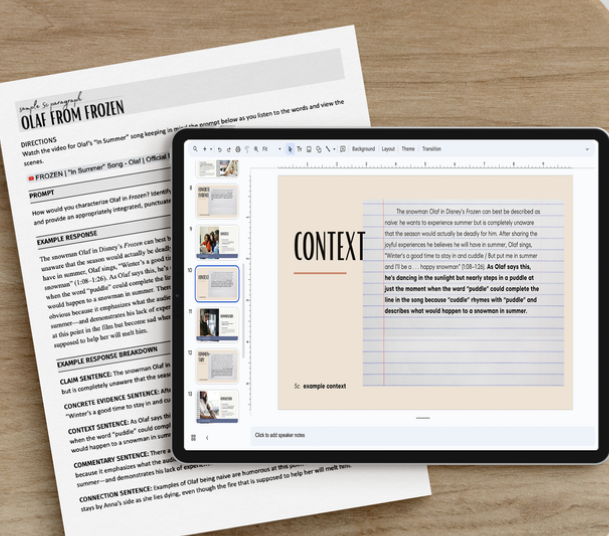
We taught our students the 5C paragraph structure at the beginning of the year and built our writing instruction around requiring them to use it for short-answer questions on their guided reading assignments. This means that by the time we got to their first essay, students had already written and received feedback on at least six 5C paragraphs.
Our first major writing assignment, on Homer’s Odyssey, was highly scaffolded. We provided the same step-by-step instructions and sentence starters that we used in our sophomore classes. In part, this modeled appropriate structure and academic language, but our prompt was also challenging to fit into a traditional structure. Students wrote an expository essay explaining how The Odyssey fits the hero’s journey structure and how the use of this archetype highlights the importance of ancient Greek ideals. We struggled to think through how to fit this task into a traditional five-paragraph essay, so we knew freshmen would find it difficult. This is a great reminder that even with more advanced students, complex prompts warrant extra scaffolding!
Later in the year, we transitioned to more moderate scaffolding. After reading Laura Hillenbrand’s Unbroken, students wrote about the strengths and weaknesses Louie exemplified as a child that affected his wartime and post-war experiences. We still provided students with detailed sentence-by-sentence instructions, but we removed the sentence starters so that students had to frame the wording themselves.
Eventually, we removed even more scaffolds. When our students argued which character or circumstance in Romeo and Juliet was most responsible for the bloodbath in the play’s final scene, they had to choose their own organizational structure based on the evidence they selected. We provided guidance, recommending that they choose between organizing chronologically or from least to most responsible, but students made the final decision. We still provided sentence-by-sentence directions, but instead of mapping out all five paragraphs, we provided one outline that students used for each body paragraph.
From here, the progression continues with a close reading prompt similar to those in AP Literature, followed by a timed essay with all scaffolds removed. This completes the gradual release model: students move from heavy scaffolding to guided choice to full independence.
Key Techniques
- Provide targeted feedback on paragraph responses, focusing on one skill at a time. When students were learning the 5C paragraph structure, we wrote feedback on the Claim for the first assignment, the Concrete Evidence for the next assignment, and so on.
- Emphasize varied methods for integrating quotations to develop more sophisticated writing. In their paragraph responses, we required students to alternate between four methods of integrating quotations.
- Remove sentence starters but keep sentence-by-sentence guidance, allowing students to practice using academic language before they’re entirely on their own.
- Provide extra scaffolding for complex prompts. Don’t remove scaffolds just because it’s later in the year; instead, assess what the prompt requires. Our Odyssey essay would have needed extra scaffolds whenever we assigned it.
- Give students opportunities for guided choice. You can scaffold students’ independence by requiring them to make more choices while still setting parameters to make those choices feel less overwhelming.
The Takeaway
Notice the pattern: We removed supports gradually but also considered the task’s complexity. Strategic writing instruction isn’t a straight line from more to less support; instead, it’s responsive to the task and the students.
Pathway 3: Quick Scaffold, Then Independent Practice
When Students Are Ready: Writing Instruction for Advanced Students

When to Use This Approach
We used Pathway 3 with our AP Lit classes, but it can work for a variety of students: those who are at or above grade level, those with solid foundational writing skills, those who need to write independently for high-stakes assessments (like AP exams), and those in their last year of high school who will be expected to write independently in college. In all of these cases, students benefit from strategic scaffolding throughout the year, but it’s essential that these students are moving toward independence.
Our Scaffolding Progression
In our introductory unit, we did a lot of paragraph practice. At least once per week (and often more), our students wrote short-answer responses in the 5C paragraph format. Much like we did for our honors students, we honed in on specific parts of the paragraph in our feedback and required students to use varied methods for integrating quotations.
We also did at least one scaffolded essay: for many years, it was the students’ first “open prompt” (Q3) about The Road; in later years, we transitioned to a scaffolded prose analysis essay (Q2) in the middle of our short story unit. The scaffolding at the beginning ensures that students understand the expectations of this new course and catches up those students who may have some gaps in their foundational writing skills.
From then on, all of the essays our students wrote were independent, timed responses to released College Board prompts. We rotated between the three prompts students would have to address on the exam, but they needed repeated practice—writing under a time limit is a skill that needs developing all on its own.
Throughout the year, we continued strategic paragraph practice, including occasional group paragraphs or essays.
Key Techniques
- Assign frequent low-stakes paragraph practice, even when students are writing full essays.
- Give students a grade, even when they’re learning. It sounds great in theory to allow students to write “just for practice,” but in our experience, student effort decreases when there is no grade attached, and then you’ve wasted an exorbitant amount of time providing personalized feedback.
- Consider assigning group writing tasks to allow for peer support and discussion, but assign specific roles to ensure participation.
- Hold students to consistent expectations: once students have mastered the writing skills, they keep practicing under the same conditions.
- Provide strategic scaffolding for new and/or complex skills, even late in the year. Even if students have the basics down, they may need extra support when analyzing a particularly challenging literary device or text.
- Practice timed writing regularly. Writing under time constraints is a distinct skill that needs its own development.
The Takeaway
This final pathway isn’t about removing scaffolds gradually; instead, it’s about quick, intensive scaffolding at the beginning, followed by extensive independent practice. But it’s still important to provide strategic paragraph practice and group work throughout the year because even advanced students benefit from targeted support for skill development.
The Bigger Picture: Scaffolding Across Years, Not Within One Year
Why Writing Instruction Is a Multi-Year Progression (And Why That’s Okay)
The Ideal vs. The Reality
Ideally, all students would receive scaffolded writing instruction that resembles Pathway 2 (or even 3): they begin high school with heavy scaffolds and, by senior year, can write competent essays independently.
The reality, however, is that not all students will ever be ready for full independence. The “ideal” approach to scaffolding only works if your entire student population is basically performing at grade level, your students are at the same school for all four years (and your English department coordinates writing instruction to move through a multi-year progression), and you don’t have a large Special Education or EL population that benefits from scaffolds. Schools like this do exist, but they’re not the norm that many of us experience.

What This Means for Your Classroom
Take a Breath: You don’t have to move students from Pathway 1 to Pathway 3 in one year. You might spend the entire year in Pathway 1, and that’s appropriate if that’s where your students are.
Reality Check: Some students will not reach “fully independent essay writing” by graduation. That’s not your failure; it’s the reality of working in a massive, unwieldy educational system that cannot meet every individual student’s needs.
Your Job: Assess where students are now. Choose the pathway that meets them there, and then make strategic progress within that pathway. Instead of worrying about what’s ideal, provide the scaffolding your students need to be successful this year with this content.
Strategic thinking
Ask yourself these questions:
- Where are my students now?
- Where do they need to be by the end of this year to be successful in my class?
- Where do they need to be eventually, whether that’s the next course, the workforce, or college?
- What’s the appropriate progression to help this group of students reach that destination?
Effective writing instruction isn’t about following a prescribed timeline or forcing all students through the same progression at the same pace. It’s about strategic scaffolding: providing the right level of support for your students right now, removing supports when they’re ready, and adding supports back when tasks are complex.
Conclusion
You can scaffold writing instruction in many different ways, depending on your students’ needs:
- Pathway 1: Maintain high scaffolding all year for students significantly below grade level.
- Pathway 2: Gradually release scaffolds for students ready to progress toward independence.
- Pathway 3: Scaffold quickly, then practice often with students ready for independent work.
Strategic writing instruction means choosing the right pathway for your students—and accepting that not all students will reach the same endpoint by the same deadline.
It’s okay if students don’t reach “fully independent” in one year. It’s okay to maintain scaffolds. It’s okay to add supports back in for complex tasks. Meeting students where they are is good teaching, not lowering standards.
The goal isn’t to remove all scaffolds by June. The goal is to help students write better by June than they did in August—whatever that looks like for your specific students.
This week, take a moment to assess where your students are right now, choose the pathway that makes sense for them, and implement just one specific scaffolding technique from the pathways above that will help them succeed. When you do, email us at hello@threeheads.works or find us on Instagram @threeheads.works to share with us how it went!