13 Effective Review Games & Activities for High School ELA: Prep That Works
“But, like, how do we study?”
Steph was stumped. School came easily to her—studying usually looked like re-reading the chapter or reading her notes a few times. She didn’t have a strategy that could be easily explained.
This was an eye-opening moment. Studying doesn’t come naturally to most of our students, and if we want them to do well on assessments, review games and activities must become a regular part of our curriculum.

But test prep can feel dull, even overwhelming, for both teachers and students. Students dismiss review as “unnecessary” because they’ve “already learned” the information. Those who haven’t read the book feel overwhelmed, unable to catch up in a single night. Students may be unsure what to study for a class that frequently tests skills rather than content.
Review, however, can be engaging, effective, and low-stress with the right strategies. We’re reflecting today on what makes for good review games or activities. Even better, we’re providing you with a roundup of review games and activities tailored for high school ELA classrooms that reinforce key skills while keeping students engaged.
Why Do We Even Need Review Games and Activities?
We briefly mentioned this in our introduction, but it’s worth spending a little more time on: many of our students are unfamiliar with test-taking strategies and don’t know how to study effectively.
As we learned while preparing our below-grade-level sophomores for the now-defunct California High School Exit Exam (CAHSEE), some students need direct instruction in and opportunities to practice using strategies such as process of elimination, circling key words like “not” or “except,” and even using flashcards.
“Teaching to the test” can be a dirty phrase in academic circles, but it’s worth taking time to provide our students with the basic skills they’ll need to navigate the educational system for 13 or more years.
Beyond test-taking skills, the testing effect is a well-known phenomenon in cognitive psychology. Memory is strengthened when we practice retrieving information rather than merely repeating or reviewing it. We’ve watched many students stare at lists of vocabulary words and definitions rather than quizzing themselves, only to wonder why they’re not earning top scores on their tests. Creating situations in which students must retrieve information from memory is an essential part of the learning process.
Not all review games and activities are created equal, however. Even a simple review game or activity must be designed thoughtfully to maximize its impact.
What Makes Review Games and Activities Effective in ELA?
In the context of ELA, effective review games or activities do three things:
English is a course in which students learn skills rather than content: literary analysis, vocabulary, grammar, reading comprehension, writing structure, and rhetorical devices. Preparing for ELA assessments, then, often means practicing skills rather than memorizing facts.
The more our students use and construct knowledge, the more likely they are to remember it.
All of us do better on tasks when we know what to expect; if our students lack the test-taking skills that come so naturally to us, it’s even more important that they practice doing exactly what they’ll need to do on test day.
It’s also important to plan review games and activities in various formats—visual, auditory, kinesthetic—to account for different learning styles
Low-Prep Review Games and Activities That Pack a Punch
Sometimes you want to go big with a memorable activity (and we’ll get to those), but good review games and activities can also be simple. These six strategies won’t require much from you but will still help your students prepare for exams.
Literary Term Bingo
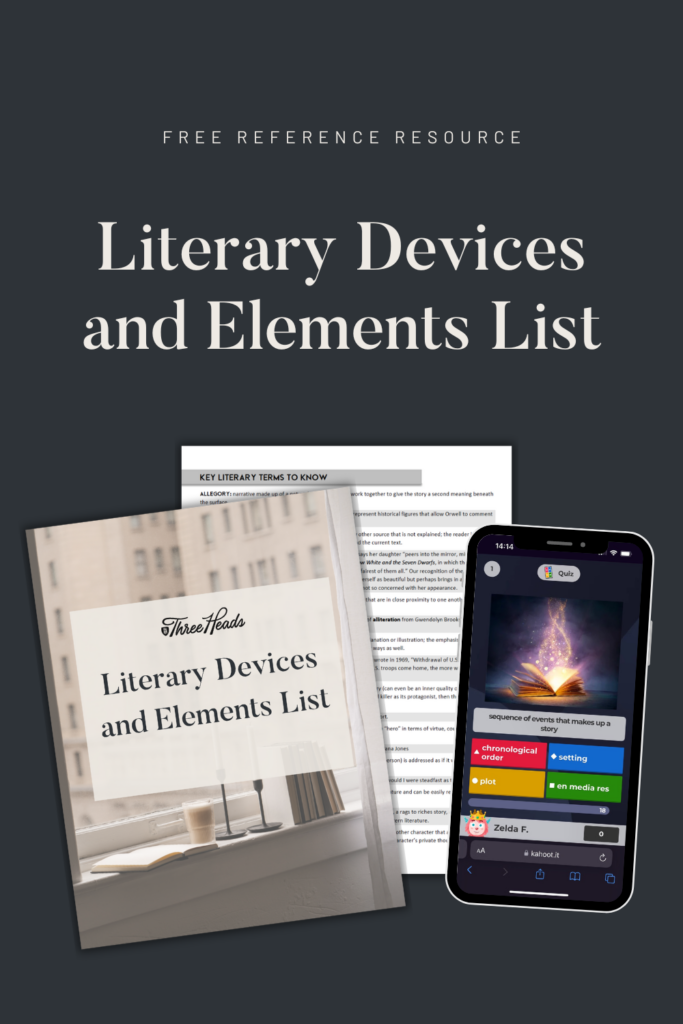
Have students fill out blank bingo cards from a list of literary terms. Then, you call out definitions and examples, prepared or spontaneous, and students mark their bingo cards. This strategy also works for allusions, character identification, and vocabulary. While students always love a good prize, extra participation points work just as well.
Free LITERARY TERMS LIST!
Sign up below to join the free resource library.
Speed Stations
Sometimes, all it takes to make a review game or activity fun is a time limit, some collaboration, and a little bit of movement. Assign small groups to rotate through a series of timed tasks—matching vocabulary words, finding grammar errors, identifying the literary device in a short passage, or writing a theme statement. This is a great way to gamify a study guide you already have.
“Find the Evidence” Challenge
Provide students with short passages and assign them to work in teams to find textual evidence for a specific claim or theme. You can even have the class vote on which team found the strongest piece of evidence.
Flashcards

They’re a classic for a reason. We created sets of oversized flashcards that we kept in a basket at the front of the classroom—one for literary terms and one for our vocabulary curriculum. Every time class ended a few minutes early, we’d grab a set of flashcards and quiz the class.
One of Steph’s favorite ways to boost engagement was to put the flashcard back in the pile every time the response was “too quiet” or “didn’t include everyone.” Not only did this show students how to use flashcards (with repeated review of terms they don’t know), but it kept engagement up, leading to groans and “hey, pay attention” pleas from peers.
“Who Said It?” Matching
We like to ask quotation identification questions on our novel exams: they hold students accountable for reading the book rather than a summary and, when the quotations are selected well, assess their knowledge of characters. Help students prepare for these kinds of questions by posting character names around your classroom and having students move to the correct character’s name when you read a quotation aloud.
Laminated Multiple Choice Cards
If you do a lot of standardized test preparation, consider making a class set of A/B/C/D cards that students can hold up. We made a set for CAHSEE prep, and not only did it mix things up, but it also allowed us to see at a glance how all students answered each question.
Collaborative and Competitive Review Games and Activities
While we all need a toolkit of low-prep options, sometimes it’s fun to go a little more complex, even if it does require some preparation. These four review games and activities get students collaborating (and determined to win).
Quiz-Quiz-Trade
In this strategy, you create a set of question cards (an easy way to convert an existing study guide into a fun game) with the question on one side and the answer on the other. Students partner up and ask each other the question on their card. If their partner gets stuck or answers incorrectly, they explain the correct answer to them, strengthening both students’ understanding of the concept. After the exchange, students swap cards and find a new partner.
Review Jeopardy (or Kahoot! or Quizizz (now Wayground) or Blooket)
A good-old-fashioned digital game always works well (and once you set it up, you can reuse it year to year). Whether you’re playing live in class or assigning it to students with a leaderboard, the competitive element inspires students to do their best, or even replay, especially if there are prizes involved.
Escape Room
We love a good escape room. Since leaving the classroom, we’ve created two of our own: one for How to Read Literature Like a Professor and one for an introductory Shakespeare lesson. Escape rooms motivate students to work through challenges and collaborate in teams.
You can also create or assign mini-escape rooms that don’t take as much time but still gamify the review process. For our The Hunger Games novel unit, we created a series of nine review games (three for each part of the novel) in which students answer questions in a Google Sheet that “unlocks” an image when they answer all questions correctly.

The nine review games work well on their own, but we framed them as Panem’s District Fair, each game sponsored by one of Panem’s districts. Teachers who want the full immersive experience can set up each game as its own “booth” around the classroom (decorated, of course, with strings of twinkle lights to mimic a midway) and maybe even offer some fresh-popped popcorn. Students each receive a “Tribute Game Card” that gets stamped as they complete each game; those who finish can be entered into a raffle with Capitol-sponsored prizes (though participation points work just as well).
What are the nine review games?
- District 4 of a Kind
- Challenge: AI Gamebot (District 3)
- Bread Basket BINGO (District 9)
- Outrun Auto Race (District 6)
- Challenge a Future Champion (District 2)
- Neon Night BINGO (District 5)
- Cattle Round Up (District 10)
- The Seam Showdown (District 12)
- Diamond District BINGO (District 1)
If you’d like to see how the mini-escape room games work, we have a free review game for the full novel (which you can’t purchase anywhere) in our Free Resource Library. District 8 is sponsoring Trial by Textile, in which students answer questions to help a new Capitol stylist achieve their vision for a tribute’s gown.

Emoji Stories
A fun way to review for a text-based unit is to have students work in groups to create emoji stories that tell all or part of a text. We used this as an introductory activity for Romeo and Juliet, but it would also work as a review activity, where each group gets a different act, set of chapters, or section of a short story or poem to represent.
Each group creates an “emoji” version of their assigned text on one slide of a Google Slides presentation. Then, groups have to work together to “unscramble” the story (this works best if you have multiple class periods). We rewarded both the team that finished first and the team that created the winning set of slides (after all, creating a recognizable emoji story is just as reward-worthy as correctly unscrambling one).
Writing-Focused Review Games and Activities
Writing is a skill we might not consider when creating a review game or activity, but quick review activities can help our students level up their skills. Here are three review games and activities you can use to review writing skills throughout the year (or help students prepare for a timed write or an assessment like the AP Lang, AP Lit, or AP Seminar exam).
Thesis Throwdown
Give students a series of prompts for which they have to write a thesis and outline a supporting argument in under five minutes. It’s a great way to reinforce prompt analysis skills, writing thesis statements, and quick brainstorming, all skills our students need.
In AP Literature, we used to do Open Prompt Speed Dating as one of our final exam review activities. We put students into groups and gave each group a strip of paper with a released AP prompt on it. They had to identify the book they would write about, craft a thesis, and outline their argument in 5–10 minutes. Then, groups would switch prompts, cycling through 5–6 prompts in a class period. In addition to helping our students practice brainstorming in a timed setting, the activity helped students review the novels we’d read that year.
Revision Rumble
Provide weak paragraphs for students to improve in partners or small groups. Whether you use anonymous student samples, write them yourself, or ask ChatGPT to craft them, an activity like this pushes students to discuss and develop their writing and analytical skills.
This could take a variety of forms depending on the level of your students. Lower-level students might benefit from editing for grammar or checking for elements of a 5C paragraph, while higher-level students could focus on improving the quality of analysis and commentary.
Timed Writing Sprints
Combining the previous ideas, students may benefit from the opportunity to write quickly and revise without the pressure of a grade attached. Between student buy-in and the increased feedback load, we weren’t fans of assigning a full essay that was “just for practice,” but giving students 5–15 minutes to draft a paragraph and then engaging in guided peer feedback is a great way to give students practice in a low-stakes context.
Tips for Maximizing the Impact of Your Review Games and Activities
It’s easy to throw together a review game or activity; it takes a lot more work to create one that you’re confident will result in student learning. Here are a few tips to help you build review games and activities with maximum impact.
- Design your review game or activity with the actual assessment in mind. The more you can align the skills and content you’re reviewing with students with what they’ll see on test day, the more the review game or activity will impact test scores.
- Scaffold your review to build confidence. Start with questions that are accessible to everyone (or give students more time), and then increase the challenge to help students identify areas they need to review.
- Use formative feedback to guide what you review. Pay attention throughout your unit to what students are struggling with, and target that content or those skills in the review (even if it’s different from what you did the year—or even class period—before).
- Mix individual, partner, and group formats to increase engagement. Collaboration does help students learn, but sometimes they need to see how they’ll do on their own.
- Be transparent without giving everything away. We like to include about 70% of the content from our actual test in our review games and activities. We’ll often rephrase the question, but we want students to recognize the material and see that studying mattered. However, we also want to see if students genuinely know the material (not just the study guide), so we try not to include every question.
- Don’t forget reflection. Asking students what they still feel unsure about helps them reflect on their preparedness and identify what they need to focus on when they study. If you’re reviewing for multiple days, it’s also helpful to ask students what they want more practice with. Sometimes what you have planned isn’t what they feel shakiest about (or might be something they know they can review on their own), so getting students’ input can help to maximize your limited time.
Test prep is something our students need, and it doesn’t have to be boring or stressful. When planned carefully, review games and activities can be meaningful, interactive, and aligned with core ELA goals. They can even be low-prep: you don’t have to create an elaborate game to make an impact (though those are sometimes fun, too).
If you’d like to see one of our mini-escape rooms in action, be sure to sign up for our Free Resource Library to get access to our The Hunger Games Trial by Textile review game. If you decide to host a District Fair in your classroom, we hope you’ll send us pictures at hello@threeheads.works!