Looking for a Short Story with Conflict? It’s Already in Your Curriculum.
It doesn’t matter how conflict-averse we are in real life. We love conflict in our stories.
Whether it’s the latest gossip from a friend, a blockbuster superhero movie, or a Pulitzer-Prize-winning novel, conflict is the driving force behind a good story. No one wants to read about a character who sets a goal and then easily achieves it, who longs for something and immediately gets it, or who just has a really nice, pleasant day wandering through a scenic landscape.
Not only do these stories sound unbearably dull, but they’re not even remotely how real life works—no matter how much we wish it did.
Finding a short story with conflict is one of the easiest things we’ll do as English teachers. Pick a short story, any short story, and you’ve succeeded.
But that doesn’t mean that teaching a short story with conflict is easy. Our students often take conflict for granted: they memorized the definitions of internal and external conflict in elementary school, and like it or not, they experience conflict every day of their lives. But add some nuance or ask students to do more than simply identify a conflict, and they’re no longer quite so confident.
All students benefit from a closer look at conflict, but AP Literature students in particular need to be reminded of the value of this key literary term. Whether they realize it or not, grappling with conflict is essential to everything they do as literary scholars, and it’s worth your time to point this out to them.
In this post, we’ll explain how to take a more nuanced look at conflict, how to fold that closer look into what you’re already doing, and provide recommendations for an engaging short story with conflict.
Why Conflict is a Top-Tier Literary Term
When it comes to ranking literary terms by priority, conflict has to be at the top of the list.
At the most basic level, this is because without conflict, a good story doesn’t exist. The entire plot diagram is structured around resolving the conflict laid out in the story’s exposition.
More importantly, however, this process of resolving a conflict provides us with the material we need for solid literary analysis. If we’re just reading for fun, a good plot is all we need: the complications characters face on the road to resolving a conflict create the suspense that keeps us turning pages.
But if we’re reading to analyze, we’re more concerned with characters and theme than we are with plot. And conflict—whether in real life or in fiction—is what reveals character. How a character responds to conflict reveals who they truly are and can lead to the changes we observe in a dynamic character. And how a conflict is resolved points us toward the deeper meaning—or theme—the author wants us to take away from a piece of literature.
Our students, especially our advanced students, need to see that conflict is the key to unlocking the deeper meaning of a text they’re looking for as they learn to do the work of literary analysis.
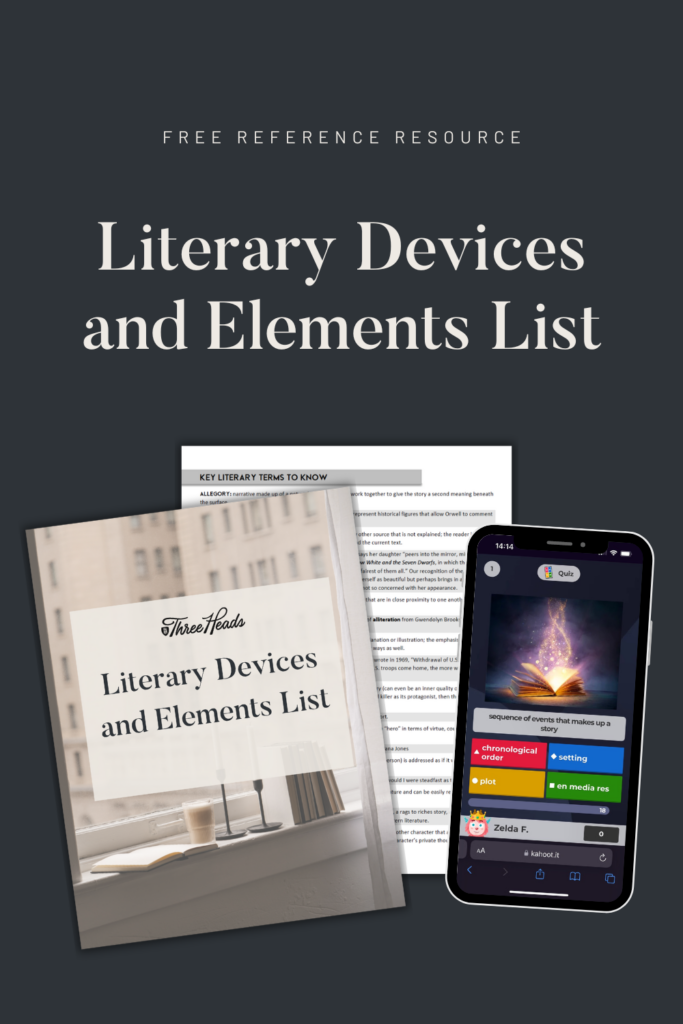
Free LITERARY TERMS LIST!
Sign up below to join the free resource library.
When and Why Students Struggle with Conflict
Let’s start by saying that most students don’t struggle with the most obvious conflicts: they can easily identify external conflict, especially when it takes the form of man vs. man.
This is probably a great place for some definitions:
|
Term
|
Definition
|
|---|---|
|
Conflict |
The problem a character faces that drives the action of a story. |
|
External Conflict |
A conflict between a character and some outside force (another person, nature, fate, society, etc.). |
|
Internal Conflict |
A conflict within a character (to overcome a weakness or fear, to make an important decision, etc.). |
Most of our students can easily identify a conflict between two characters, especially between the protagonist and antagonist. They need little help from us to explain that in the first three phases of the Marvel Cinematic Universe, the Avengers face an external conflict as they try to prevent Thanos from carrying out his evil plans.
It’s when conflict becomes more nuanced that students struggle to recognize or articulate it. External conflict isn’t always between people: it can be between a person and the natural environment, as when the man in Jack London’s “To Build a Fire” struggles to survive a walk through the woods in below-freezing temperatures. It can be between a person and fate or a higher power, as when Oedipus takes great pains to avoid the prophecy that he will kill his father and marry his mother. It can even be between a person and the lack of a higher power, as when Meursault struggles to make meaning in the meaningless universe of Albert Camus’s The Stranger. It can be between a person and society, as when Harrison Bergeron gives his life for a moment of joy and beauty in a dystopian world. It can even be symbolic: in Jhumpa Lahiri’s “Interpreter of Maladies,” the conflict between American and Indian cultures is far more significant to the story’s meaning than the literal conflict between Mr. Kapasi and Mrs. Das.
In our experience, students also struggle to identify internal conflict accurately, often mistaking a character’s response to another character’s actions—an external conflict—as internal because the character developed in some way as a result. It takes a lot of practice to help students understand that an internal conflict is truly within a single character. If we return to our Marvel Cinematic Universe example, Tony Stark faces an internal conflict when his guilt over losing Spider-Man prevents him from doing what others need him to do.
Now, to some extent, labeling the conflict correctly isn’t that big of a deal. Yes, students will encounter test questions where they are asked to do so, and we want to help them master those questions. But in the grand scheme of things, the reason our students need to recognize these nuanced examples of conflict is that doing so makes them more perceptive to the clues that will help them effectively discuss character and theme—even when they’re dealing with a text that lacks the classic man vs. man struggle.
6 Strategies for Teaching Students to Discuss Conflict
If you have younger or below-grade-level students, it might be worth your time to give students a list of examples and have them practice labeling the conflicts as internal or external. You might even break the external examples down into man vs. man, man vs. nature, man vs. fate, man vs. society, etc.
If your students are familiar with conflict, this can also be done as a quick review: we often asked students to provide us with examples of each type of conflict from pop culture. As a class, we were always able to get multiple examples of each type of conflict.
2
Fold conflict identification into larger lessons or units.
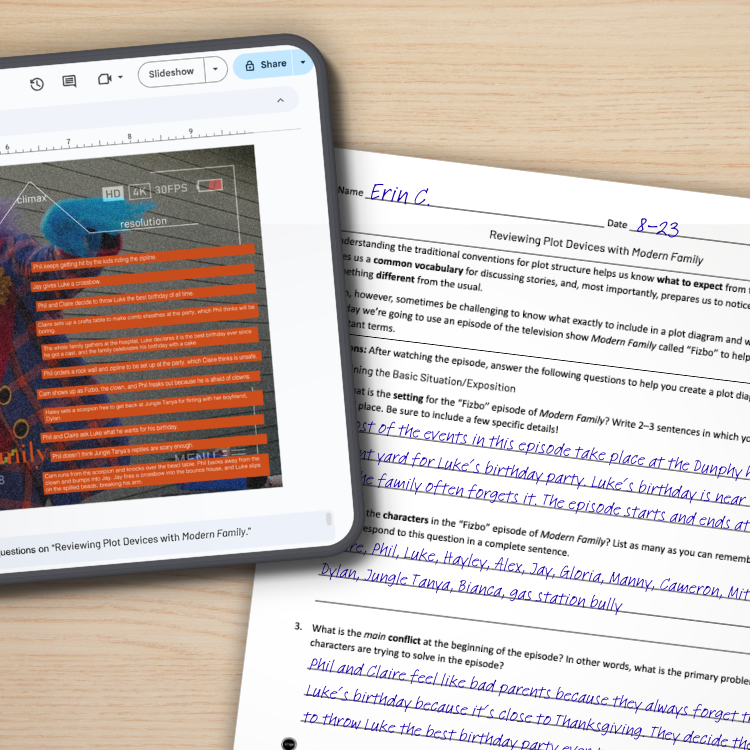
Again, if you have younger or below-grade-level students, it might be worth spending a week or two focusing directly on conflict.
However, most middle and high school students already have some familiarity with the relevant terms, and conflict can just become one of the literary terms you regularly ask students about. We included conflict as part of our larger unit on plot (which we sometimes even combined with character and point of view). Our AP Literature discussions often included references to conflict as they came up in the text.
You don’t have to give up large amounts of valuable teaching time to give your students practice with this common literary device.
3
Include questions about conflict in your guided reading questions.
This is an extension of the previous strategy, but you can regularly include questions about conflict in the guided reading questions you assign to students. Not only does this give students regular practice, but it encourages them to consider those conflicts in context.
In our AP Literature classes, we always asked students to identify and discuss an internal and external conflict as part of their regular end-of-novel flip book activity. It became part of the routine they knew to expect throughout the year.
4
Pair discussion of conflict with discussion of theme.

When you’re teaching students to write theme statements, take time to show them the connection between conflict and theme. Often, the way a conflict is resolved provides clues about the author’s larger meaning, and taking time to make this connection explicit will help students improve both skills.
If, like us, you use Pixar shorts to help students practice writing theme statements, identifying conflict is a natural part of the discussion.
5
Connect identification of conflict to a larger purpose.
Again, this is an extension of the previous strategy, but it’s essential to help students see that identifying conflict for its own sake isn’t particularly meaningful. It’s when we connect conflict to theme or characterization that we see its real value. Any time you discuss a conflict, ask students what it reveals about the character experiencing it or what it might suggest about the author’s larger purpose.
6
Present students with examples of unresolved conflicts.
It’s important, especially in AP Literature, for students to see that deviations from the norm are also valuable in literature. We come to a story expecting all conflicts to be resolved in some way or another. When they aren’t resolved, as in Nathaniel Hawthorne’s “Young Goodman Brown,” Yann Martel’s Life of Pi, or Cormac MacCarthy’s The Road, that means something. Considering what an author might be trying to say by leaving a conflict unresolved is an important challenge for students to work through.
7 Recommendations for a Short Story with Conflict
One of the most common recommendations for a short story with conflict is Richard Connell’s “The Most Dangerous Game.” The protagonist, Sanger Rainsford, is shipwrecked on Ship-Trap Island, where General Zaroff hunts humans for sport. When Rainsford refuses to join General Zaroff in his hunt, Rainsford becomes the prey, and the adventure that follows makes the text a classic example of suspense in literature.
This story is great for introducing students to the type of conflict, as it incorporates many examples with one piece and clearly illustrates how conflict works on a plot level. It’s also engaging for students, though be warned that it’s quite long for a short story.
The usefulness of “The Most Dangerous Game” is somewhat limited, however, for advanced students. Because the conflict works primarily on a plot level, students aren’t able to explore the device’s value in developing rich characters or themes, making this a better fit for earlier in the school year. Our textbook used the short story in the first unit to help students understand the difference between literary and commercial fiction, pairing it with Tobias Wolff’s “Hunters in the Snow.” This pairing made for meaningful conversation in our course and helped us introduce the often-confusing concept of literary merit to our students.
When it comes to other examples of a short story with conflict, the good news is that you can use any short story. We’ve shared many of our favorites to teach in other posts.
Short Story Blog Posts
However, the six titles below are short stories we’ve used in AP Literature when focusing on theme specifically, and they lend themselves well to a purposeful analysis of how conflict contributes to theme and characterization.
“The Destructors,” by Graham Greene
Greene’s story, about the group of boys who make up the Wormsley Common Gang in post-World War II England, can easily fit anywhere in your short story unit—it’s got rich characterization and themes, an omniscient narrator, and symbolism.
The boys live in a city destroyed by the Blitz, and the story details their efforts to take down a home built by famous architect Christopher Wren from the inside out. The story of their project is certainly engaging (and features multiple examples of conflict), but the deeper conflicts it reveals between the boys and society give the story richness and meaning beyond just a childhood prank.
“The Lesson,” by Toni Cade Bambara
Our adult narrator, Sylvia, tells us the story of a day in her childhood when Miss Moore, a teacher who annoyed her, takes her and her classmates on a field trip to an expensive toy store in an effort to teach them a lesson about the haves and the have nots. Sylvia, at the time, is resistant to learning what Miss Moore is trying to teach, but it’s clear from the adult perspective that the experience was impactful for Sylvia.
The story works well for exploring conflict and its connection to characterization and theme because there are multiple conflicts at play—between Sylvia and Miss Moore, between the various schoolchildren, between the characters and society, and within Sylvia herself. All of these conflicts are valuable in helping us understand complex characters and themes.
“The Parable of the Prodigal Son” (Luke 15:11–32)
Many students are already familiar with the parable of the prodigal son, a story Jesus tells to confront religious leaders with their self-righteousness. In it, a younger brother demands his inheritance from his father, wastes it all on reckless living, and returns home to a celebratory feast from his father. His older brother, however, refuses to come inside to the feast, resentful that he, the “good” son, does what’s right and isn’t rewarded while his younger brother is celebrated despite his foolish behavior.
Again, the story incorporates multiple conflicts, and students benefit from taking a closer look since this is a story that has long been misinterpreted. Much discussion of the parable focuses on the younger son and the father’s extravagance at his return, reading their interaction as a parallel for the way God responds when people turn from their sin and come to Him. While this isn’t inaccurate, the emphasis is meant to be on the older brother (representative of spiritual leaders at the time) and what his resentful attitude reveals about his own heart towards the father.
We found this to be a useful text when teaching theme because it’s quite short and relatively straightforward; however, it easily lends itself to morals, so students have to work to phrase their interpretation of the text in a way that makes an observation about life rather than telling the reader how to behave.
“Once Upon a Time,” by Nadine Gordimer
Gordimer’s story within a story tells us the “bedtime” story of a family so determined to protect their young son from the dangerous world that they ultimately destroy him. While this gives some meat to analyze on its own, the framing of the story within South Africa under apartheid adds a level of social commentary that enriches discussions of both conflict and theme.
The use of fairy tale elements also offers an opportunity to discuss allusion, which can be challenging to discuss with students, given the requirement that they be familiar with the original text. Most students are able to recognize the fairy tale elements Gordimer relies on, thanks to Disney.
“The Open Boat,” by Stephen Crane
Based on real events in Crane’s life, “The Open Boat” tells the story of four men—a correspondent, a captain, a cook, and an oiler—drifting at sea in a small boat after surviving a shipwreck. Full of conflicts large and small, the story uses man vs. nature and man vs. fate conflicts to comment on the indifference of the universe toward human suffering.
Crane’s use of imagery and figurative language to describe the setting lends itself well to close reading, the characterization of the men as individuals gradually shifts to the characterization of the men as a unit, and the ending is heavy with irony. All of these devices make the short story an effective choice for a short story unit.
“The Worn Path,” by Eudora Welty
Welty’s short story describes Phoenix Jackson’s journey through many obstacles in Natchez, Mississippi, to obtain the medicine that her grandson needs for his throat after swallowing lye. Simple to summarize, the story is rich in symbolism that requires deeper analysis and allows students to discuss characterization in detail.
If you teach Thomas C. Foster’s How to Read Literature Like a Professor, the story is a great opportunity for students to practice identifying the elements of a quest, especially the “real reason” to go (which helps point them toward the story’s theme).
Conflict is essential to literature, which means that finding a short story with conflict is easy: pretty much any short story you already teach will do. However, students need practice with nuanced examples of conflict that go beyond the basic protagonist versus antagonist struggle. The more we can help our students see the ways that conflicts of all types provide clues to characterization and theme, the stronger their literary analysis skills will be.
Whether you use it to teach conflict or as your go-to resource for any unit in your class, make sure you check out our free literary terms list, which comes with access to review Kahoots. These were the “need-to-know” terms we found most helpful for our AP students over the years, and we’ve included student-friendly examples. If you’re teaching conflict as part of an introduction to plot, be sure to check out our plot structure lesson, which uses Pixar shorts to review the plot diagram before students apply their understanding of key devices to Frank R. Stockton’s, “The Lady, or the Tiger?”