
Skip the Essay: 7 Book Project Ideas That Make Assessment More Fun (and Just as Rigorous)
Tired of reading the same five-paragraph essays over and over? You know the ones—60 students have selected the same three reasons that Scout or Brutus or Katniss is a brave person, and you find yourself wandering around the house after essay #10, suddenly discovering that reorganizing your junk drawer is more appealing than reading one more “analysis” of courage.
We hear you. It’s hard to get away from assigning traditional essays—they make up an entire section of our content standards, our students are expected to write them for a variety of standardized assessments (and, eventually, in college), and our students need a lot of practice.
But essays can be so painful to read. When we were procrastinating, we always moved our stacks of essays to the bottom of our to-do list, making for truly miserable end-of-semester grading sessions.
Essays have an important place in our curriculum, and we’re not advocating for that to change. But occasionally, integrating alternative book project ideas can be just as rigorous, more engaging for students, and far more fun to grade.
This post features high-quality, creative book project ideas that assess literary understanding without relying on traditional essays, including a spotlight on our The Hunger Games unit project.
Why Consider Book Project Ideas That Go Beyond the Essay?
Essays are, of course, valuable. They require our students to make defensible claims, develop a line of reasoning, support claims with evidence, and write commentary that uses that evidence to build an argument. The writing process forces us to think in ways that other activities do not, and in an age where we’re offloading more and more of our thinking to computers, it’s essential that our students spend time writing.
However, essays don’t always capture the full range of student thinking. Not all students are naturally gifted at learning or expressing themselves through language and may be able to uncover and articulate deep insights through different modes of thinking. Alternative book project ideas can give students new ways to demonstrate their comprehension, analysis, and creativity.

The beauty of creative book project ideas is that their unusual constraints push students to think more deeply. Well-crafted projects naturally guide students toward the highest levels of Bloom’s taxonomy—that “Create” level that sits at the very top. And if you look at the typical action verbs for creative thinking (design, invent, construct, produce, compose), you’ll see they’re exactly what students do in good creative projects.
Finally, creative book project ideas can have a positive impact on classroom morale. They can boost student interest and energy, especially when they’re hands-on, visual, or performance-based. Classrooms where students are having fun are often classrooms where real learning can take place.
What Makes Book Project Ideas Rigorous?
This does not, of course, mean that any creative project will do. Not all book project ideas are created equal, and we must take care to ensure our non-traditional assignments still challenge our students and require the kind of critical thinking demanded by our content standards.
Rigorous book project ideas have three key elements:
1
A clear academic purpose
Even creative projects should assess literary elements, critical thinking, and the ability to use textual evidence.
2
Built-in scaffolding
When students are working at the higher end of Bloom’s taxonomy, they need more support than they do on a simple comprehension task. Many of our students also lack the planning skills to carry out a multi-stage project without guidance, which leads to feelings of overwhelm and rushed last-minute submissions. Prewriting activities, step-by-step instructions, outlines, checkpoints, and rubrics can all help support high-level work.
3
Accountability
If we aren’t careful, it becomes too easy for students to draw a quick picture that technically meets the task directions. The task must be designed to require elements like textual evidence, thematic analysis, or reflection. It is equally important to assess those elements. When the rubric allows students to earn an A or a B without engaging in any real analysis or critical thinking, our creative project loses its power as a learning opportunity.
Want more practical, actionable tips like these delivered weekly? Our newsletter shares classroom-tested strategies that actually work (and as a bonus, you’ll gain access to our Free Resource Library).
7 Tried-and-True Book Project Ideas
We’ve rounded up seven book project ideas that have been tested in real classrooms (five by us, and two by other teachers). Each one has the potential to draw deep insights from students while allowing them to have some fun, and each one can be adjusted to meet the needs of varying learners. We used several of them with standard-level and honors-level students, tweaking our requirements and rubrics based on what those students could (or needed) to do.
Project #1: The One-Pager
One-pagers are a popular ELA creative project that can be completed in 1–2 class periods. Betsy Potash at Spark Creativity has abundant resources for implementing this assignment in a variety of ways. Students represent their learning on a topic (or a text) on a single page with a combination of words and images. Many teachers have created templates, and what we love most about the one-pager is that it’s incredibly flexible. Whatever you’re focusing on in your classroom can be the focus: theme, symbolism, characterization, you name it.
It’s essential, however, to provide clear directions and ensure that your rubric holds students accountable for them. If the directions are too open-ended, it’s easy for students to either feel overwhelmed because they don’t know where to start or stay at a superficial level. We recommend requiring that students include specific elements in the spaces of the template and provide correctly cited textual evidence to support their choices.
Project #2: The End-of-Novel Flip Book
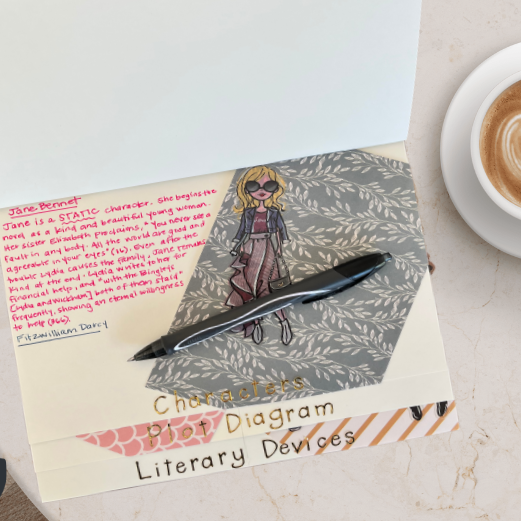
One of our go-to assignments was an end-of-novel flip book that students worked on as we discussed a novel. After years of refining, we ended up with an assignment that looks beautiful and requires sophisticated literary analysis. Students create a six-page booklet by folding three pieces of paper, and each page requires them to provide examples of a different literary element:
- Page 1: Title, author, point of view, setting
- Page 2: Theme statement and supporting paragraph
- Page 3: External and internal conflict
- Page 4: Three important characters, labeled by character type
- Page 5: Plot diagram
- Page 6: Three additional literary devices used in the text
Each page required visual elements and textual evidence, and some pages required a brief explanation. The key requirement that made it especially valuable for our AP students is that the elements on the various pages had to support the theme statement on page 2. In doing so, students had to craft a cohesive project using the same skills as in a literary analysis essay, and the project served as a meaningful review tool for the AP exam. We also modified the assignment (and simplified the directions) for our standard-level students, and we’ve used it successfully with short stories like Judith Ortiz Cofer’s “Catch the Moon”—it’s surprisingly versatile.
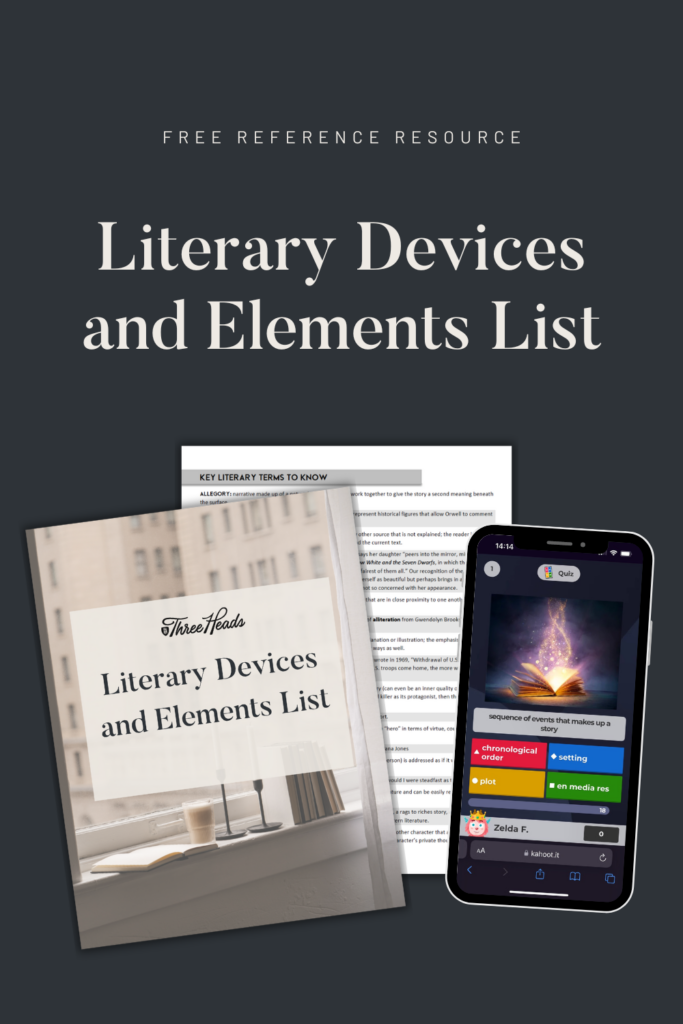
Free LITERARY TERMS LIST!
Sign up below to join the free resource library.
Project #3: The Body Biography
In Steph’s teacher training program, she was introduced to a Stickman graphic organizer for character analysis. While it served its purpose, we wish we’d found Danielle Knight’s body biography project.
For a given character, students must provide direct quotations, virtues, vices, what the character loves/cares about, the character’s thoughts about their inner-self and how they appear to others, what the character tries to control, symbols, goals, the character’s best accomplishment, a challenge the character faces, the character’s physical appearance, and whether the character is static or dynamic. Students then present this rich analysis in a stunning poster-sized representation of the character. If we’d discovered this resource while we were still in the classroom, our students’ posters would stay on our walls for years.
The posters each require four sheets of paper; Knight recommends allowing students to move desks together or work at a table so they have enough space. You’ll also want to make sure students have access to markers, crayons, scissors, and tape. While this could certainly be done independently, we’d probably let students work in groups for a couple of class periods.
Project #4: Character Journal and/or Scrapbook
Character journals and scrapbooks require students to consider characterization, point of view, and voice as they empathize with a character, taking on their persona for themselves. They’re also easily adaptable to any fictional world.
When we taught To Kill a Mockingbird, we alternated between the two options. Some years, students wrote a journal entry from the perspective of a character at key moments throughout the novel; other years, students created a scrapbook for that character that, in addition to journal entries, included literary analysis activities we completed in class, a map of Jem and Scout’s neighborhood, and a creative writing assignment like a script for one of the children’s plays about Boo Radley or a series of postcards between Dill and the Finch children during the school year. Students could also earn extra credit by including “artifacts” from the novel or historical period.
Many students created beautiful projects (the pile always smelled a little smoky, thanks to paper that had been “aged” by burned edges), and the different components required students to engage with the novel in various ways. We also incorporated multiple elements of choice, allowing for flexibility and creativity.
Project #5: Crime Scene Report and Business Letter
One of our favorite projects over the years was our Julius Caesar crime scene report and business letter. As we read Acts 1–3 of the play, students collected evidence from the crime scene, body, and witness interviews (Cassius, Brutus, and Mark Antony). For the witness interviews, students close-read key passages. Finally, students wrote a business letter to a historian arguing whether Brutus should be remembered as “the noblest Roman of them all” or a traitor to the Roman republic.
The crime scene report assessed students’ comprehension, character analysis, and close reading skills, and the business letter component assessed their persuasive writing skills. The “real world” feel of the activities brought Shakespeare’s words to life for our modern (and often struggling) readers. Students were far more engaged in the text (especially when they decided Brutus was a “snake” who betrayed his best friend) than they had been when we spent days slogging through each line of the play together as a class. (While our unit is specific to Julius Caesar, a similar approach would work well for any of Shakespeare’s tragedies.)
Project #6: Short Mid-Unit Creative Assignments
It’s also possible to weave creative book project ideas throughout your unit, allowing you to incorporate creativity and a variety of learning modes while still assigning a traditional essay.
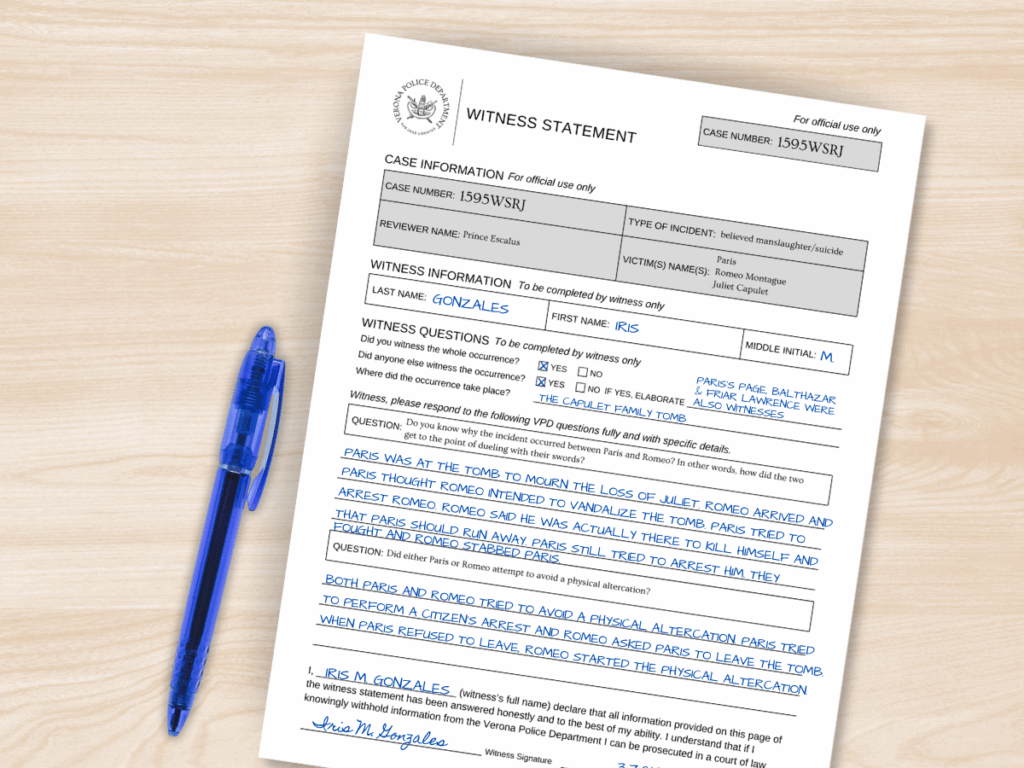
When we taught Romeo and Juliet in 9th-grade Honors, students completed a close reading activity for each act of the play. After close reading a key scene in class, students completed a small creative assignment to demonstrate their understanding of the scene:
- Act 1: Comic Strip
- Act 2: Structured analytical paragraph (using the 5C format)
- Act 3: Letter from Romeo, Juliet, Friar Lawrence, or the Nurse
- Act 4: Advice column (or pair of TikTok videos) about Juliet’s dilemma
- Act 5: Verona Police Department Witness Statement
Similarly, when we taught Homer’s Odyssey: students created Instagram posts from a character’s perspective for Books 1–8 and a storyboard for Books 9–12.
These assignments can be completed in one class period, breaking up days of reading with activities that allow students to demonstrate their understanding of a text in creative ways.
Project #7: Game Design Pitch for The Hunger Games
Unlike the first six projects, which could easily be adapted to fit a variety of texts, our last project is specific to our unit for The Hunger Games, but we couldn’t leave it out.
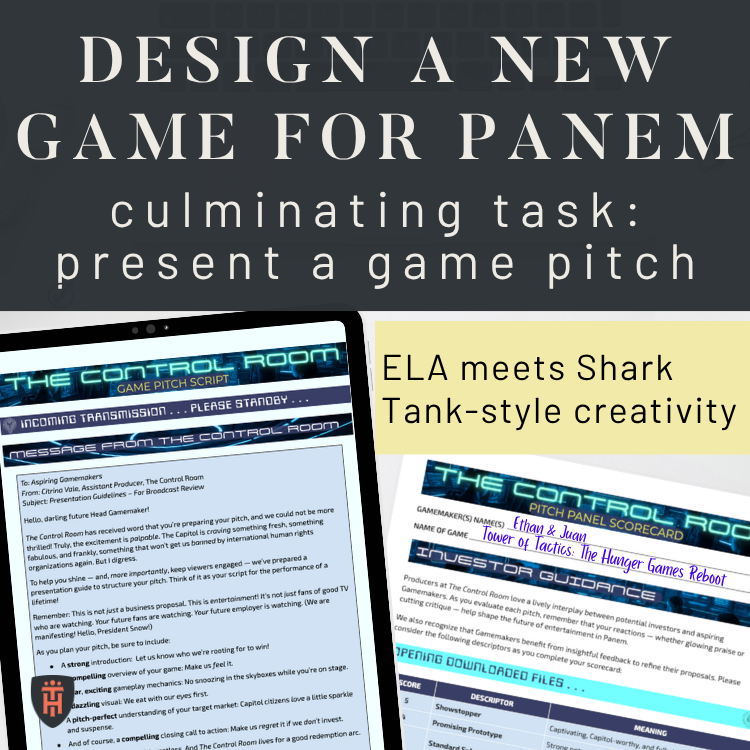
We decided to frame our unit for The Hunger Games around a key question: “Is the Hunger Games actually a game?” We began the unit with an introduction to game design theory, which students made connections to throughout the novel; at the end of the unit, students designed a new national game for Panem that met the characteristics of a game, avoided human rights violations, and still appealed to the entertainment-hungry residents of the Capitol. Students created a 2–3 minute pitch to investors (in a Shark Tank-styled format we called The Control Room) that they delivered in front of the class, who voted on the best game.
As fun as the project was, it also required rigorous thinking: students had to consider game design theory and ethics, demonstrate an understanding of their audience, and deliver a persuasive oral presentation—all real-world skills.
Add a Fresh, High-Engagement Project to Your Hunger Games Unit
Already have a Hunger Games unit you love? This stand-alone project lets you add something new without buying a full curriculum. Includes our Characteristics of a Game presentation with student handouts, a board-game-style “Is the Hunger Games a Game?” activity to use between Parts 2 and 3, and all the scaffolded materials you need to assign and grade the final game pitch project.
Tips for Managing Creative Book Project Ideas
No matter what creative book project you design or implement, there are practical things you can do to make the project go smoothly:
Set clear expectations

Provide detailed instructions, rubrics, and models to maintain academic rigor. On our end-of-novel project, students couldn’t just select any conflict or literary element—it had to tie directly to their chosen theme. We also specified the number of quotations/sentences/elements in a plot diagram to include. Side note: it took us ten years of attempting to address student errors to get here—don’t feel like you need to make the perfect set of specific directions the first time around!
Offer choice with structure
Allow students to choose from a list of projects (or to select elements within the project), but provide parameters to ensure alignment with your learning goals.
Remember that not all students are skilled artists
Any time you incorporate a creative project in your class, it’s inevitable that you’ll get at least one “But I’m not creative!” complaint. Neither of us is particularly good at drawing ourselves, so we always allowed students to use images from magazines or online or to create their own using online programs like Canva. The only rule was that they couldn’t just print out a picture of the existing book cover or images from the movie—their selections had to be thoughtful and creative. We also assured students that our grading was based on effort and creative thought, not artistic skill.
Build in checkpoints
Projects completed at the last minute rarely demonstrate the critical thinking we’re hoping for, so prevent last-minute work by breaking the project into steps. This also surfaces misunderstandings early, when there is still time to correct them. For example, we identified which sections of our Julius Caesar crime report aligned with each Act of the play and had students update their graphic organizer after each act. This broke up the reading and allowed us to clarify any misunderstandings. When we drafted the business letter, students completed a prewriting assignment and scaffolded rough draft, both of which were checked for completion before the final draft was due.
Reflect and debrief
Have students write or discuss what they learned through their project. This helps them see the purpose behind the assignment and consider how to improve their work process on future assignments.
You don’t have to sacrifice depth for engagement—creative book project ideas can provide both. But you can also start small! Try one non-essay project this semester and see how students respond. It’s okay if it doesn’t go perfectly or the results aren’t as rigorous as you hoped for—use that as data to help you refine the project for next time.