
The 30 Must-Know AP Lit Terms (and How to Actually Teach Them)
No matter how many years we’ve been teaching or how confident we feel in our subject matter, the assignment to teach AP Lit eventually triggers imposter syndrome.

Maybe it’s at our AP Summer Institute, as we try to make the nine units laid out in the Course and Exam Description fit into a single academic year. Maybe it’s when we sit down to grade our first stack of essays, only to find all of our students scoring at the bottom of the College Board’s rubric. Or maybe it’s the moment we realize we have to teach the novel we struggled through in high school (looking at you, Heart of Darkness). At some point, the feeling of inadequacy rattles even the most experienced teacher.
For some of us, that moment comes when we try to decide on the list of AP Lit terms we’ll present to our students. A quick Google search suggests there are upwards of 100 literary devices (though no two sites agree on an exact number), and we’re left wondering: Which literary devices are actually important? What if my students don’t understand them? What if I’m not sure I fully understand them? (We asked this last question when we encountered synecdoche and metonymy in our AP Lit textbook.)
Over the years, we learned that the list of AP Lit terms students genuinely need to know is much less overwhelming than we’re tempted to think it is. Not only can we narrow our focus to a smaller list of terms, but we can also prioritize the basic terms we cover in our non-AP classes.
Today, we’re helping you sort through the overwhelm to narrow in on the most important AP Lit terms. If your students can discuss these 30 literary devices capably, they’ll be prepared for the AP exam . . . even if they never figure out the difference between synedoche and metonymy.
Reality Check: You Already Know the Key AP Lit Terms
The skills covered in the AP Literature Course and Exam Description are grouped into categories that our students have been learning since elementary school: character, setting, structure, narration, figurative language, and literary argumentation.
When it comes to literary devices, the difference between 9th grade and AP Lit isn’t the number of terms; it’s the complexity of the examples students can recognize and discuss.Let’s take, for example, metaphor, which first appears in the Common Core standards in Grade 5 and as Skill 6.B in AP Lit. Over the three poetry units, here’s how the progression of essential knowledge develops:
This pattern is repeated throughout the entire course. Few new terms are introduced; instead, students learn to identify more subtle examples and consider additional effects.
The Essential AP Lit Terms Your Students Need to Know
If you were to only teach your students one literary term in an entire year of AP Literature, it should be theme.

AP Lit is all about students’ interpretation of a text. Their interpretation of a text—what it’s about, what it’s saying, why it matters—that’s the theme. When the College Board uses the phrase “meaning of the work as a whole” on FRQ3, they mean the theme. There are multiple-choice questions about the theme of a text, and the third FRQ requires students to defend a theme.
This is why our introductory unit for AP Lit always includes a review of theme: we review the six characteristics of a good theme and give students multiple opportunities to practice writing theme statements about Pixar shorts before analyzing a single piece of literature.
Of course, none of us is likely to teach only one literary device all year. These are the terms we’ve found most important to emphasize. We’ve organized them according to the Big Ideas laid out in the Course and Exam Description. While other terms appear in the more detailed Skills and Essential Knowledge statements, these are the ones that recur most often, that we discuss frequently, and that we’ve seen our students use most successfully in essays.
Character
Antagonist
The person or force that opposes the protagonist in a story (can even be an inner quality of the protagonist’s); not necessarily the “bad guy” (if the story featured a serial killer as its protagonist, then the police might be the antagonist).
Dynamic Character
A character who undergoes a significant change in personality, character, or outlook (not circumstances, mood, or appearance) over the course of a story.
Epiphany
A moment of sudden understanding or insight; may lead a character to undergo significant change in personality, character, or outlook.
Foil Character
A character with opposite traits to another character, often a main character, in a text; the contrast between the two characters better allows us to understand each of them.
Protagonist
The main character of a story.
Static Character
A character who does not undergo any significant change in personality or character over the course of a story.
Structure
Conflict
The problem a character faces that drives the action of a story.
- An external conflict is between a character and some outside force (another person, nature, fate, society, etc.)
- An internal conflict is within a character (to overcome a weakness or fear, to make an important decision, etc.).
Foreshadowing
A plot device in which the author presents clues about something that will happen later in the narrative; often used to create suspense.
Irony
A general term for a mismatch between appearance and reality, expectations and fulfillment, and/or what happens and what would seem appropriate in that situation.
- Dramatic Irony: occurs when the audience knows something that a character does not know.
- Situational Irony: occurs when what happens is the opposite of what is expected or what would seem appropriate.
- Verbal Irony: occurs when a character says the opposite of what he or she means; the reader is intended to understand that this is not how the character feels (it is not a lie intended to deceive).
Sonnet
A fourteen-line poem written (almost always) in iambic pentameter that follows a set rhyme scheme.
- English/Elizabethan/Shakespearean Sonnet: a sonnet divided into three quatrains and a concluding couplet that follows the rhyme scheme abab cdcd efef gg. Examples: any of Shakespeare’s sonnets or “Death, be not proud” by John Donne.
- Italian/Petrarchan Sonnet: a sonnet divided into an octave and a sestet; the octave has a rhyme scheme of abbaabba, and the sestet has two rhyme sounds, like cdcdcd or cdecde. Examples: “On First Looking Into Chapman’s Homer” by John Keats or “The world is too much with us” by William Wordsworth.
Suspense
The quality of a story that makes a reader want to continue reading to find out what happens next.
Narration
First-Person Point of View
The narrator is a character in the story, using pronouns like “I,” “me,” and “we.”
Second-Person Point of View
The story is told from the reader’s perspective, using pronouns like “you.”
Third-Person Limited Point of View
The narrator is not a character in the story, using pronouns like “he,” “she,” “it,” and “they” to tell the story; the perspective is limited to one character’s thoughts and feelings.
Third-Person Omniscient Point of View
The narrator is not a character in the story and uses pronouns like “he,” “she,” “it,” and “they” to tell the story; the narrator has unlimited knowledge and permission to go anywhere, whether the narrator chooses to reveal that information to the reader or not.
Tone
The writer’s or narrator’s attitude toward the subject, the reader, a character, or himself/herself.
Helpful Hint: Are your students having trouble distinguishing between third-person limited and third-person omniscient point of view? Even if the story is told primarily from one character’s perspective, if you can find even one sentence where the narrator identifies something that the character wouldn’t know, the point of view is third-person omniscient.
Figurative Language
Hyperbole
Exaggeration for the purpose of humor or emphasis; may be referred to as overstatement.
Imagery
Language that appeals to the senses; may be visual (sight), auditory (sound), olfactory (smell), gustatory (taste), tactile (external touch), organic (internal sensation, like nausea or thirst), or kinesthetic (movement).
Metaphor
A comparison between two unlike things in which, instead of being directly expressed, the figurative term is substituted for or identified with the literal term.
Personification
A type of metaphor in which a nonhuman idea or object is given human qualities.
Simile
A comparison between two unlike things in which the comparison is directly expressed using “like,” “as,” “resembles,” or a similar term.
Symbol
An object (or place, name, etc.) that functions both literally and figuratively in a text; that is, the object is literally in the text, but it also represents something else.
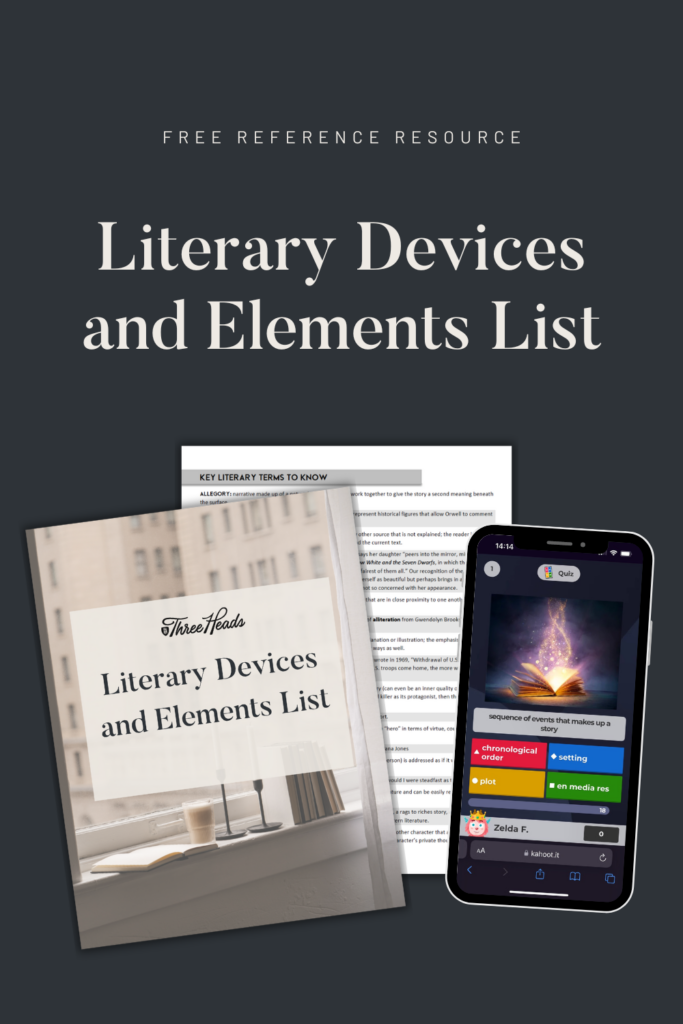
A Complete LITERARY TERMS LIST!
Sign up below to join the free resource library.
Common Student Mistakes to Address
In our experience, there are four primary student mistakes to watch out for and address as you’re teaching these terms throughout the school year.
1
Students forget that “easy” terms like imagery and metaphor still count.
Students are used to AP classes being hard, so they assume that terms they’ve been learning since elementary school are “too easy” for AP Lit when, in fact, they’re exactly the terms students should be using. We’ve reminded students of this before, only to hear, “Those are literary terms?” YES. Yes, they are.
Remind your students regularly that these terms are valuable, use these terms in your discussion, and don’t overemphasize complicated terms just because it’s an AP class.
2
Students overreach for sophisticated terms when simpler ones work better.

Related to the first mistake, students get overexcited about using “new” and “sophisticated” literary terms. They’ve just learned what an allegory is, or you just taught them how to identify trochaic tetrameter, so they try to write an essay in which they either misidentify the text as an allegory (it rarely is) or argue that the use of trochaic tetrameter reveals a poem’s theme (it seldom does).
When we started pushing students to use the terms they already knew, they were far more likely to write a well-reasoned and convincing argument. Terms like symbol, metaphor, and imagery are common for a reason!
3
Students confuse similar literary terms, especially when they come in pairs.
Our students frequently confused flat, round, static, and dynamic characters, so those terms appeared regularly in our discussions and assessments. Our textbook also provided examples that taught us to explain the nuance between similar terms. For example, an image is literal, a metaphor is figurative, and a symbol is both. Sarcasm is intended to hurt (like a bully), satire hurts to help (like a surgeon), and verbal irony is merely a tool (like the bully’s fist or the surgeon’s scalpel).
It’s well worth the time it takes to explicitly point out these differences and revisit terms your students frequently misuse.
4
Students misinterpret figurative language.
Correctly interpreting examples of figurative language—metaphor, simile, symbol, allusion—is tricky, even for adult readers. Students need lots of practice identifying and using these terms throughout the year, which is part of the reason we always spend more time on poetry than on prose.
Tips for Teaching Literary Devices
We’ve written several blog posts that detail strategies for teaching specific literary terms: plot, character, point of view, theme, symbolism, structure in poetry, denotation and connotation, and imagery.
Here, however, we want to emphasize a few general principles.
Start simple: ensure your students have the basic definitions down.
While we want to move our students beyond definitions, they do still need to know them. We administered several literary term quizzes throughout the year, and we used literary term review Kahoots as weekly bellringers for regular practice.
Incorporate both identification and function.
Students do need to be able to identify examples of these literary devices, but identification alone isn’t enough. They need to be able to recognize the effects of using these literary devices and how they contribute to the overall meaning of the text.
Build complexity.
Of course, when you first introduce or review a term, it’s helpful to start students out with straightforward examples. But as students move through the units in the Course and Exam Description, they’re not adding more advanced terms so much as they’re working with more complex, nuanced, and ambiguous examples. Provide students with plenty of opportunities to practice with challenging texts.
Assess meaningfully.
It’s important to assess your students in ways that mirror the actual AP exam. Yes, there are occasional multiple-choice questions where students must identify a specific quotation as an example of a particular literary device, so ask students those questions.
But students also need to answer multiple-choice questions about the effect of a literary device and how it contributes to tone and mood. They need to be able to select evidence to support a claim, identify the literary device being used in that piece of evidence, and then explain how the use of that literary device helps to convey meaning.
It’s essential that students practice these skills regularly, in formal and informal assessments, and receive feedback on them.
Making It Manageable (for You and Your Students)
It’s important to note that we did introduce students to other literary terms. They had a list of over 100 terms that they kept in their binders, and those terms appeared in their Kahoot bellringers and on literary term quizzes. We also discussed those terms when they played a significant role in a text.

We don’t only want to prepare our students for the exam, but we also want to expose them to the language they’ll encounter in college literature classes.But the more you can recognize which terms are “nice to know” and which terms are “need to know,” the more you’re able to focus your instruction on the practice your students need most. Sure, we introduced comedic terms alongside The Importance of Being Earnest and spent a week playing with rhythm and meter, but we explained to our students that these terms were “icing on the cake” rather than essential content. For example, a student who briefly points out that the meter of a line of poetry reinforces the feeling that the words convey might stand out from the crowd, while a student who tries to argue that the poem’s meter conveys the theme itself may struggle to earn a passing score.
We hope this post has eased some panic or given you the permission you need to cut your list of AP Lit terms in half. Literary terms are one of the few pieces of content we teach our students in an otherwise skills-based class, so they’re an important part of our curriculum, but they can easily become overwhelming if we don’t prioritize.
Are you looking for a ready-made, student-friendly curated list that you can share with students? The curated literary terms list our students kept in their binders (and links to the Kahoots we used as bellringers) is available in our Free Resource Library. We also have a multiple-choice literary terms assessment based on this list that you can use as a pretest, a semester final, or exam review. It’s available on its own or in our AP Lit Jump Start Kit, which includes the seven resources we use in our introductory unit.
AP® is a trademark registered by the College Board, which is not affiliated with, and does not endorse, this website.


