How to Differentiate Theme Statement Lessons Without Doubling Your Workload
Differentiation is one of those educational buzzwords that can make teachers cringe.
On the one hand, we know differentiation is necessary. Each combination of 30–40 students that cycles through our classrooms includes students with varying language proficiencies, educational experiences, interests, levels of neurodivergence, and learning styles. What works for one student may not work for their seat partner.
Consider teaching students how to write a theme statement. Some students still write plot summaries or one-word “themes” like “friendship,” while others are ready to analyze how a surprisingly insightful theme evolves across a story arc.
Writing a theme statement is also a skill that, as English teachers, we have to cover in every class we teach. Whether we’re teaching below-grade-level freshmen or AP Literature seniors, our students need to know how to write a theme statement.
Then there’s the other side of the dilemma. Differentiating theme statement lessons sounds great in theory, but who has time to plan three versions of every lesson?
Certainly not us.
What we’ve learned, however, through years of teaching both standard-level (and often below-grade-level) sophomores and AP Lit is that you can differentiate theme statement instruction meaningfully without reinventing the wheel, especially if you start with short, visual texts like Pixar films.
Why Differentiation Matters for Theme Statement Lessons
Theme is one of the most abstract concepts we teach in English classes. Students must not only read and understand a text (which may involve unpacking figurative language, symbolism, and irony), but then they must articulate what overarching truth about life the text’s many details come together to reveal.

Identifying the overarching truth is challenging enough, and drafting an effective theme statement is even more difficult (our theme statements often require tweaking, and we’re the supposed experts). Some students need concrete scaffolds, while others are ready for a challenge.
But without differentiation, we often end up “teaching to the middle.” We over-scaffold for our more advanced students, which stifles their deeper thinking. At the same time, we under-support our students who are still figuring out what a theme even is.
So, how do we meet all of our students’ needs without designing a separate lesson plan for each student? We’ve got four different strategies to help you assemble theme statement lessons that work for all your students but don’t require hours of planning on your end.
Strategy #1: Use Short Films with a Range of Cognitive Demands
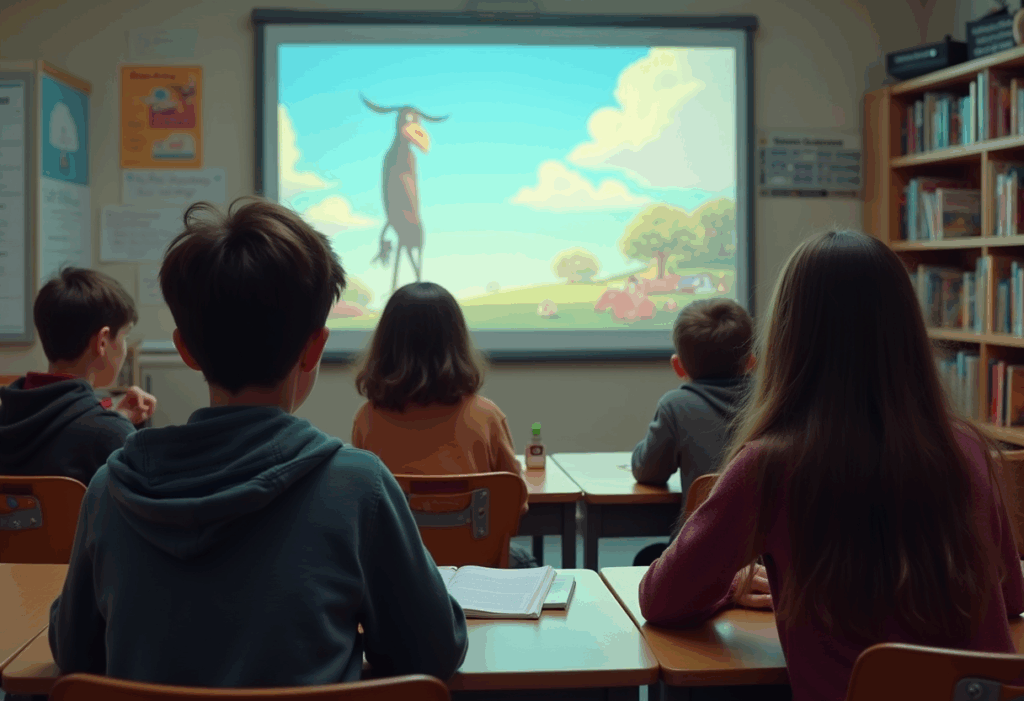
We’ve long been fans of using Pixar shorts to introduce key ELA concepts, and they work particularly well for theme. Most of them don’t have dialogue (simplifying the task for students), they’re classroom-appropriate, students love them, they portray surprisingly rich themes, and they tell a full story in under 10 minutes.
Not all Pixar shorts are created equal, however. Some are straightforward (like “For the Birds”), while others are complex or symbolic (like “La Luna” and “Float”).
An easy way to differentiate your theme statement lessons is to change up the Pixar shorts you use based on your students’ needs. Whether you’re using the same activity in 9th grade, 10th grade, and AP Lit or trying to vary the levels of difficulty within one class, carefully selecting the Pixar shorts you use is a relatively quick and easy place to start.
Here’s a suggested breakdown of the shorts that we think work well for teaching students how to write a theme statement (we’re lumping together Pixar shorts, SparkShorts, and Walt Disney Animation Studios shorts).

- If you’re doing full class instruction, you can select the short films you use based on your students’ readiness, or even use the same lesson in multiple courses with different Pixar shorts.
- If your students are working in groups, you can assign each group the short films that are most appropriate to their current level.
- If your students are working independently (perhaps in a flipped classroom model), consider allowing students to choose from a curated list.
Psst! We offer two versions of our bestselling Pixar Theme Activity (Volume I and Volume II) with a mix of accessible and advanced shorts. Whether your students need all the practice they can get or you’re teaching two different courses and don’t want to duplicate, we’ve got you covered.
JOIN our Free Resource Library TO RECEIVE…
Access to free resources for you and your students!
Strategy #2: Vary the Task, Not the Content
Another way to differentiate your theme statement lesson without entirely reinventing the wheel is to use the same Pixar shorts for all students but vary the tasks you assign. Everyone watches the same film but responds in different ways.
For emerging writers, it might work best to have students select the correct theme from multiple options, whether you give them multiple-choice questions to answer for each short (a strategy we use in both volumes of our Pixar Theme Activity) or ask students match a variety of theme statements to the correct Pixar shorts (we love using manipulatives for activities like this).
Depending on your students, there are two different ways you could set up these multiple-choice questions:
- If your students need help choosing the theme statement that is best supported by a given text, you could offer 3–5 possible theme statements and ask students to select the one that is best supported by the short film. This is a common question type on standardized tests, including the AP Lit exam.
- If your students need help crafting an effective theme statement, you could present them with 3–4 “inappropriate” theme statements and one “good” theme statement, and then ask them to select the most effective one. This is the approach we use in our Pixar Theme Activities.
While our Pixar Theme Activity products are designed to scaffold the process of writing a theme statement, which means only some of the questions are in multiple-choice form, we include multiple “sample possible themes” in the teacher answer key, making it easy to adapt the lesson for emerging writers.
Not sure what makes an appropriate theme statement? We give students six criteria.
A good theme statement:
- Is not just a topic or phrase, but a complete sentence.
- Is not a cliché, or a cheesy/overused saying you have heard before.
- Is not a plot summary.
- Does not use terms like “always,” “never,” “all,” etc.
- Does not address just one part but covers the whole story.
- Is not a moral, which means it doesn’t tell the reader how to behave.
We encourage students to ask themselves, “What does this story or movie seem to be noticing is true about life?”

We encourage students to ask themselves, “What does this story or movie seem to be noticing is true about life?”
For on-level students, it may be appropriate to invite students to write their own theme statements. We like to give students a couple of “warm-up” multiple-choice practice questions first, but on-level students of varying grade levels are often ready to tackle this challenge, whether they do so in groups or individually.
On-level students may also be ready to start providing evidence to support their theme statements, even if you simply ask students to share their theme statement with the class and explain why it works.
For advanced learners, one way to “level up” their theme statement practice is by asking them to revise weak theme statements. This requires them not only to evaluate a theme statement based on a set of criteria but also to refine the wording of a theme statement rather than starting from scratch. For us, refining is often the most difficult part. Psst! We have an activity that includes this, too!
Another option for advanced learners is to ask them to identify two themes for a given short film. Not only is this the beginning of one of the 11th/12th grade ELA content standards (CCSS.ELA-Literacy.RL.11-12.2), but it introduces students to the important idea that complex texts have more than one interpretation, an understanding that will serve them well in AP Lit and college literature courses.
Finally, for your advanced learners, consider showing several short films that address the same topic and assigning students to discuss how each film tackles the same topic differently. Here are some pairings that would work well for this:
Bullying and Prejudice:
“Day & Night”
“For the Birds”
“Presto”
“Lou”
“Float”
“Kitbull”
“Purl”
Parent-Child Relationships:
“Bao”
“Far from the Tree”
“Sanjay’s Super Team”
“Float”
“La Luna”
“Nona”
“Wind”
Overcoming Personal Fears or Weaknesses:
“Piper”
“Burrow”
“Kitbull”
“Self”
“Us Again”
Being Different:
“Float”
“La Luna”
“Purl”
“Self”
Love:
“Feast”
“Bao”
“Far from the Tree”
“Paperman”
“Float”
“Kitbull”
“Nona”
“Us Again”
“Wind”
Strategy #3: Pair Theme Practice with Targeted Writing Support
Some students struggle not with understanding the concept of theme, or even how to write an effective theme statement, but with explaining a theme statement in writing. This is a core task for the free-response questions on the AP Lit exam, so whether you’re teaching a PreAP course or AP Lit itself, students need to master the skill.

Just like writing a theme statement, however, this is a skill that students are unequally prepared for, and we need to differentiate. Our best strategy for doing this is to combine theme activities (like the ones we’ve described above) with a scaffolded paragraph structure.
We’ve done this in a couple of different ways. For students who are just starting with writing paragraphs to support a theme statement, it may be most helpful to write a supporting paragraph for one of the Pixar short films you watched together. The short films don’t include dialogue, so you don’t have to worry about teaching students to select, integrate, cite, and punctuate quotations correctly. Instead, you can focus on the basic elements of a strong literary analysis paragraph (we like our 5C model: Claim, Concrete Evidence, Context, Commentary, Connection) and how those can be utilized to support a theme statement.
For students who are making progress in their ability to write and support theme statements, we love to transition to a longer accessible film with dialogue (The LEGO Batman Movie is our absolute favorite—and you can get all the materials for yourself). As students watch the movie, they answer guided viewing questions about how Batman changes, which will help them to craft and support a theme statement; then, they write a lengthy analytical paragraph (again, following an expanded version of the 5C model) that fully supports that theme statement by explaining how it is developed throughout the text.
This was our first unit every year in our sophomore class (following the Pixar Theme Activities, of course) because it was fun while teaching a key skill that we’d require students to use throughout the year.
This writing task can easily be differentiated as well:
- Emerging writers can write their paragraph without providing quotations and, instead, paraphrasing details from the film. You can also include sentence starters for each sentence of the analytical paragraph to help students organize and communicate their thoughts.
- On-level writers can select quotations from a bank you’ve provided (this is what we did) to gradually increase the skill level by moving from paraphrased evidence to quoted evidence. On-level writers may benefit from sentence starters as well, or they may be able to complete the task with sentence-by-sentence directions.
- Advanced learners can complete the task without any scaffolds—they select their quotations and craft their sentences following the 5C model.
Pairing theme statement lessons with scaffolded and targeted writing practice allows you to support students who need writing help and challenge students to go beyond theme identification to theme analysis. And better yet, you can do it without creating separate materials for different levels.
Strategy #4: Use Flexible Discussion & Reflection Formats
Differentiation doesn’t always mean different assignments. You can also differentiate in how you have students share their theme statements.
- Use quickwrite prompts or think-pair-share for hesitant students, allowing them to participate without the anxiety of addressing the entire class.
- Offer structured sentence frames for whole-class discussion or consider having students share their theme statements anonymously and then discussing them as a class.
- Invite confident student to debate competing themes or even offer one another constructive feedback on their theme statements.
Let Us Make Differentiation Easy for You
The ideas we’ve presented here can be easily adapted for any classroom or even an existing theme activity. But we have everything you need to differentiate as you teach your students how to write a theme statement, and our biggest goal at Three Heads is to take something off your plate and allow you to focus on the parts of your job that you love most.
Our theme activities product line includes the following products:
- Pixar Shorts for Teaching Theme, Volume 1
- Pixar Shorts for Teaching Theme, Volume 2
- Leveling Up Theme Writing
- Bundle: Pixar Shorts for Teaching Theme, Volumes 1 and 2 + Leveling Up Theme Writing
- Connecting Theme to Character Analysis (The Lego Batman Movie mini-writing unit)
- Bundle: Pixar Shorts for Teaching Theme, Volume 1 + Connecting Theme to Literary Analysis

The Pixar Shorts for Teaching Theme (Volume 1 and Volume 2) activities include materials to teach the elements of an effective theme statement, multiple-choice options for your emerging students, and opportunities to practice writing theme statements for a variety of Pixar shorts.
The Leveling Up Theme Writing activity includes theme statement revision activities and paragraph extension activities, and the Connecting Theme to Character Analysis activity includes writing prompts and scaffolds that can be included or removed as needed.
Each product includes an answer key with suggested theme statements, making it easy for you to adapt the materials for emerging writers, and the files are editable, allowing you to remove any scaffolds your advanced learners no longer need.
These materials allow for skill spiraling throughout the year, easy differentiation without extra prep, and rigorous instruction that works whether your students are in middle school or AP Lit.
Wrap-Up: One Resource, Many Learners
Differentiating theme statement instruction is possible—and even easy—when the materials are flexible, student-friendly, and ready to go.