
How to Teach Introductions and Conclusions in Secondary ELA
Updated: October 2026
The problem isn’t that students have never learned about introduction and conclusion paragraphs. They know an introduction includes a hook and a thesis statement, and they vaguely recognize that a conclusion paragraph includes some kind of summary.
It’s easy to state what belongs in an introduction or conclusion. But actually drafting those sentences effectively takes effort and creativity. And, as teachers, we may not be totally sure how to teach introductions and conclusions beyond a basic outline.

For years, we glossed over this skill, reminding our students what to include and hoping for the best. After all, as long as students have a strong thesis, we thought, the rest of the introduction and conclusion didn’t really matter. Time seemed better spent focusing on strong body paragraphs and effectively integrating quotations.
But our students always wanted more. “But how do you write a hook?” “What do you say?” “How do I start?”
As we wrestled over how to teach introductions and conclusions—paragraphs that resist one-size-fits-all formulas—we realized that helping our students write more meaningful introductions and conclusions wasn’t a waste of time. The paragraphs might not earn rubric points on their own, but planning a strong introduction and conclusion helps students think more deeply about their argument, and a well-written introduction sets students up for a more organized essay.
Introductions and conclusions might resist the sentence starters we like to give students for other parts of their writing, but we can still break down the thinking process for them and give them a repeatable strategy to use. Here’s how we did it.
How to Teach Introduction Paragraphs in Secondary ELA
It didn’t take us long to identify the elements we wanted our students to include in an introduction paragraph. For beginning writers, a solid introduction paragraph should include three elements:
1
A hook that grabs the reader’s attention and introduces the essay’s topic.
2
A context sentence that provides the reader with any necessary background information.
3
A thesis statement that directly answers the question in the prompt.
Many of our students could write a decent version of each sentence in isolation but struggled to produce a cohesive introduction that flowed well because all three elements worked together. We realized this was because we had focused on each element in isolation rather than helping students practice them as one related move.
But we also realized that the order in which we addressed each sentence mattered. We began teaching our students to start with a hook, move to a thesis statement, and use the context sentence to bridge between the two.
Start with the Hook Sentence
Students often find writing a hook to be the most challenging part of any essay. If your students are like ours, they can spend an entire class period staring at a blank screen because they don’t know what to say (and are very resistant to skipping ahead and coming back to it later).
Hooks can be challenging to write and to teach because they require creativity. It’s difficult to craft a sentence starter that works for all students. As a result, students often default to painfully awkward question hooks like, “Have you ever had to overcome an obstacle? Well, Elie Wiesel did.”
We decided the best approach was to give students four types of hooks to choose from that aren’t questions. They could begin their essays with:
We discuss our lesson in more detail here. We provided students multiple examples, had them practice identifying the type of hook, and then had them write several hooks—one for a prompt we planned to use. This was a low-stakes way to practice the skill that fit in a single class period.
Move on to Thesis Statements
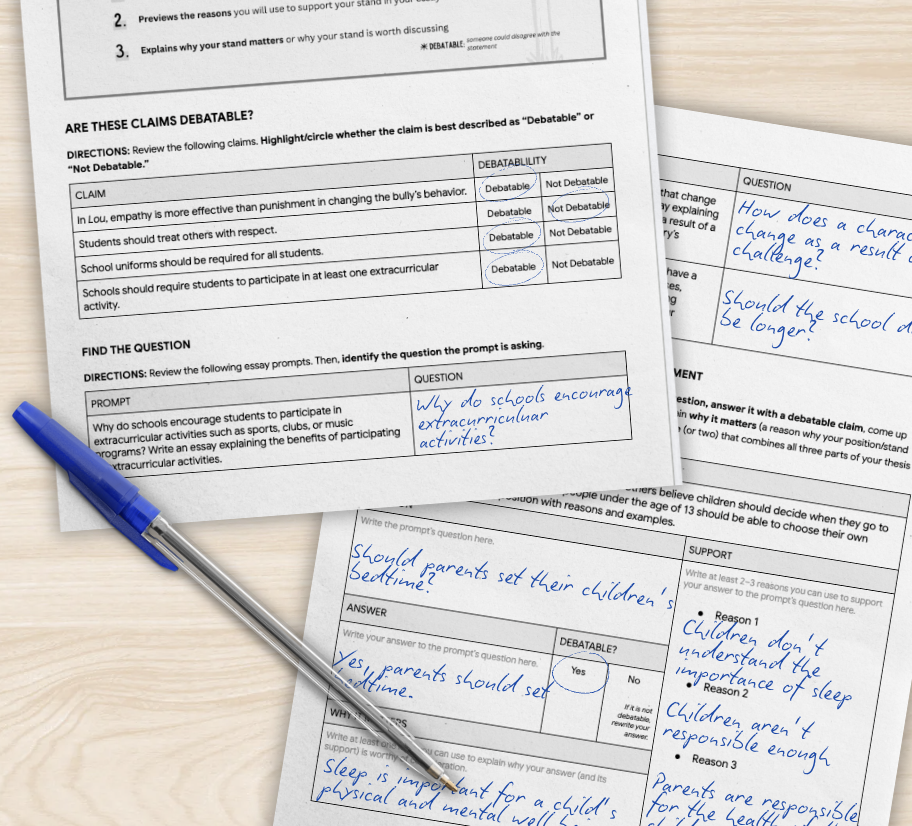
After students had a few more tools for tackling the dreaded hook, we moved to thesis statements.
Most students had at least some idea that a thesis statement should introduce their topic, so we focused on a go-to strategy for writing a strong thesis that sets up the rest of the essay. We taught them that a strong thesis statement includes the following elements:
- It answers the question in the prompt by taking a specific, debatable stand.
- It previews the reasons they will use to support that stand.
- It explains why the stand matters or is worth discussing.
We unpack each of those elements (and how we structured our lesson) here. In addition to direct instruction on the three elements above, we provided scaffolded practice activities that ended with students writing their own thesis statement for a prompt we would continue to work with in subsequent activities.
Connect the Hook and the Thesis with a Context Sentence
Once students felt comfortable with the hook and thesis statement, we turned to the introduction as a whole.
We explained that the purpose of an introduction is to, well, introduce the reader to both the topic and the writer, moving from a broad entry point to the narrower argument the writer will make in the essay.
We showed students how the hook served as that broad entry point, and the thesis statement served as the narrower statement of the writer’s argument. Then, we introduced the context sentence not as a separate element but as the bridge connecting these two sentences.
We encouraged students to look at their hook and thesis statement and ask, “What does my reader need to know before I make my claim?” The answer to that question formed the context sentence. (By the way, if you’re used to telling students to include their TAG—title, author, genre—and summary for a literary analysis essay, this is where that goes.) We then modeled two introduction paragraphs about different prompts, highlighting each sentence and showing how they all work together.
Finally, students drafted their own introduction. We had them review the hook and thesis statement they had already written and, after checking that the two sentences worked together, consider what the reader needed to know to understand the thesis statement.
Once students had answered that question, they drafted a context sentence (or two) that connected the hook and thesis. After checking that the introduction started broad and narrowed to their specific argument, they rewrote the three sentences as one cohesive paragraph.
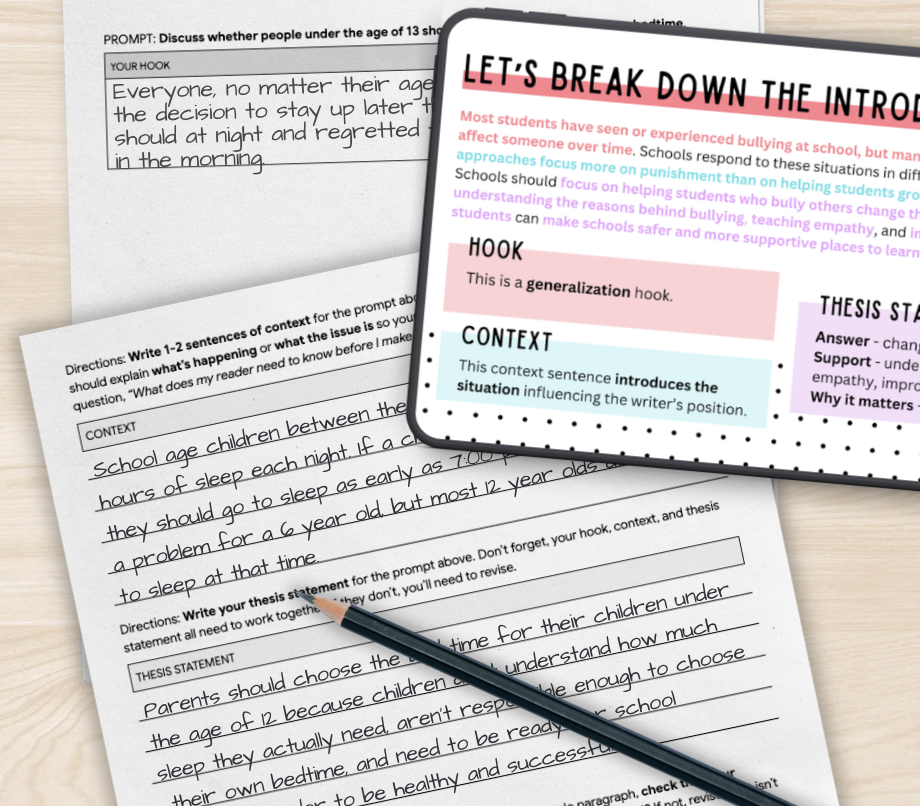
Breaking down the thought process behind writing an introduction paragraph was exactly what our students needed. Of course, they weren’t immediate experts and needed plenty more practice opportunities, but their introductions started to improve in originality and cohesiveness. Additionally, because they had a strong introduction, they also had the elements they needed to craft a strong conclusion.
If you want this whole sequence—hook, thesis, and full introduction—laid out and ready to teach, that’s exactly what our Writing an Introduction Paragraph bundle covers.
How to Teach Conclusion Paragraphs That Build on the Introduction
Teaching conclusion paragraphs effectively took us much longer to figure out, in part because there was no generally accepted list of sentences that belong in a conclusion. Like our students, we had a vague idea that they were meant to summarize what came before, but that felt incomplete (and our students’ conclusions were dull and repetitive).
Our concept of a conclusion as summary was incomplete for two reasons. A strong conclusion returns to the introduction, bringing the essay full circle. But it doesn’t do this mechanically—it adds insight to those original ideas. A strong conclusion calls back to the introduction, but it also looks forward.
It still took us time to figure out exactly how to communicate this to students, and for many years, we essentially crafted fill-in-the-blank conclusions for them. Their conclusions read better, but we weren’t really teaching them the skill.
Eventually, we decided to teach conclusions as a separate skill, scaffolded similarly to our lesson on introductions. The lesson came after students had drafted an introduction and at least one body paragraph (its own lesson) for an assigned prompt.
We started by briefly explaining the purpose of a conclusion paragraph: it’s not an arbitrary paragraph that we tack onto the end of an essay because we’re “supposed to.” Instead, it shows the reader why the ideas presented in the essay matter. It returns to (and thus is built from) the introduction, signalling to the reader that the essay is coming to a close, but instead of repeating the introduction, it shows how the writer’s thinking has grown.
A strong conclusion, then, should include three elements:
1
It returns to the hook.
2
It restates the thesis but adds a new final insight.
3
It builds on the writer’s ideas and leaves the reader thinking.
Once we introduced these elements to students, we unpacked and practiced them one at a time.
Revisit the Hook Without Simply Rewriting It
For years, we told our students to start their conclusions by revisiting their hooks, but without guidance, most students changed a couple of words in their original hook and moved on.
This time, we directed them to re-read their hook and ask what they could now say that they couldn’t say at the beginning of the essay. This prompt pushed them to build on their original idea instead of simply rephrasing it.
This, however, is still fairly abstract for most students, so we included a practice activity in which they read four pairs of hooks and restated hooks, decided whether each restated hook was effective, and explained why or why not. The ineffectively restated hooks included problems like restating the original hook without adding a new insight and revisiting the hook but shifting the focus away from the prompt.
Then, we assigned students to write their own revisited hook, either for a sample essay that we provided or for the essay we had been building throughout the writing instructional sequence.
Helping Students Explain Why Their Ideas Matter
For our students, restating hooks was all they were ready for. We provided light scaffolding to help them draft the rest of the conclusion, encouraging them to look back at their body paragraphs to find “something more” to add to their original thesis statement and consider how their ideas might apply in a larger context.
If you have more advanced students, however, they can continue to “level up” their conclusions by strengthening the insights in those final two sentences.
We created a practice activity in which students receive two sets of thesis statements followed by the three ideas presented in the body paragraphs of a hypothetical essay. After reviewing the three ideas in each set and looking for details that weren’t evident in the original thesis statement, students can consider what those details reveal about why their claim matters and draft a more effectively restated thesis.
Then, for each set, students considered why the ideas matter beyond this one essay and where else they might matter. These prompts helped them to draft a final sentence that would leave the reader thinking about the ideas in the essay.
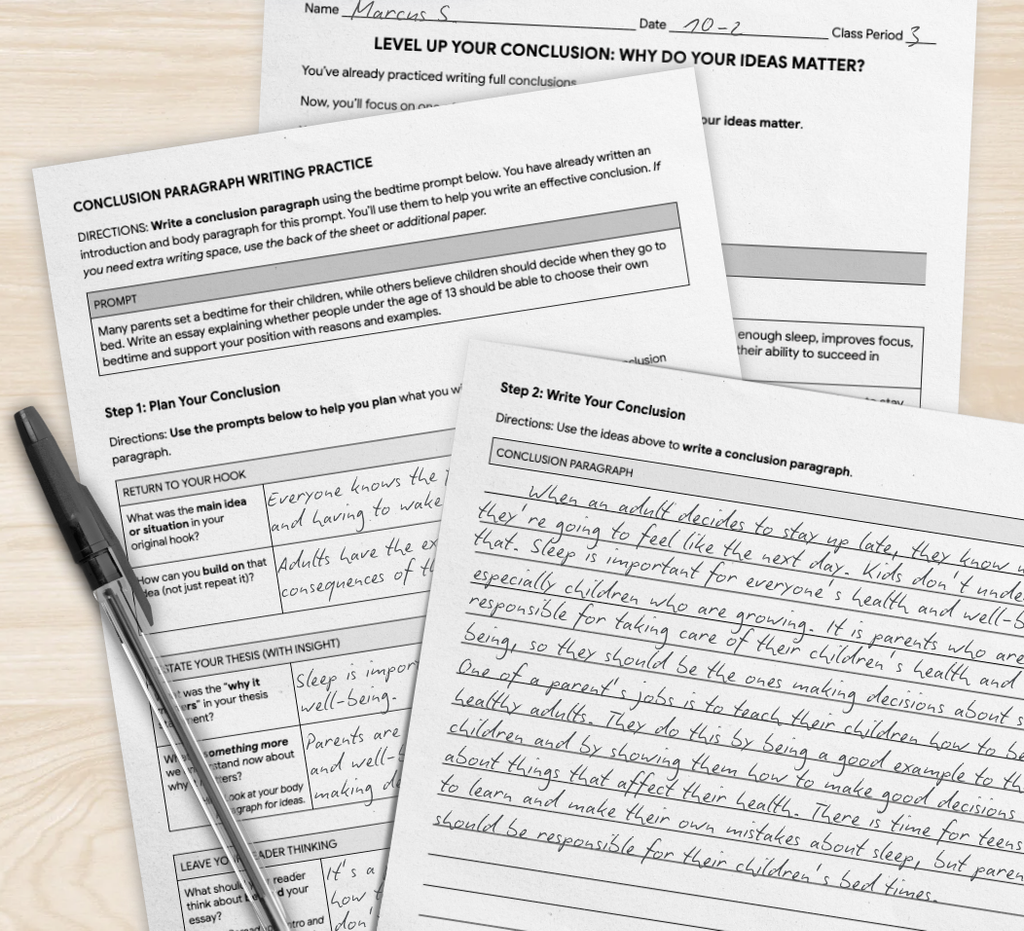
Writing insightful conclusions is a challenging skill—one students will likely master through repeated practice rather than in a single activity or school year. But providing explicit instruction, scaffolding, and practice makes the thinking process that experienced writers use more concrete and enables students to move beyond simple paraphrase and summary.
If you’d rather skip building these activities from scratch, our Writing Conclusion Paragraphs lesson includes both the hook-revisit evaluation activity and the leveled thesis-insight practice described above, plus a teacher presentation, student notes, and a scoring rubric, all ready to hand to students the next time you’re teaching conclusions.
Introductions and conclusions may not merit their own lines on most writing rubrics, but these two paragraphs help students think more deeply about their ideas and why they matter. As we considered how to teach introductions and conclusions, it became clear that students don’t just need outlines and formulas—they need us to make the thinking process clear and offer plenty of practice opportunities. Few of our students fully mastered the art of an insightful conclusion by the time they left our classrooms, but that’s okay. They made progress and gained tools they could use, no matter what classroom they ended up in next.
If you’re interested in a ready-to-use version of these lessons for yourself, we’ve created a Writing Introductions and Conclusions bundle that includes all the materials needed to implement these lessons right away in your classroom—teacher presentations, student notes, practice activities (digital and print), eye-catching classroom posters, and scoring rubrics. You can also purchase our Writing an Introduction Paragraph bundle and Writing Conclusion Paragraphs lesson separately.