
Why Literary Allusions in AP Lit Aren’t Optional (And How to Fill the Knowledge Gap)
“When Ah-HAWKS strives some rock’s vast weight to throw . . .”
We, of course, do our best to avoid laughing at students’ mistakes, but Steph was so caught off guard by the student’s loud, confident mispronunciation of “Ajax” that she got the giggles and couldn’t move on.
This small moment illustrates a problem that every AP Literature teacher faces at some point: our students are often unaware of the basic cultural references that we, as long-time readers of literature, assume they possess.
Literary allusions pose a unique challenge for AP Literature teachers. Our course lends itself to a heavy focus on British and American literature, which is full of allusions to Greek and Roman mythology, the Bible, fairy tales, Shakespeare, and historical events. When our students don’t have the background knowledge to recognize these literary allusions, they miss entire layers of meaning.
And the challenge isn’t just that students miss these references—it’s that we often don’t realize how much they’re missing until it’s too late. Unlike other literary devices that students can analyze without prior knowledge, allusions require background information that we don’t have time to teach in the moment.
This is increasingly true for our students. They might recognize Disney’s The Princess and the Frog, but have never heard the original Brothers Grimm fairy tale it’s based on. They know Poseidon as Percy’s dad, but miss the deeper mythological significance when he appears in classical literature. This knowledge gap puts them at a disadvantage when analyzing texts that assume this cultural foundation.
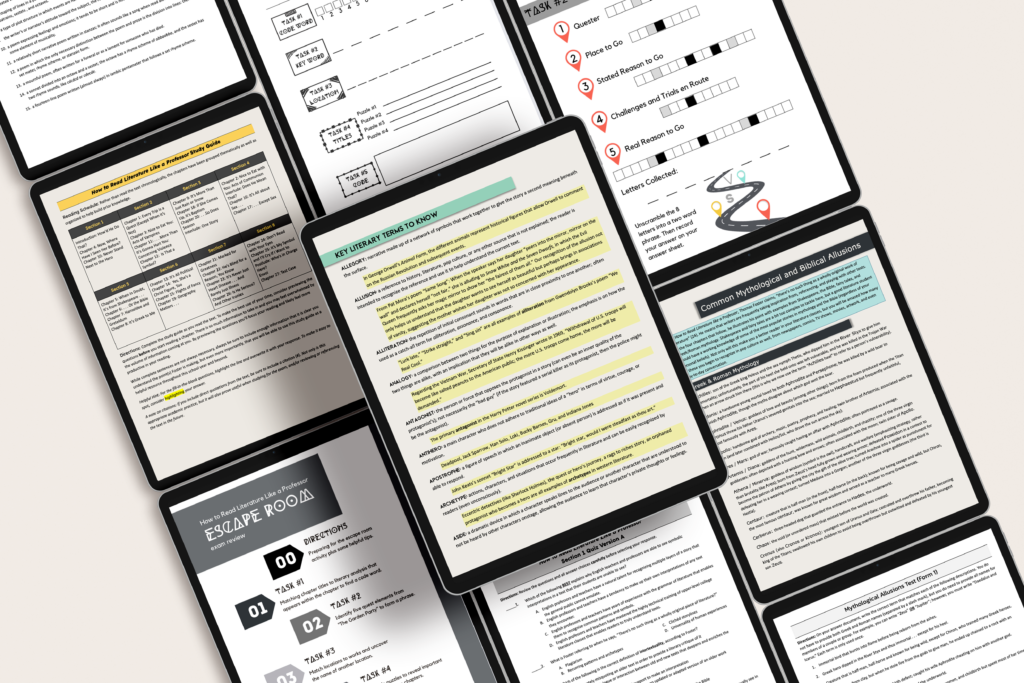
This is why, before beginning the nine units that make up the AP Literature curriculum, we made time for an “introduction to AP Literature” unit. We helped our students build what we called a “cultural toolkit” by explicitly teaching basic writing structures, common literary archetypes (using Thomas Foster’s How to Read Literature Like a Professor), and common literary allusions.
Covering these basics wasn’t about cultural elitism—we believe exposure to a wide variety of diverse voices and viewpoints is essential. However, we also wanted all of our students to enter college with the tools and foundational knowledge that their professors and peers might take for granted. The question was: how could we do this efficiently, without sacrificing time for other essential skills?
When Students Miss the Point: Real Classroom Examples
Literary allusions are both effective and challenging because they are concise. In only a word or two, authors infuse their writing with an entire outside text. When readers recognize the cultural reference, it’s a neon arrow signaling how to interpret the piece of literature. Missing that clue can leave a reader struggling to understand what a story is really about.
One of our favorite poems to teach is Kathryn Howd Machan’s “Hazel Tells LaVerne.” Hazel is working as a motel cleaning lady when a frog appears from the toilet she’s cleaning and “starts talkin / bout a golden ball / an how i can be a princess” if she kisses him, a clear allusion to “The Frog Prince” (10–12).
Most years, not one student could correctly identify the allusion. The closest they came was The Princess and the Frog, but they were stumped when we responded, “What is that based on?”
Close enough, right? No—the difference matters.
The original fairy tale assumes kissing the frog is obviously the right choice—but Hazel doesn’t even consider it. While Disney’s version features a strong, ambitious protagonist, the original fairy tale is purely about transformation through romance. Hazel’s rejection of this romantic fantasy reveals everything about her life experiences, but only if readers know what she’s rejecting.
This pattern repeats across AP Literature texts: students miss the biblical fall imagery in James Joyce’s “Araby,” the Christ figure symbolism in Cormac McCarthy’s The Road, and the mythological warnings against playing God in Mary Shelley’s Frankenstein.
The AP exam itself isn’t exempt. The poetry analysis question on the 2009 exam featured a soliloquy from Shakespeare’s Henry VIII in which Cardinal Wolsey references Lucifer in the final lines. The prompt specifically encouraged students to consider this allusion. Many students attempted to do so without knowing the story of the fallen angel, leading to misinterpretations that weakened their arguments.
The pattern was clear: when students missed these cultural references, they could still analyze other elements of the text, but they lost access to a significant layer of meaning that authors intended readers to recognize.
Implementation That Actually Works (No Extra Class Time Required)
We wanted to address this background knowledge gap, but the AP Literature curriculum doesn’t allow a lot of extra time for teaching literary allusions. We needed an efficient approach that wouldn’t require an overhaul of our overly packed calendar.

We kept it simple. In the first week of class, we distributed our curated 78-term list of common mythological and biblical allusions (join our Free Resource Library for access). At the end of the first six-week grading period, we assigned students a matching test: 78 names and 78 descriptions.
Our list started as something we found online—it may even have been Steph’s list from her own AP Lit class. We emphasized Greek and Roman mythology and the Bible because those are the most common sources of literary allusions in AP Lit texts and because they’re manageable to teach in this format. (One year, we tried to do an overview of Shakespeare’s plays, and it was a real dud for everyone but us.)
Over the years, we removed some obscure allusions and added others that we thought were obvious (really—no Hera???) or that appeared in the texts we assigned. We revised the descriptions each time we discovered an error, eventually rewriting all the descriptions in student-friendly language.
We considered just giving students the list of allusions to keep as a reference, but as we all know, students won’t read handouts unless they have a reason to, so we added a test. But we kept it simple: all we wanted to do was make sure students looked at the packet and could recognize literary allusions as something worth investigating if they encountered them. They didn’t need to be experts, and they didn’t need an in-depth understanding of the stories—just recognition.
For many years, this is all we did—students made flashcards or found flashcards on Quizlet and took the test. Our involvement was limited to reminding students to study.
But when we added bellringers to our weekly routine, we decided to create Kahoots—two for mythology and two for biblical allusions—that we would rotate through each week. The self-paced Kahoots (included in the Free Resource Library) were essentially just flashcards.
By incorporating them, however, we ensured that students were reviewing the terms throughout the year, not just studying for the allusions assessment and then forgetting everything. We also created multiple versions of the assessment—matching, multiple-choice, and separated by mythology and Bible—to give teachers flexibility.
Of course, no curated list can include every possible literary allusion. For more obscure allusions, we just provided context during discussion or added a footnote to students’ study guides. Sometimes, we ignored it altogether; when it was crucial to understanding a novel, we included it in our introductory activities.
Our students weren’t necessarily experts when they left our class, but that wasn’t the goal. In the age of Google, students don’t need to be. They just need to know when a name or phrase is worth a second look.
Free LITERARY TERMS LIST!
Sign up below to join the free resource library.

What Students Actually Need (And What They Don’t)
While teaching literary allusions has benefits for college preparation, allusions aren’t essential for AP Literature success, and it’s important to keep this balance in mind.
Keep your list manageable: 78 worked for us, but if that’s too many for your students, pare it down to the major figures and stories that appear repeatedly. Even if students only recognize a few more references, their cultural literacy is increasing.

Most importantly, students need to know that they don’t need to (and often shouldn’t) force allusion analysis into their essays unless they’re completely confident in their interpretation.
Many students learn something new and become overeager to use it in their essays. Sometimes, they’re just excited to flex their growing literary analysis skills; other times, they think they “have” to use the new, more advanced term instead of “basic” terms like imagery that they’re more familiar with.
But allusions rarely carry the meaning of a text. Literary allusions always involve risk on the writer’s part—not all readers will catch them. So it’s unlikely that literary allusions are the only clue to a text’s meaning. We teach our students that literary allusions are “icing on the cake”: they reinforce meaning and add a nice touch to an essay when students are confident they understand it.
It’s far better for students to miss an allusion than to discuss it inaccurately. Students need to know that on the AP exam, they’re far more likely to encounter the term “allusion” as an incorrect answer choice than as the crucial element for analysis in the Free Response section.
Making It Work for Your Students
Any increase in cultural literacy is worthwhile, so if you’re working with many ELL students or students with IEPs, you can differentiate your instruction by reducing the number of allusions on the list, separating mythological and biblical allusions into separate lists, or assigning a multiple-choice version of the test to make the options less overwhelming. (Our editable exams come with options for all of these modifications.)
This is also something we do for our AP Literature students, not for our standard-level students. Because literary allusions are “icing on the cake,” our time in standard-level classes is better spent practicing and reinforcing the reading and writing skills that students are likely to need wherever their future takes them.
Finally, we address any potential concerns about a Western-centric focus by including this explanation on our handout:
“In How to Read Literature like a Professor, Thomas Foster claims, “there’s no such thing as a wholly original work of literature” (24). He means that writers are frequently taking inspiration from, referencing, and playing with other texts. In the four chapters that follow, he illustrates his point with examples from Shakespeare, the Bible, fairy tales, and Greek/Roman mythology. Shakespeare and fairy tales are a bit too complex to tackle here, but a good literature student should have a working knowledge of some of the most popular stories in mythology and the Bible (regardless of your personal beliefs). Not only will this make you a better reader in your literature classes, but you will be amazed how many of these you begin to recognize in pop culture as well, from newspapers, comics, TV shows, movies, artwork, and even day-to-day conversation.”
In our experience, students are generally accepting of this approach, and grounding it in Foster’s text lends our decision pedagogical authority that’s helpful if you do face pushback from students, parents, or administrators.
Building Bridges, Not Barriers
Teaching literary allusions in AP Lit isn’t about cultural gatekeeping but about access and opportunity. It’s something that can be done with minimal time investment on your part, with a long-term payoff as your students develop a cultural toolkit that will help them succeed in AP Lit and beyond.
If you’re interested in trying this approach, our Free Resource Library includes the curated allusions list and practice Kahoots. You can also purchase our complete assessment package with multiple test variations to fit diverse classroom needs. For teachers wanting the full foundational approach, our AP Lit Jump Start Kit includes this allusions resource plus literary terms, How to Read Literature Like a Professor materials, and scaffolded writing activities.