
How to Make a Unit Plan Your Students Will Love (And You Will Too!)
One thing we’ve been asked surprisingly often since starting Three Heads is why a curriculum business that sells directly to classroom teachers is necessary. Doesn’t the school provide that?
Experienced teachers, however, know that the provided curriculum—often consisting of simply a textbook and a pacing guide—is far from engaging and rarely practical. It moves at a pace few of our students can keep up with, assumes students have a confident grasp of all content that “should” have been covered in previous years, and may not even be written by an expert in the field or a teacher with classroom experience.
Many teachers are left wondering how to make a unit plan that won’t be a slog for everyone in the room.
Of course, we learned how to make a unit plan in our teacher training courses, but that, too, is far removed from the reality of day-to-day instruction. The long, tedious process adds to an already heavy workload and focuses not on what’s best for students, but on demonstrating that teachers-in-training have met the credentialing requirements.
Even if we just consider the content standards (or, if you teach an AP course, the learning objectives described in the Course and Exam Description), we’re left wondering how to make a unit plan that covers all that content, provides sufficient practice, and holds students’ interest. It’s tough, there’s not nearly enough support or time, and while some teachers (like us) love the planning process, many teachers would rather do anything else.
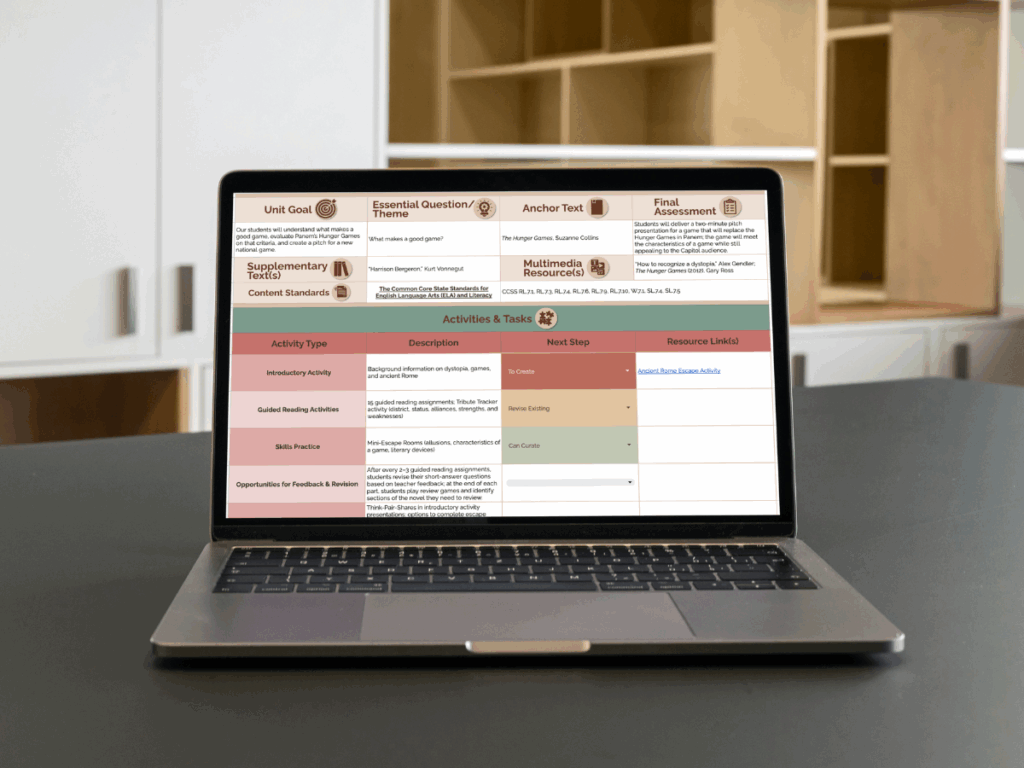
If you’ve been wondering how to make a unit plan your students will love, this post offers a step-by-step approach to creating a unit plan that blends rigor, creativity, and student interest while minimizing the time you need to spend on it.
We’ve created a free template for you to use (access it by joining our Free Resource Library), and we’ve included three example unit plans—one that’s text-based, one that’s skill-based, and one that’s essential question-based. No more wondering how to make a unit plan; instead, simply fill in the blanks, and you’ll end up with a standards-based unit plan that works in real life.
Step 1: Start with Purpose, Not Just a Text
Before you do anything else, decide on a single primary goal for the unit.
As a starting point, look at your textbook, district pacing guide, or AP Course and Exam Description. You probably have a list of texts you’re meant to cover, a “theme” you’re supposed to explore, or a list of content standards or learning objectives you need to address. You probably can’t do everything listed (and you definitely can’t do it all with the same level of detail), so make a decision: What do you want your students to feel, know, or be able to do by the end of the unit?
Once you’ve settled on your top priority, create a clear essential question or “theme”—identity, justice, truth vs. perception, coming of age—that students can relate to. Note: If you’re building a skills-based unit, you might use a goal or objective (e.g., SWBAT, or “Students will be able to . . . “) instead; we’ve never been fans of forcing an awkward question for the sake of having one.
Step 2: Pick the Right Anchor Text(s)
Once you’ve settled on your purpose, it’s time to select (or finalize) the text(s) you’ll use.
Sometimes, this is easy: your school or district has directed you to teach a specific text. Sometimes, this seems easy, but there are still choices to be made. Textbooks often provide 10–15 texts in one unit—it’s nice that you don’t have to come up with one, but that’s far too many for most teachers (and students). Other times, you’re completely on your own.
Regardless of the situation you’re in, here are a few tips to help you decide:
- Look for a high-interest text. It’s challenging enough to get students to read, so we’re almost always going to prioritize a text they—just maybe—might be interested in.
- Aim for diversity in genres and voices. Whether it’s over the full year or within the unit, try to include a variety of perspectives and genres.
- Consider the cultural toolkit. Tempting as it is to select only contemporary YA novels, sometimes we want to expose our students to texts that college professors will assume they have read.
- Ask which text will best help students reach your goal. This decision might be based on content (if you’re teaching satire, you need to select a clear example of satire) or rigor (if the skill or concept you’re focused on is complex or challenging, go easier on the text).
- Take the version into account. We often used prose versions of Shakespeare plays with our reluctant readers (graphic novels are another popular option); we selected Emily Wilson’s translation of The Odyssey because it was particularly readable.
- Don’t forget about videos and multimedia. Consider supplemental materials to introduce background information (e.g., TED-Ed videos) or comparison (e.g., a film adaptation of your text).
Step 3: Work Backward
The next thing to identify is your summative assessment: a literary analysis essay, a creative project, a podcast, a Socratic Seminar, a debate, a presentation—the options are endless. It doesn’t matter what the final assessment is, but you must identify it from the beginning.
Then, you’ll work backward, thinking through the steps and activities students need to take to succeed on that summative assessment.
Identifying that final task also gives you a filter. There are always more options for what you can do than you’ll have time for, and knowing your endpoint enables you to skip or eliminate activities that aren’t ultimately going to help students reach their final goal.
In some cases, your school, district, or textbook has already determined the summative assessment. If not, think about what you’ve done in previous units. If you’ve already written a few essays, consider a more creative option. If you’ve assigned a creative project already, it’s probably time to tackle a literary analysis essay. If you’re crunched for time or behind on grading, consider a group project or presentation.
Step 4: Mix Up Your Activities
Student engagement is highest when you combine reading, writing, speaking, and creative thinking. You and your students will enjoy the unit more when you incorporate a variety of activities and balance high-energy and reflective moments.
This is where you get to dive into your teacher toolkit. If you don’t already have ideas in mind, consider things like:
- Collaborative annotation and close reading
- Quick writes and low-stakes journals
- Project-based checkpoints like one-pagers or character maps
- Game-based review or peer teaching opportunities
Sometimes, it’s as simple as transforming a traditional worksheet into something that seems fun: instead of a graphic organizer about character traits, why not assign students to create a social media profile instead? Same skill, but it doesn’t feel quite as much like work.
Our rule of thumb is to build the skeleton of our unit with traditional guided reading assignments and then add in collaborative and creative activities at regular intervals to break up the reading.
As you select your activities, try to include these nine elements somewhere in the unit:
- Introductory Activity
- Guided Reading Activities
- Skills Practice
- Opportunities for Feedback and Revision
- Opportunities for Collaboration
- Writing
- Scaffolded Final Project
- Final Assessment
- Something “Different”
Naturally, some elements will overlap: if, for example, your summative assessment is an essay, then “writing,” “scaffolded final project,” and “final assessment” will all be the same thing. Your something “different” that makes the unit memorable could easily overlap with any other element.
The most important thing to keep in mind? Filter every idea through the lens of your overarching theme, essential question, or end goal: if the activity doesn’t help students reach that end goal, skip it.

Step 5: Curate What You Can and Create When Necessary (or Desired)
One of our biggest regrets as we’ve reflected on our experience with burnout is that we insisted on creating everything rather than curating first and creating only what we truly needed (or wanted) to.
If you’re a teacher who loves creating materials (we hear you—it’s by far our favorite part of the job), you absolutely can and should create some of your materials. But you just don’t have the time to create everything and maintain a healthy work-life balance, so learn to focus your creative energies on the elements of your plan that you can’t find elsewhere or that you genuinely want to create yourself.
Here are some of our best tips for finding the materials you need to curate the unit you want:

- Look for a unit that includes as many of the activities you’ve thought of as possible.
- Recognize that you probably won’t find exactly what you’re picturing. Be willing to make adjustments to your plan if you find a unit that’s close to what you want or consider combining a couple of units that, together, resemble the unit you have in mind.
- Prioritize those elements you’re least interested in (or able to) do yourself.
- View the preview: do the sample materials look like they will work for your students, your overall theme or goal, and your class structure? We all have different teaching styles and students, so not every lesson or unit plan will work for every teacher, and that’s okay.
- Check to see if answer keys are provided. This is an enormous time saver.
- Look for editable materials. When curating a unit, you may need to make slight modifications, so check the product description to ensure you can.
- Consider looking for general materials that you can adapt. If you have a specific idea in mind, it might be easier to find a generic one-pager, social media template, or scaffolded writing task that you can adapt. This still saves you time (and if you’re purchasing materials, individual items often save you money, too).
Step 6: Attach Content Standards
Teacher training programs everywhere are probably cringing in horror that this is Step 6 rather than Step 1. Don’t get us wrong—you should have some idea of key content standards you plan to focus on when you’re setting your overall lesson goal.
But when it comes to ELA content standards, most of what you do already fits a content standard. Our standards focus on skills such as supporting a claim with evidence, identifying themes, analyzing interactions between characters, comparing different versions of a story, and writing arguments. It’s often easiest to think through what you want to do in a unit and then go back and attach content standards to those activities—you’ll likely find that most of the standards are covered by what you’re already planning to do.
Step 7: Create a Rough Calendar
Finally, it’s time to create a rough calendar of your actual unit. We’ve shared our best calendaring and timing tips before, but it’s important to take this step for two key reasons.

First, a plan keeps you focused. Your students are more likely to reach the unit objective if you’ve taken the time to create a roadmap. It’s too easy to forget activities, present them in a confusing order, or take way too long if we haven’t taken a moment to map things out ahead of time.
Second, creating a calendar helps you identify places you need to streamline. When we’re brainstorming ideas, our unit plans can easily spiral into full-semester monstrosities that aren’t practical, either because we have other things to cover or because even the most engaging unit on the planet can be beaten to death. Map out your ideas and then check that the length of the unit is appropriate.
Keep Unit Planning Sustainable for You
Unit planning is just one of many things you have to focus on, and if your process is too involved, you’ll burn out. Here are some practical strategies to make the process sustainable:
- Reuse a flexible structure with different texts. The outline of our units always looks about the same: introductory activity, guided reading activities, scaffolded essay prompt. We’ll make slight variations and try to mix up the activities, but the core of our units is consistent, which streamlines the planning process.
- Batch prep and planning when you can. Try to plan out a full unit at once (or even a full semester at once) so you can get it done while you’re in “planning mode.” In the long run, setting aside time to develop a long-term plan will make your life easier than trying to figure it out day by day.
- Leave some room for spontaneity, student-led discussion, and struggle. If you’re too rigid with your plan, you don’t have room for those magical moments where a student asks an insightful question or the class gets worked up about a character’s decision. You’ll also find that students need longer than you anticipated to complete an assignment, or that it would be worth going back to revise and review.
- Make reflection notes. As you teach the unit, jot down observations about what to improve next time. This will allow you to refine your plan instead of starting from scratch every time (or forgetting about what went wrong and experiencing the same frustrations year after year).
Remember, a great unit doesn’t need to be new every time—it just needs to be intentional.
A unit that students love challenges them, connects to their world, and gives them room to explore. Stop wondering how to make a unit plan and feel confident that you can build meaningful units without burning out. Even better, we’re here to help you! Join our Free Resource Library to download our free unit planning template and calendar, which comes with a sample unit plan; you’ll also gain access to other resources intended to make your life easier and a weekly email newsletter full of encouragement and practical teaching tips.


